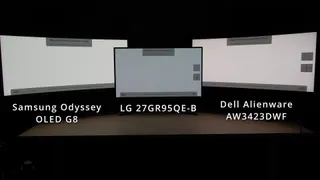
Screen burn-in and uniformity issues are a long-documented downside of OLED displays , but manufacturers have made strides in recent years (primarily in software) to combat this issue more meaningfully. The folks over at RTINGS.com, known for their high-quality display benchmarking and reviews, have decided to put manufacturer claims to the test and put over 100 TVs (alongside a few monitors) into the ultimate torture test.
The torture test involves running a 24/7 CNN news feed on each display at maximum peak brightness. Static elements (like TV channel logos, PC taskbars, static game HUDs, etc) are known to "burn" into panels, especially OLEDs, in these circumstances. This can either be temporary image retention or permanent burn-in . The two are easy to mix up, even by an expert's eye, but regular old image retention will go away after a "refresh cycle" or a move to sufficiently different content.
Besides the panels' longevity, the manufacturers' countermeasures, called " compensation cycles, " were also tested. Short or long compensation cycles are processes that attempt to reset the color uniformity of the screen after a certain amount of time has passed. Depending on the length of these compensation cycles (short or long), the TV tries to fight off either temporary image retention or mitigate the impact of permanent burn-in.

This torture test has recently reached the tenth month of its ongoing cycles for OLED TVs and LCD TVs. The same testing is also being done with three OLED Ultrawide PC monitors, though this testing is only at six months. We've also covered a prior hitch in the OLED TV testing due to inconsistent compensation cycle software handling, though this seems to have been fixed in the time since.
If you want the full picture of RTINGS' testing, we've included a link to their text write-up and the corresponding video (embedded below). But here's the most important need-to-know information from their testing.
Here are the core findings found by RTINGS' 10-month OLED and LCD TV testing, as well as their OLED monitor testing:
- After ten months of torture testing (equivalent to roughly four years and two months of real-world use), every OLED TV has started to develop some form of permanent burn-in. It's worse on some than others, though.
- While OLEDs are the primary focus of most people's burn-in concerns, testing with LCD TVs has also uncovered some serious issues with LCD longevity as well. Distracting zebra stripe-esque degradation to uniformity has developed on every LCD TV, with far more severity than what's happening with OLED TVs in the same testing.
- Five TVs and one monitor died entirely throughout the course of testing.
- The OLED monitors show very little signs of image retention, even at month 6 (simulated 2.5 years) of torture testing. This is promising but also arguably necessary, considering the nature of PC work and gaming having many static elements.
For more detailed information on the findings and per-panel results, visit RTINGS' material.
