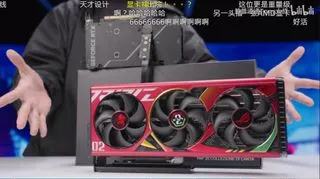
Asus took advantage of the RTX 4060 Ti's limited use of the PCIe interface and rewired the PCIe tracing internally to integrate a 2280-size PCIe 5.0 SSD slot directly onto the GPU. This slot is mounted on the top of its RTX 4060Ti's PCB through the backplate's cut-out, giving the Dual GeForce RTX 4060 Ti 8GB a leg up on competitors with a unique feature — the company even demoed the new GPU delivering over 12GB/s of throughput from the integrated SSD. The integrated PCIe port can also host other devices to create new functionalities, such as using an RTX 4090 as an eGPU.
The RTX 4060 Ti only uses eight of the available 16 PCIe lanes, leaving the rest empty, thus providing room for Asus to add the SSD slot. Despite the RTX 4060 Ti using a PCIe x16 4.0 interface, as long as the M.2 drive and the motherboard are PCIe 5.0 compatible, the M.2 slot on the GPU can run at full PCIe 5.0 speeds. The Dual GeForce RTX 4060 Ti also uses an additional six-pin PCIe power connector to power the M.2 storage. The card is also overclockable, with the OC profile giving a 30MHz boost.

In a prototype demonstration a few months ago , the PCB featured a cutout for the air to blow from the GPU fans to the fin stack and the front PCB area that packs both the controller and the NAND chips, but that's not the case with the retail version. While there is a cutout through the GPU's PCB, the M.2 SSD, which has the controller and the NAND chips, will contact part of the GPU heatsink.
Asus's backplate has a large thermal pad pre-installed for the front M.2 drive's PCB, and the GPU comes with two screws and a screwdriver.
Tony Yu's Unique Demonstration
M.2 Performance on Asus Dual GeForce 4060 Ti- 4TB Crucial MP700 5.0 NVMe SSD
Asus China's product manager, Tony Yu, demonstrated the retail version of the Asus DUAL-RTX4060TI-O8G-SSD via China's BiliBili using the Samsung 2TB 980 Pro PCIe 4.0 SSD and the Crucial MP700 PCIe 5.0 SSDs .
With the Samsung 2TB PCIe 4.0 drive, the GPU delivered 6.75 GB/s of sequential read and 4.8 GB/s of sequential write bandwidth through the RTX 4060 Ti. As thermal performance makes or breaks the real-world performance for such storage devices, Tony tested the SDS while running the Furmark stress test on the GPU to ensure the graphics cores ran at maximum temperatures. The Samsung 980 Pro 2TB ran at a reasonable 42C while the GPU's Furmark load increased the RTX 4060 Ti's temperature to 63C.
As far as PCIe 5.0 performance goes, Tony demonstrated a 4TB Crucial MP700 Gen 5.0 SSD delivering 12.4 GB/s of sequential read and 11.7 GB/s sequential write throughput, which are the same advertised speeds by Crucial . The SSD ran at 50C during the test.
He also showcased an exotic setup where he paired the system with RTX 4090 connected through the RTX 4060 Ti's M.2 slot via a Gen4x4-to-M.2 adapter. This limits both cards to PCIe 4.0 bandwidth, so the RTX 4090 could only use four PCIe 4.0 lanes via the RTX 4060 Ti's M.2 slot. However, it pulled 75W from the PCIe slot through the M.2 interface.
Who Will Use This?
One would ask about the point of providing an M.2 slot in any graphics card, even if it has enough bandwidth and power throughput to do so. All mid-to-high-end motherboards have had at least two PCIe 4.0 NVMe SSD ports for a while, with the latest chipset providing a PCIe 5.0 NVMe slot as well. This couldn't be more emphasized by the feature being limited to H770, Z690, and Z790 Intel chipsets because B-series chipsets do not support PCIe lane splitting. On the other hand, AMD's A620, B450, B650, and X670 support PCIe lane splitting.
One may speculate this could be in a scenario where the tall air coolers might block physical access to the first M.2 slot typically used as a primary drive slot. But users will ask if that's a real issue, as many wouldn't really remove M.2 cards from the slot unless it's to swap or upgrade.
The ASUS Dual RTX 4060 Ti would come at a premium. Currently, this graphics card is not listed for sale anywhere yet, but we'll follow up with pricing when it is available.