Loongson 3A6000 CPU with four cores released, ASUS announced consumer XC-LS3A6M motherboard for next-gen Chinese desktops
ASUS lends support to a Chinese CPU manufacturer with the introduction of a new motherboard. This could help Loongson CPUs become more popular.
Loongson LS3A6000 CPU, Source: Uncle Tony/Bilibili
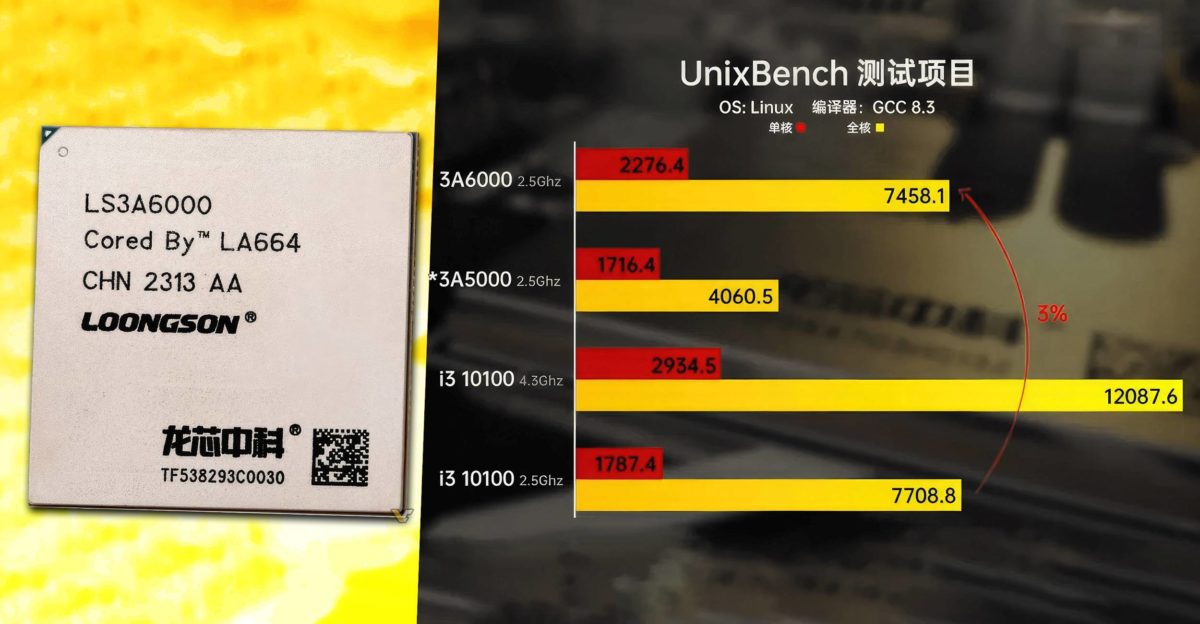
Over the weekend, Loongson announced a new desktop CPU, the 3A6000. This processor is not a high-end CPU, rather it is unable to compete with the entry-level segment from Intel based on the 10th Gen Core series. However, it has made significant progress in terms of speed compared to its predecessor.
The 3A6000 processor is a newer version of the 3A5000 processor. The 3A5000 has four cores and four threads and runs at 2.5 GHz. It uses 14/12nm nodes. This CPU is designed for 35W TDP and supports DDR5-3200 memory. On paper, the 3A3600 is not a major upgrade, as it still relies on the same node, offers the same clock and has TDP increased to 50W. However, it introduced hyper threading.

Loongson LS3A6000 CPU, Source: Uncle Tony/Bilibili
ASUS Product Manager for China, Tony Yu, conducted tests on the CPU and also unveiled the first ASUS motherboard designed for this Chinese platform. The results of the tests indicate a 32% improvement in single-core performance and an 84% increase in multicore performance compared to its predecessor, the 3A6000. At the current standard clock speed of 2.5 GHz, this CPU can rival Intel’s older Core i3-10100 clocked at the same 2.5 GHz frequency; otherwise, Intel maintains a significant speed advantage.
There is a belief that Loongson and ASUS will collaborate to enable higher clock speeds, with the possibility of surpassing 3.0 GHz not being ruled out for this CPU. Presently, the ASUS motherboard unveiled alongside the new CPU imposes a limit of 3.0 GHz.

ASUS XC-LS3A6M motherboard, Source: Loongson
It seems like Loongson has a lot to do to reach the level of AMD/Intel offerings from 3-4 years ago, let alone contemporary options. The current architectural limitations stem from the utilization of 14/12nm nodes. However, that’s hardily an excuse because Intel’s i3-10100 also employs a 14nm process.
Source: Tom’s Hardware