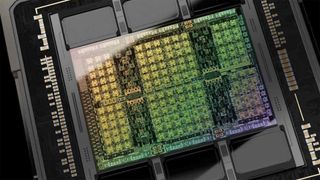
The codename of Nvidia's post-Blackwell GPU architecture could be Vera Rubin , if a new statement by hardware leaker @kopite7kimi is correct. Given Nvidia's new and more aggressive introduction cadence, Nvidia's Rubin GPUs for artificial intelligence (AI) and high-performance computing (HPC) are expected to be released in 2025. However, it is unclear whether Nvidia's client GPUs are set to adopt the same architecture.
@kopite7kimi says two GPUs belong to the Rubin family, the R100 and the GR200. The R100 is likely the first product based on the 'big' Rubin GPU for AI and HPC workloads, whereas the GR200 is likely a refined Rubin GPU akin to the GH200 GPU launched earlier this month. It is close to impossible to guess the characteristics of these GPUs, given that they are two years away and their target specifications are only being finalized now.
In fact, we would not even try to guess whether Nvidia plans to make Rubin GPUs at its traditional foundry partner TSMC (using its N3P or N3X fabrication process), Intel (using its 18A manufacturing technology), or Samsung (using its SF3 or SF3P production node).
Nvidia's newly unveiled roadmap indicates that from now on, the company will update its data center-grade GPUs aimed at AI and HPC workloads once a year, not once in two years as previously. As a result, the company aims to release codenamed Blackwell products in 2024, and codenamed Rubin products in 2025. It is unclear whether the company also plans to update its client GPUs once a year, like in the good old days of the 2000s and 2010s. To that end, while we expect Blackwell to power some of the best graphics cards in 2024 and 2025, we suspect the Vera Rubin architecture may not make it to the consumer market — it would be more like the Volta architecture.
It is noteworthy that Vera Rubin will be the first of Nvidia's architectures named after an astronomer. Through her observations of the rotation rates of galaxies in the 1960s and 1970s, Rubin provided strong evidence for the existence of dark matter, which was a major contribution to the field of physics. Previously Nvidia named its GPU architectures only after physicists, including Fahrenheit, Celsius, Kelvin, Rankine, Curie, Tesla, Fermi, Kepler, Maxwell, Pascal, Volta, Turing, Ampere, Ada Lovelace, Hopper, and Blackwell.

Anton Shilov is a Freelance News Writer at Tom’s Hardware US. Over the past couple of decades, he has covered everything from CPUs and GPUs to supercomputers and from modern process technologies and latest fab tools to high-tech industry trends.
