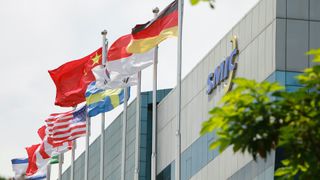
TrendForce , a market intelligence firm, reports that Huawei is prepping a successor that will be made using SMIC's N+2 fabrication technology. Huawei's HiSilicon's post-Ascend 910B AI chip is expected to offer higher performance, partially due to its new process node — HiSilicon's next-generation AI processor purportedly uses SMIC's N+2 process technology (which some believe is a 5nm-class node). This marks the second such Huawei effort that's thought to employ the sanctions-defying SMIC 5nm node — the company recently listed a laptop with an advanced chip with 5nm manufacturing tech, a feat previously thought impossible due to U.S sanctions.
Moving forward to a new node makes a lot of sense for the next-gen accelerators, but there are two big snags. First, Huawei's push into smartphones means most of SMIC's capacity goes to that consumer market, including the Kirin 9000S, which might leave less room for making AI chips. Second, SMIC is blacklisted by the U.S., making it hard to get the advanced chipmaking tools and the spare parts it needs. As such, the company may not have the production volume to build enough processors for Huawei's needs.
Huawei has been using its Ascend 910B chip for artificial intelligence (AI) workload acceleration for some time now, and it is believed that its performance is comparable to Nvidia's A800/A100 processor. When it comes to performance, the Ascend 910B looks rather competitive. However, its software differs from Nvidia's CUDA, which will slow its adoption as many workloads are optimized for Nvidia's platform. But even facing these issues, the tightening U.S. restrictions might push Chinese companies to rely more on homegrown chips like the Ascend 910B.
Huawei's existing Ascend 910B is currently used to run the company's cloud services and is also sold to other Chinese companies, like Baidu, which bought over a thousand of these processors to build 200 AI servers. Another customer is iFlytek, who teamed up with Huawei for enterprise large language models (LLMs) that use the Ascend 910B as part of the 'Gemini Star Program' that kicked off in August.

Reacting to the tightening of U.S. sanctions against China's supercomputer and AI sectors, Chinese cloud service providers like Baidu and Alibaba are doubling down on developing their own AI chips. Baidu made its own AI processor, the Kunlunxin , yet it also plans to use the Ascend 910B along with expanding Kunlunxin's use in its AI infrastructure. After buying CPU IP supplier Zhongtian Micro Systems and starting T-Head Semiconductor, Alibaba also designed its own AI accelerators, including the Hanguang 800, mainly for Alibaba Cloud.
The path to making top-tier AI chips in China is rough, largely due to sanctions against China's semiconductor and supercomputer sectors as well as an inability to procure electronic design automation (EDA) tools for leading-edge nodes, such as TSMC's N2 and Samsung's SF3. These restrictions are a big hurdle for designing chips on advanced process technologies and pose long-term challenges for Chinese chip designers in general. Despite these roadblocks, China is determined to keep pushing forward in the global tech race.