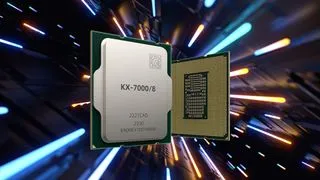
It's been a long journey for Zhaoxin and its KX-7000 series consumer CPUs, which were first anticipated to launch in 2019 . They have arrived at last, with Zhaoxin claiming that the KX-7000 is twice as fast as the previous generation KX-6000 processors we tested. The KX-7000 represents an important step forward for China's fledgling semiconductor industry as it looks to gain independence from Western technology and sanctions, and it comes from the sole Chinese company with an x86 manufacturing license. Speaking of which, the US has restricted China's access to leading process node technologies, making it hard for the country to create chips. Zhoaxin isn't divulging the process node used in its new processor, and sources close to the matter tell Tom's Hardware that the company won't reveal its fab partner or process node due to an NDA.
In either case, the Zhoaxin KX-7000 chips are sure to be one of the fastest CPUs natively made in China, and they come with a much more robust array of platform features that provide modern amenities — a rarity with China's self-designed chips. These new features include PCIe 4.0 interfaces and DDR5 memory support.
The new "Century Avenue" architecture inside KX-7000 has an improved front-end, out-of-order execution, and optimizations to the cache and memory system, so it's plausible that Zhaoxin might have pulled off a Zen moment . Fellow Chinese CPU maker Loongson achieved Zen 3-like IPC with its 3A6000 , so there's no reason Zhaoxin couldn't do the same.
Chinese CPU designer Zhaoxin was founded in 2013 when VIA Technologies joined forces with the Shangai Municipal Government. Although VIA hadn't been particularly relevant in the CPU space for several years, it crucially is one of the three companies with a license to the x86 architecture, alongside Intel and AMD. This gives its CPUs a big leg up since they can natively access the massive library of PC-related software made for x86 processors.
| Row 0 - Cell 0 | KX-7000* | KX-U6880A | Ryzen 7 7700X | Core i5-14600K |
| Cores | 8 | 8 | 8 | 14 (6P+8E) |
| Threads | 8 | 8 | 16 | 20 |
| Base Frequency | 3.2GHz | 3GHz | 4.5GHz | 3.5GHz |
| Boost Frequency | 3.7GHz | N/A | 5.4GHz | 5.3GHz |
| Cache | 4MB L2 + 32MB | 8MB L2 | 8MB L2 + 32MB L3 | 20MB L2 + 24MB L3 |
| Memory Support | DDR5-4800/DDR4-3200 | DDR4-2666 | DDR5-5200 | DDR5-5600/DDR4-3200 |
| Maximum Memory | 128GB | 64GB | 128GB | 192GB |
| PCIe Support | 4.0 | 3.0 | 5.0 | 5.0/4.0 |
| PCIe Lanes | 24 | 16 | 24 | 20 |
| Process | TSMC 7nm** | TSMC 16nm | TSMC 5nm | Intel 7 |
*Specific model name not yet known
**Unconfirmed
Zhaoxin hasn't named any specific members of the KX-7000 series, but the spec sheet indicates there will be at least two models differentiated by clock speed. We've put the model with the higher clock speed in the table. The top-end KX-7000 chip, compared to the last generation KXU-6880A, has a 23% higher frequency and over four times the cache, which would partly explain why KX-7000 CPUs are expected to be twice as fast as KX-6000 models.
Zhaoxin hasn't increased core or thread counts with KX-7000, and the highest configuration remains an eight-core and eight-thread CPU. Assuming Zhaoxin is accurate with its performance claims, the rest of the increased performance presumably stems from architectural improvements, implying a monstrous boost in IPC (instructions per clock).
KX-7000 is more than just a performance boost, though, as it also comes with several platform improvements. Compared to the KX-6000, the KX-7000 has double the supported memory capacity, DDR5 RAM, PCIe 4.0 compatibility, eight more PCIe lanes, and support for USB4.
Of course, KX-7000 will naturally be compared against its x86 rivals, and the comparison isn't super favorable. The midrange Ryzen 7 7700X and Core i5-13600K both have massively higher clock speeds than the top-end KX-7000 model, plus more threads — and cores in the case of the 13600K, though most are smaller E-cores. They also support faster RAM speeds, which can factor into a variety of workloads.
On the other hand, the KX-7000 is remarkably equal when it comes to platform features. KX-7000 CPUs and motherboards support as much RAM as AMD's Ryzen 7000-series, and even as many PCIe lanes. Intel has Zhaoxin beat on memory capacity, but KX-7000 actually bests Intel's Raptor Lake architecture in PCIe lane count. Indeed, KX-7000 doesn't have PCIe 5.0 support, but that's not a massive problem for consumer PCs given that the technology is only used for top-end SSDs at the moment, which aren't likely to appeal to the kind of consumer interested in the KX-7000.
Whether KX-7000 beats or even levels the playing field isn't the whole point for China. The ultimate goal is achieving technological autonomy, even if using Chinese CPUs means losing out on raw performance and features. The chip's support for SM encryption instructions, made in China to avoid prying Western eyes, is emblematic of the country's efforts to attain autonomy.