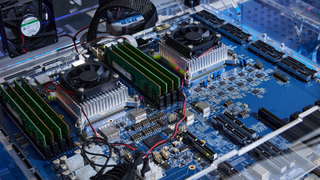
For over five years, Tachyum has been working on its universal Prodigy processor, which it claims is equally good for artificial intelligence, high-performance computing, and other data center workloads. The processor was originally meant to tape out in 2019 and hit the market in 2020. However, it has slipped to 2021, then 2022, then 2023, all while the company has made increasingly wild and unrealistic performance claims even though it has never demoed working silicon. Perhaps unsurprisingly, the company's most recent roadmap now earmarks the Prodigy launch for the second half of 2024. Tachyum will supposedly follow up with the Prodigy 2 processor with more cores and a higher-performance memory subsystem in the first half of 2026.
The company made its mark by suing Cadence when its original design didn't meet performance targets, all the while making unrealistic claims that its 'Universal Processor' " does everything ' and will power a 20 ExaFlops supercomputer .
The latest roadmap published by Tachyum says that its first Prodigy processor, made using a 5nm-class process technology, is set to sample in Q2 2024 and then ship in the second half of next year, which probably means very late in 2024, which is about a year later than the company said just a few months ago and four years later than its original launch date. In addition, the company now says it will follow up with a Prodigy 2 processor that will feature PCIe 6.0 connectivity with the CXL protocol on top, which will significantly enhance the platform's capabilities when it comes to market — if it ever does.

Tachym describes its first-gen Prodigy as a universal monolithic processor integrating up to 192 proprietary 64-bit VLIW-style cores that feature two 1024-bit vector units per core and two 1024-bit matrix units per core, all of which run at a massive 5.70 GHz peak frequency. The CPU features 96 PCIe 5.0 lanes and sixteen DDR5-7200 memory channels that are said to support massive memory capacities for large language models.
Interestingly, the company seems to have further altered the architecture of its Prodigy processor since 2022. Instead of one 4096-bit matrix unit per core, Prodigy now has two 1024-bit matrix units per core. An architectural change like this requires a compiler change and recompilation of software meant to run on Prodigy natively. However, it is hard to say how many programs are actually ready to do that as of now.
However, there is yet another new significant inconsistency in the latest whitepaper published by Tachyum: Although the original Prodigy now supposedly features up to 192 cores , the company's roadmap slide points to 128 cores in 2H 2024.