Intel’s SSD 665p hits the market infused with the company's latest 96-Layer QLC flash to give it a performance and endurance edge. Intel focused on pushing the performance of its QLC flash this time around, so the 665p addresses the typical shortcomings of the cheaper flash and hits peaks of 2 GBps. It also comes with much higher endurance than before. However, the 665p isn’t quite the same value as its predecessor, the 660p, is today.
Intel's 665p serves as a refresh for the SSD 6 series with the company’s third-generation 96-Layer 3D QLC NAND, which enables a few improvements. Performance and endurance are the two most apparent, but Intel also tweaked the write cache to make it even faster than before.

Intel refined its Intelligent dynamic write cache, so the dynamic cache will still remain at the maximum available capacity (varies based on the size of the drive) even when the drive is up to 50% full. As you fill the drive beyond halfway, the cache capacity scales downward to a static capacity of 12GB for the 1TB model, and 24GB for the 2TB model. Generally, the more space you leave free, the better the drives' write performance over sustained periods, and vice versa.
Specifications
| Product | SSD 665p 1TB | SSD 665p 2TB |
|---|---|---|
| Pricing | $124.99 | N/A |
| Capacity (User / Raw) | 1024GB / 1024GB | 2048GB / 2048GB |
| Form Factor | M.2 2280 | M.2 2280 |
| Interface / Protocol | PCIe 3.0 x4 / NVMe 1.3 | PCIe 3.0 x4 / NVMe 1.3 |
| Controller | Silicon Motion SM2263EN | Silicon Motion SM2263EN |
| DRAM | DDR3L | DDR3L |
| Memory | Intel 96L QLC | Intel 96L QLC |
| Sequential Read | 2,000 MBps | 2,000 MBps |
| Sequential Write | 1,925 MBps | 2,000 MBps |
| Random Read | 160,000 IOPS | 250,000 IOPS |
| Random Write | 250,000 IOPS | 250,000 IOPS |
| Security | AES-256 / Pyrite 2.0 | AES-256 / Pyrite 2.0 |
| Endurance (TBW) | 300 TB | 600 TB |
| Part Number | SSDPEKNW010T9X1 | SSDPEKNW020T9X1 |
| Warranty | 5-Years | 5-Years |
Intel also added support for AES 256-bit hardware encryption and Pyrite 2.0. Additionally, you can secure erase the drive easily with various tools, including Intel’s SSD Toolbox.
Intel’s SSD 665p is a PCIe 3.0 x4 NVMe 1.3 SSD that comes in two capacities of 1TB and 2TB. The company dropped the 500GB capacity point it had with the previous-gen 660p. The 1TB model currently sells for $124.99, a premium over the 660p this holiday season. The 2TB model’s pricing has yet to be disclosed and will be available in Q1 2020.
The 2TB SSD 665p offers sequential read/write throughput up to 2GBps, while the 1TB model has a slightly lower write speed of 1,925 MBps. Random performance is rated for up to 250,000 read/write IOPS, but the smaller 1TB model is a bit slower in random read workloads with a peak of 160,000 IOPS.
Intel's new 96-Layer QLC flash allows the company to double the endurance rating. which is covered by a five-year warranty. Intel specs the 1TB model for up to 300TB of writes, while the 2TB model can absorb up to 600TB of data. That brings the drives up to half the endurance rating of most mainstream NVMe SSDs, though it is notable that most of the competing models use more-endurant TLC flash.
Software and Accessories
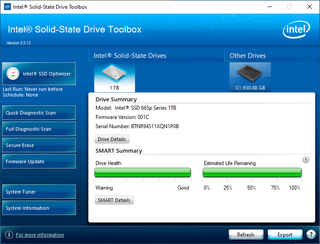
Intel also provides its Data Migration Software for download. This software is Intel’s licensed version of Acronis True Image, so some of the advanced functionalities are locked. With it, you can clone your existing data to your new Intel SSD. You can also download Intel’s NVMe driver to use with your Intel SSD, too.
The drive management software provides various monitoring information, like S.M.A.R.T. data, and diagnostic tests that you can run if needed. The Intel SSD Toolbox can manually Trim the drive to restore performance, and even clear the write cache when you need full performance back after intense use.
A Closer Look
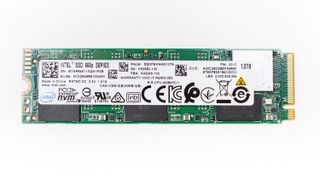
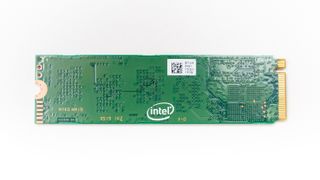


The 665p comes in an M.2 2280 single-sided form factor in both capacities, making it a good fit for thin and light designs. But if you're building a new gaming PC and your motherboard doesn’t have a heatsink to cover it, the green PCB and white sticker are a nightmare for those chasing the best aesthetics.
The hardware layout is essentially the same as before. Intel’s SSD 665p uses a Silicon Motion SM2263EN controller, which is a fairly competitive and cost-effective four-channel NVMe controller. Intel uses its own in-house firmware. The controller takes advantage of a DDR3L DRAM cache for LBA map caching and interfaces with two NAND packages on our 1TB sample.
MORE: Best SSDs
MORE: How We Test HDDs And SSDs
MORE: All SSD Content
Also, in your review of the 660p here, the sustained write speed of the 660p seems to be 175 MB/s (not 125 MB/s mentioned in this review). Just some points of clarification please. Thanks.
A direct-to-QLC speed of 185 MBps is perfectly acceptable to me, once the price drops a bit to 660p levels. The improvements in cache recovery and power efficiency are welcome too. Thanks for the very good review.