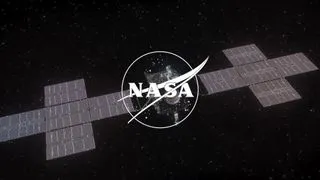
NASA Deep Space Optical Communications successfully conducted an experiment involving streaming an ultra HD video clip 19 million miles (equivalent to 80 times the distance between the Earth and the moon) from deep space to Earth. The 15-second test video took 101 seconds to reach Earth at a speed of 267 Mb/s.
The communications technology and the video are a part of NASA's Psyche mission, launched on October 13. The psyche spacecraft is currently en route to an asteroid belt 2.2 billion miles from Earth between Mars and Jupiter, where it will send another high data rate signal.
The Tech Behind the (Almost) Live Video Stream
The deep space laser transmission technology is designed to work over distances between ten to a hundred times greater than the current radio frequency used by many of NASA's deep space missions. The new laser-based technology is embedded in a flight laser transceiver. The success of this experiment enables NASA to have almost live ultra HD video and audio communication with any future deep space missions.
The system uses an encoded laser stream from the Psyche spacecraft to the Hale Telescope at Caltech's Palomar Observatory in San Diego County, California. This was then streamed to NASA's Jet Propulsion Laboratory in South California. To blend with the theme of establishing a video link via lasers, the team used a video of a JPL employee's cat chasing lasers over the couch.
The video also included overlayed graphics containing different color spectrums, graphics, Psyche's flight trajectory, random data, and other details in different sizes to ensure no video quality degradation. Video clarity with minimal to no loss is important as the stream would include mission-critical information from onboard computers. The next transmission may also include a video-on-video overlay for further analysis.
Since the next experiment will involve a distance of 2.2 billion miles from the mineral-rich asteroid belt, it will be interesting to see the impact on the latency and quality of the video. Regardless, a 101-second delay over 19 million miles is nothing but extraordinarily groundbreaking because it establishes that the technology can work flawlessly, allowing further development and even integrating a telescope similar to or better than the Hale telescope for future deep space missions.
