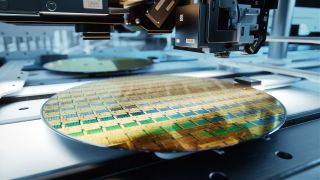
Increasingly sophisticated wafer fab tools are needed to produce chips on leading-edge process technologies, thus intensifying costs with each new node. Analysts from International Business Strategies believe that the situation will worsen at 2nm, with chip costs growing by around 50% compared to 3nm processors, reports Nikkei , ultimately resulting in a $30,000 price tag for each wafer of 2nm chips.
IBS estimates that a 2nm-capable fab with a capacity of roughly 50,000 wafer starts per month (WSPM) costs around $28 billion, up from around $20 billion for a 3nm fab with a similar production capacity. The cost increase will be driven by the increased number of EUV litho tools required to maintain a 50,000 WSPM capacity for a 2nm-class technology. This will significantly increase production costs per wafer and per chip, which will inevitably affect companies that use leading-edge fabrication technologies, such as Apple, which is currently the only company that mass produces processors for smartphones and PCs using TSMC's latest N3B (3nm-class fabrication process).

IBS further estimates that it will cost Apple around $30,000 to process a single 300mm wafer using TSMC's N2 fabrication process when it is introduced in the 2025 – 2026 timeframe, which is up from around $20,000 for an N3-based wafer , as estimated by IBS and some other analysts. Such a tangible cost-per-wafer increase will inevitably increase the per-chip cost by a similar margin.
However, IBS seems to be a little dramatic with its per-chip cost estimate. The company believes that Apple's current 3nm per-chip cost is around $50, but it does not define the chip's die size. Arete Research estimates that Apple's latest A17 Pro system-on-chip for smartphones has a die size between 100mm^2 and 110mm^2, which is in line with die sizes of the company's previous-generation A15 ( 107.7mm^2 ) and A16 (around 5% larger than A15, so, approximately 113mm^2 ) SoCs. If Apple's A17 Pro has a die size of 105mm^2, then one 300-mm wafer can fit 586 of these, which brings their cost to approximately $34 at an unrealistic 100% yield and $40 at a more realistic 85% yield.
International Business Strategies further estimates that a 2nm 'Apple chip' will cost around $85, up from $50, which implies rather low yields. At $30,000 per wafer and 85% yield, a single 105mm^2 chip would cost $60, but this is a very rough estimate.
In contrast, a projection from earlier this year indicated a cost of $25,000 per 2nm wafer at TSMC's fabs , reminding us that estimates can vary significantly.
Even with very rough estimates about 2nm fab costs and wafer costs, it is clear that chips made using a 2nm node will be more expensive than processors produced on a 3nm-class process technology. That said, expect companies like AMD and Intel to accelerate the adoption of multi-chipset designs comprised of chiplets made on different nodes in the coming years, thus defraying the costs associated with leading-edge nodes. Meanwhile, it is likely that smartphone processors will retain monolithic designs for a while as advanced packaging costs are still quite high.