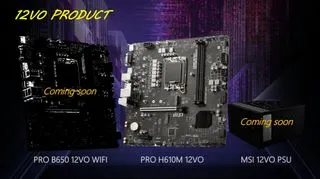
MSI is gearing up with two 12VO-compliant motherboards, covering both Intel and AMD platforms, and a 12VO Power Supply that it's releasing simultaneously: The Pro B650 12VO WiFi, Pro H610M 12VO , and MSI 12VO PSU power supply are all 'coming soon,' which presumably means they'll officially launch at CES 2024. HardwareLuxgot et a pretty good look at MSI's offerings during its EHA (European Hardware Awards) tech tour, including the ' Project Zero ' we covered earlier.

One of the noticeable changes is the absence of a 24-pin ATX connector, as the ATX12VO connectors use only ten-pins. The publications also saw a 12VO-compliant FSP power supply in a compact system with a thick graphics card. A couple of years ago, we reported on FSP 650-watt and 750-watt SFX 12VO power supply . Apart from that, there is a 1x 6-pin ATX12VO termed 'extra board connector' according to its manual and a 1x 8-pin 12V power connector for the CPU. There are two smaller 4-pin connectors that will provide the 5V power needed for SATA drives. It is likely each of these connectors provides power to two SATA-based drives.
Benefits of a 12V-Only PSU for the Desktop PC Market
Intel proposed the ATX12VO standard several years ago, but nothing has come out of it until now. This standard is designed to provide 12v exclusively, completely removing a direct 3.3v and 5v supply. The success of the new standard will depend on the wide availability of the motherboard and power supplies, though SSF builders would be very interested.
Components like RAMs, USB, and M.2 SSDs don't use 12v rails or draw from the power supply directly — M.2 SSDs and RAMs use 3.3V, while USB and SATA-based drives use 5V. The motherboard will be responsible for managing voltages for these components. While this makes sense for M.2 SSDs, RAMs, and USB as they do not take power from a power supply directly and now would need a step-down converter on the motherboard, the 4-pin SATA power outputs will have a 12v-to-5v step-down converter powering through a cable (provided by the motherboard manufacturer as MSI includes one cable with its motherboard) for the SATA-based drives, each output possibly powering two devices.
Hence,12VO should be easier to implement now as the dependency on SATA-based drives has been significantly reduced in the enthusiast space by M.2 SSDs. Having a single voltage rail handled by the power supply should help with better AC-DC power efficiency, and fewer cables due to the absence of 5.5 and 3v rails would lead to better cable management.
Potential Early Users- System Integrators
According to Hardware Luxx, it seems that the initial ATX12VO components are aimed at system integrators like Dell / Alienware, HP / Omen, Lenovo, and several others. It makes sense as these companies are likely to jump on the bandwagon immediately, as the removal of 3.3v and 5v would help reduce manufacturing costs. There will also be retail components like motherboards and power supplies for this standard, starting with companies like MSI and PSU manufacturers like FSP.
