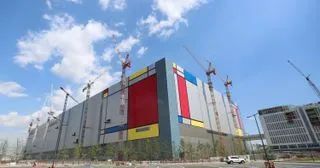
Samsung is delaying the start of mass production at its Texas foundry to 2025, according to a report published by Business Korea . The new fabbing plant, which was originally set to begin mass production in the second half of 2024, is now only expected to have limited production by that time. The apparent reason for Samsung scaling back its Texas operation is due to uncertain financial factors, like CHIPS Act subsidies and the global economy.
The Korean conglomerate is set to invest $200 billion in Texas alone with 11 total foundries, with the first one being built at Taylor, Texas to produce 4nm chips. The Taylor fab has been delayed, much like TSMC's Fab 21 in Arizona. However, while TSMC's Arizona foundry was mired in conflicts with local workers and unions , the delay at Samsung's first Texas fab is apparently more intentional, with the corporation deciding to postpone mass production in favor of a smaller level of production until 2025.
For comparison, Samsung's brand-new 4nm foundry at Pyeongtaek in South Korea is capable of producing 28,000 wafers a month. The lower level of production at the Taylor, Texas fab is said to be 5,000 wafers per month, about a sixth of what the Pyeongtaek facility is capable of.
Business Korea claims that finances are a key concern of Samsung, especially when considering CHIPS Act subsidies and the state of the global economy. The CHIPS Act is supposed to grant subsidies to semiconductor companies like Samsung to encourage the construction of foundries in the U.S. However, these subsidies are still largely in the pipeline, with just $35 million of the total $52 billion granted so far.
Samsung is also concerned that even when subsidies are finally released, Intel could receive the lion's share, with a report from last month alleging Intel was set to receive up to $4 billion early . The U.S. arm of Samsung is apparently lobbying politicians to distribute the funds more equally and not favor Intel, arguing that Samsung has only invested so much in Texas because it trusted that the CHIPS Act would go into effect.
The health of the global economy is also on Samsung's mind. Although the U.S. has seemingly achieved a so-called soft landing and has avoided a true recession, other parts of the world aren't so lucky. Samsung is still reeling from low SSD and RAM prices, even though revenue is finally on the rise . The PC market is forecasted to finally recover to 2020 levels in 2025, but the high peaks of 2021 are apparently well in the past. All of this just makes Samsung tepid about its $200 billion investment in the U.S., which could spell success or disaster for the company.