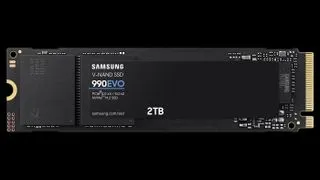
Samsung has accidentally published the product page for its upcoming 990 Evo NVMe SSD, complete with marketing and hardware specifications (via WinFuture ). Although Samsung is mostly known for making top-end SSDs like its 990 Pro , the 990 Evo is a firmly midrange drive thanks to its reads and writes of just 5,000MB/s and 4,200MB/s respectively. However, the 990 Evo is unique in its four PCIe 4.0 lanes / two PCIe 5.0 lanes configuration.
Samsung hasn't revisited its more midrange and affordable Evo lineup since the 970 Evo Plus in 2019, which only came with support for PCIe 3.0. Back then, the 970 Evo Plus was pretty high-end even though 2019 was also the year the first PCIe 4.0 SSDs were introduced. Ever since however, Samsung has continued to make more 970 Evo Plus drives, and they've largely become the company's low-end SSD.

| Row 0 - Cell 0 | 990 Evo 1TB | 990 Pro 1TB | 970 Evo Plus 1TB |
| Form Factor | M.2 2280 | M.2 2280 | M.2 2280 |
| Interface | PCIe 4.0 x4/PCIe 5.0 x2 | PCIe 4.0 x4 | PCIe 4.0 x4 |
| Sequential Read | 5,000MB/s | 7,450MB/s | 3,400MB/s |
| Sequential Write | 4,200MB/s | 6,900MB/s | 2,500MB/s |
| Random Read | 680K IOPS | 1,200K IOPS | 500K IOPS |
| Random Write | 800K IOPS | 1,550K IOPS | 450K IOPS |
| Security | TCG/Opal 2.0 | TCG/Opal 2.0 | TCG/Opal 2.0 |
| Part Number | MZ-V9E1T0BW | MZ-V9P1T0BW | MZ-V75S1T0B |
Although you'd expect some pretty impressive gains after five years, the 990 Evo offers only a fairly modest uplift compared to its predecessor. Part of this is probably down to the fact that the 970 Evo Plus was already a pretty fast SSD for its time, and brushed up against the limit of the PCIe 3.0 interface. By contrast, the 990 Evo gets nowhere near the ~8,000MB/s limit of PCIe 4.0 with four lanes. Instead, the 990 Pro continues to be Samsung's flagship PCIe 4.0, with the 990 Evo slotting in between it and the 970 Evo Plus.
Perhaps the 990 Evo's most unique selling point is that it supports PCIe 5.0, but only with two lanes, which is equivalent to the bandwidth of the four lanes of PCIe 4.0 that it also offers. PCIe 4.0 SSDs work completely fine on PCIe 5.0 slots, so there's technically no advantage for the 990 Evo to support PCIe 5.0, especially when it's not even bottlenecked by its PCIe 4.0 connection.
However, there is a niche scenario where these two PCIe 5.0 lanes would come in handy. Although the bandwidth for two PCIe 5.0 lanes and four PCIe 4.0 lanes both are 8,000MB/s, there is a difference if the data connector only has two lanes. On a PCIe 5.0 interface with two lanes, a PCIe 4.0 SSD will only be able to use two lanes and would see its bandwidth cut in half from 8,000MB/s to 4,000MB/s.
By contrast, the 990 Evo would be able to retain its normal bandwidth since it can run those two lanes at PCIe 5.0 speeds. Additionally, running two lanes instead of four could also save a little power. However, as a consumer drive, it's hard to see how these PCIe 5.0 lanes will actually be useful. Desktops have plenty of PCIe 4.0 and 5.0 M.2 slots with four lanes to go around, and no laptops support PCIe 5.0 yet. We haven't seen any other brand support two different versions of PCIe like this, and it's curious why Samsung didn't simply use four PCIe 5.0 lanes.
WinFuture noted that Amazon Germany had prices listed for the 990 Evo, which were a little more expensive than the 990 Pro. Those prices have since been removed, and although it's not clear why, we can probably safely assume Samsung won't launch a midrange SSD that has an MSRP higher than the price of its flagship.