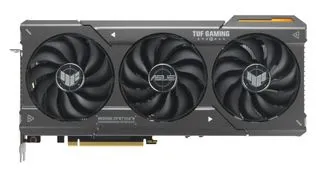
We've heard rumors about AMD's Radeon RX 7600 XT for several months now, and it's finally official. Leveraging the same Navi 33 GPU as the vanilla Radeon RX 7600 , the key difference is in the VRAM department. The 7600 already used the full Navi 33 complement of 32 Compute Units (CUs), and the 128-bit memory interface isn't going to change, which leaves only two routes to improving performance and features: more memory and higher clocks.
AMD will use both to provide an upgraded experience over the RX 7600. Will that be enough to push the RX 7600 XT into the ranks of the best graphics cards ? We'll find out later this month when the cards launch on January 24, 2023.
Let's get to the specifications first. Here's the rundown of AMD's current RX 7000-series, with the RTX 4060 included as a reference point for the new RX 7600 XT. AMD hasn't announced a price yet, but we suspect it will land right around the $299 mark.
| Graphics Card | RX 7600 XT | RX 7600 | RTX 4060 | RX 7700 XT | RX 7800 XT | RX 7900 XT | RX 7900 XTX |
|---|---|---|---|---|---|---|---|
| Architecture | Navi 33 | Navi 33 | AD107 | Navi 32 | Navi 32 | Navi 31 | Navi 31 |
| Process Technology | TSMC N6 | TSMC N6 | TSMC 4N | TSMC N5 + N6 | TSMC N5 + N6 | TSMC N5 + N6 | TSMC N5 + N6 |
| Transistors (Billion) | 13.3 | 13.3 | 18.9 | 28.1 + 3x 2.05 | 28.1 + 4x 2.05 | 45.6 + 5x 2.05 | 45.6 + 6x 2.05 |
| Die size (mm^2) | 204 | 204 | 158.7 | 200 + 113 | 200 + 150 | 300 + 225 | 300 + 225 |
| SMs / CUs / Xe-Cores | 32 | 32 | 24 | 54 | 60 | 84 | 96 |
| GPU Cores (Shaders) | 2048 | 2048 | 3072 | 3456 | 3840 | 5376 | 6144 |
| Tensor / AI Cores | 64 | 64 | 96 | 108 | 120 | 168 | 192 |
| Ray Tracing Cores | 32 | 32 | 24 | 54 | 60 | 84 | 96 |
| Boost Clock (MHz) | 2760 | 2625 | 2460 | 2544 | 2430 | 2400 | 2500 |
| VRAM Speed (Gbps) | 18 | 18 | 17 | 18 | 19.5 | 20 | 20 |
| VRAM (GB) | 16 | 8 | 8 | 12 | 16 | 20 | 24 |
| VRAM Bus Width | 128 | 128 | 128 | 192 | 256 | 320 | 384 |
| L2 / Infinity Cache | 32 | 32 | 24 | 48 | 64 | 80 | 96 |
| Render Output Units | 64 | 64 | 48 | 96 | 96 | 192 | 192 |
| Texture Mapping Units | 128 | 128 | 96 | 216 | 240 | 336 | 384 |
| TFLOPS FP32 (Boost) | 22.6 | 21.5 | 15.1 | 35.2 | 37.3 | 51.6 | 61.4 |
| TFLOPS FP16 (FP8) | 45.2 | 43 | 121 (242) | 70.4 | 74.6 | 103.2 | 122.8 |
| Bandwidth (GBps) | 288 | 288 | 272 | 432 | 624 | 800 | 960 |
| TDP (watts) | 190 | 165 | 115 | 245 | 263 | 315 | 355 |
| Launch Date | Jan 2024 | May 2023 | Jul 2023 | Sep 2023 | Sep 2023 | Dec 2022 | Dec 2022 |
| Launch Price | $299 | $269 | $299 | $449 | $499 | $899 | $999 |
| Online Price | — | $260 | $300 | $440 | $510 | $760 | $960 |
Understandably, the main difference between the RX 7600 XT and RX 7600 consists of the two changes already mentioned: higher clocks and double the VRAM. We assume AMD has done the same thing that Nvidia did with the RTX 4060 Ti 16GB — or any number of professional AMD and Nvidia cards — putting two 2GB GDDR6 chips on both sides of the PCB operating in 'clamshell' mode, so 4GB per 32-bit channel.
Until we get 4GB chips — which might happen with GDDR7 but probably not for GDDR6 — that's the maximum amount of memory that can be used per 32-bit interface. AMD hasn't confirmed this is the case, but we're not aware of any other way to get 16GB out of a 128-bit memory interface at present.
Early speculation on the RX 7600 XT suggested AMD might use Navi 32 to improve the VRAM capacity without resorting to clamshell configurations, but that was never likely to happen. Navi 32 costs substantially more to manufacture, since it needs the GCD (Graphics Compute Die) as well as multiple MCDs (Memory Cache Dies), and the RX 7700 XT already represents a downsized Navi 32 configuration.
It's still unclear whether AMD could do an asymmetrical MCD with Navi 32 to get to a 10GB card (three MCDs, one only half populated), but even if it's possible we suspect such a card won't ever come to market. Instead, previous generation cards like the RX 6750 GRE can cover that middle ground.

The performance uplift from the additional memory, clocks, and power will vary quite a bit, depending on the workload. As we saw with the RTX 4060 Ti 16GB , many less demanding games will likely see little to no performance uplift from the additional VRAM, leaving clocks and power to provide a performance boost. However, more and more games are starting to push beyond 8GB of VRAM use, and those games could see a larger performance delta.
AMD provided internal testing results, shown in the above slide, indicating the RX 7600 XT will outperform the RX 7600 by anywhere from 7% to as much as 45%. Most of the examples AMD shows (at 1080p and 1440p running max settings) fall in the 10–15 percent range, which suggests they're mostly impacted by the clocks and power — the 7600 XT has a 5% higher boost clock and a 15% higher power rating.
The one big exception from AMD's tests? Forza Horizon 5 . That's one of the games in our test suite where we've repeatedly noticed that it can benefit from more than 8GB when using the extreme preset, even at 1080p. It's not the only game that will use more than 8GB, but there are plenty of older games where the gains will be far more muted.
The extra memory isn't just about games, however. AMD also talked about running AI workloads, including Stable Diffusion XL and Llama2 13B. Both of those currently exceed the VRAM capacity of the RX 7600 and refuse to run at all, and there are plenty of other LLMs (large language models) that won't work with 8GB of memory. AMD also notes that 8K projects in Adobe Premiere Pro require more than 8GB.
The problem of course is that the compute potential of the RX 7600 XT could still hold it back in such workloads. The RX 7800 XT has the same 16GB of memory, over twice the bandwidth, and 65% more AI compute performance. In general, we'd expect anyone who's seriously looking into AI and LLMs will be better off opting for the more expensive GPUs. But if you're just wanting to play around with Stable Diffusion XL and aren't looking to maximize throughput, the RX 7600 XT should be fine.
AMD also continues to work on its drivers and software features. New for 2024, it's adding support for video upscaling — similar in theory to Nvidia's VSR that came out last year. It's not clear if AMD is using any form of AI for this, but we'll be looking into it for the upcoming review.
AMD has also tweaked the hardware video encoding quality with the latest drivers. We haven't done a deep dive on video encoding since last March, when we determined that AMD was still trailing Nvidia and Intel in encode quality. We'll have to see how things fare with the updates, as it would be nice to have more competitive streaming and encoding quality from AMD.
The RX 7600 XT will launch on January 24. Nvidia also has its upcoming 40-series Super refresh , but those will all land far higher on the pricing ladder and won't compete directly with the RX 7600 XT.
AMD won't have a reference card, letting its add-in board partners handle that side of things, and we can expect to see cards from all the usual suspects. AMD provided images of the above cards from Acer, ASRock, Asus, Gigabyte, PowerColor, Sapphire, and XFX.
Given the $329 target price and the 16GB of VRAM, while we weren't thrilled with the RX 7600, the 7600 XT may be a better prospect overall. Still, we're looking at about $70 more than the non-XT card for double the VRAM and a minor boost in clocks and power. Considering the 4060 Ti 16GB is down to a $50 upsell, AMD's only doing slightly better.
We'll be putting a sample card through our benchmark suite in the coming weeks, with the cards launching on January 24, so stay tuned. The full announcement slide deck is included below, for your perusal.