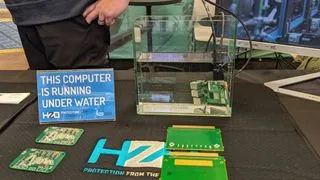
Take most electronics, let alone bare circuit boards, drop them into water and they are destroyed forever. Some phones and smartwatches are water resistant, but you certainly wouldn't expect a single-board computer to operate while submerged. At CES , a company called HZO demonstrated the effects of its waterproofing process by running a Raspberry Pi 4 in a tank of water, connecting it to both USB Type-C power and micro HDMI video out, which was going to a not-submerged monitor.
Astute readers and Pi fans may remember that we showed, all the way back in 2020, how anyone can make a waterproof Raspberry Pi by coating the board with CorrosionX, a lubricant. But lubricants, while widely available to consumers, aren't suited for manufacturers. The waterproofing doesn't last forever, and the electronics become extremely slimy to the touch. I still have the waterproof Pi I used in 2020 and touching it gets chemicals on my fingers, so I never use it.

HZO uses a process called chemical vapor deposition (CVP) to apply a coating of Parylene, a polymer, to electronics. According to HZO's website , electronic components are placed in a deposition chamber. Then a precursor solid material is heated until it becomes a gas and then heated even more until it turns into reactive monomers. The monomers land on the electronics, connecting to each other and forming a polymer film that's 2 to 25 microns thick.
At CES, an HZO representative said that electronics like the Raspberry Pi would have to be in the deposition chamber for around 15 hours. He noted that many different electronics pieces could be in the chamber at the same time so the company can do this in vast quantities. He said that the micro HDMI and USB-C cables which were connected to the Raspberry PI had also undergone CVP treatment.
At its booth, the company had a couple of sample circuit boards that they had undergone Parylene coating. I touched them and couldn't tell there was anything on them. There was nothing sticky or slimy about their textures.
As a normal person, you wouldn't have access to HZO's process. The company, which has been in business for many years, provides its Parylene and other CVP coating services to manufacturers who want to use it in the manufacturing process. On its site, the company boasts that it has worked with Dell on its rugged tablets, with Nike on its FuelBand and with Rakuten Kobo, a maker of eReaders.
The company rep told me that companies can either ship their products to HZO's own factory to have them coated or they can buy the company's equipment to use in their factories. This isn't a brand new process, but it is an important one.