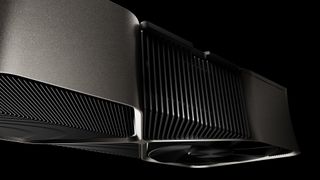
When U.S. sanctions banned the RTX 4090 from being sold to China in November, Nvidia scrambled to make a new version, the RTX 4090D . This Chinese version of the 4090 has been tested by Expreview , and although many feared this new model would be hobbled by significant reductions to power, cores, and frequency, it turns out that the 4090D is only 5% slower on average.
Based on the AD102-250 die as opposed to the 4090's AD103-300 chip, the 4090D uses a reduced core count with a slightly lower TDP. However, it retains the 4090's 2,520MHz boost clock and even increased the base frequency to 2,280MHz from 2,235MHz. The memory speed and capacity are also unchanged.
| Row 0 - Cell 0 | RTX 4090D | RTX 4090 |
| SMs | 128 | 114 |
| CUDA Cores | 14,592 | 16,384 |
| Tensor Cores | 456 | 512 |
| RT Cores | 114 | 128 |
| Boost Clock | 2,520MHz | 2,520MHz |
| Base Clock | 2,280MHz | 2,235MHz |
| VRAM Speed | 21Gbps | 21Gbps |
| VRAM Capacity | 24GB GDDR6X | 24GB GDDR6X |
| VRAM Bus Width | 384-bit | 384-bit |
| VRAM Bandwidth | 1,008GB/s | 1,008GB/s |
| L2 Cache | 72MB | 72MB |
| ROPs | 176 | 176 |
| TMUs | 456 | 512 |
| TDP | 425W | 450W |
Across 16 games, Expreview found that the 4090D was just 5.5% slower on average than the 4090 without ray tracing enabled. In games with ray tracing, that percentage dropped just slightly to 5.8%. The worst game for the 4090D saw its performance lag 7.6% behind the 4090, which is still a relatively minor difference and would be difficult to notice in person.
Considering the recent sanctions were in part triggered by concerns over China gaining access to cutting-edge AI hardware, you would expect the 4090D to see significantly less performance in AI workloads, and that's somewhat true. In Stable Diffusion, the 4090D lags by nearly 10% at 512x512 resolution, but that gap practically disappears at 768x768 and 1024x1024. Performance in D5 Render and Blender however saw over a 10% drop in performance.
Early rumors indicated that the 4090D would have no overclocking and would have a locked TDP, making any performance boosts impossible, but that turns out to not be entirely correct. While the TDP is capped to 425 watts, it's still possible to overclock, and Expreview was able to push the frequency by 200MHz. Due to the TDP cap, it wasn't possible to go any further, but if that cap is ever unlocked in the future, then the 4090D could theoretically be overclocked to achieve performance on par with the 4090.
The end result of the sanctions that banned the RTX 4090 really don't seem to have done much. To be sure, the RTX 4090D is a slower GPU, but it's hard to see how a few percentage points here or there will make much of a difference. The U.S. government might even be coming around to this point of view, as it eases up on increasing the strictness of its GPU export regulations .