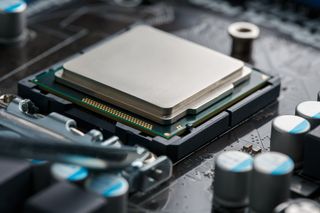
Intel's dual-core 300 CPU has been tested in a review by PC Watch , and while the branding has changed (or perhaps disappeared), the 300's performance is still very similar to the Pentium Gold G7400 that it succeeds. While the 300 is technically a serviceable CPU and even achieved 60 FPS or more in three of the four games PC Watch tested, it's not exactly a chip that warrants a shakeup in branding.
Although the Intel 300 coincides with the branding changes that arrived with Intel's Meteor Lake CPUs , this newish CPU uses the same Alder Lake chip as the Pentium Gold G7400 did. As such, it's a Raptor Lake Refresh CPU in name only. Both CPUs have two cores with Hyperthreading for four total threads, though the 300 does have an extra 200MHz worth of frequency and even support for AVX-VNNI, according to the official product page.
| Row 0 - Cell 0 | Intel 300 | Pentium Gold G7400 | Core i3-14100 |
| Cores | 2 | 2 | 4 |
| Threads | 4 | 4 | 8 |
| Base Clock Speed | 3.9GHz | 3.7GHz | 3.5GHz |
| Boost Clock Speed | N/A | N/A | 4.7GHz |
| Cache | 6MB L3 + 2.5MB L2 | 6MB L3 + 2.5MB L2 | 12MB L3 + 5MB L2 |
| TDP | 46W | 46W | 110W |
Realistically, the 300's extra 200MHz (or 5%) frequency gain is all that sets it apart from the G7400, and in PC Watch's testing, that didn't really make much of a difference. In many cases, performance was almost the same between the two CPUs, such as in Handbrake and Cinebench 2024. The 300 was slightly faster in games and, surprisingly, could sustain 60 FPS in every game but Cyberpunk 2077, where it was just a little short at 56 FPS. The 300 could even play the Resident Evil 4 remake at well over 60 FPS, though its two cores were pegged at 100% the entire time.
PC Watch also tested the Core i3-14100, a 4.7GHz version of the Core i3-13100 and 12100, and it was around twice as fast. That's not a surprising result considering it has twice the cores, twice the cache, and a frequency about 20% higher. Even for gamers only targeting 60 FPS, the 14100 provides an objectively better gaming experience as its 1% low framerate was always at least 60 FPS, which means the framerate virtually never dropped below 60 FPS. By contrast, the 300 had 1% low framerates significantly lower than 60 FPS in the two games.
The single significant advantage the 300 has is its power consumption, which was just 27 watts in Cyberpunk 2077, compared to the 14100's 65 watts. Additionally, the 300 has an MSRP of $77 to $87, while the Core i3-14100 and 14100F (which have disabled integrated graphics) go for $170 and $125 on Amazon , respectively. However, the 300 isn't yet available at retail, and even $50 more for around double the performance makes the 14100F look like the better deal.