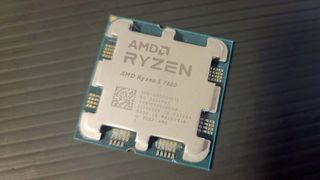
Earlier this month, news emerged that AMD has removed all markings which mention that its chips are manufactured in Taiwan from its consumer Ryzen 7000 desktop PC processors, a move largely thought to be a reaction to demands from the People's Republic of China.
The changes made headlines in China as a sign of yet another company acquiescing to the PRC's insistence that products created in Taiwan are labeled as 'Made in China,' a demand often placed on Taiwanese products as a result of the contentious relationship between the two. Some theorized that the change would only apply to AMD processors shipped to China, while the remainder of the company's processors would still be labeled as 'Diffused [made] in Taiwan,' but AMD says this change applies to all of its processors.
"AMD removed the country of diffusion from all new CPU and APU products in 2023 to align with the product marking process for our other products ," an AMD spokesperson told Tom's Hardware , indicating that the company will no longer mark (silkscreen) any of its consumer or enterprise processors with the country where the silicon die inside the chip was originally fabricated (diffused). In the case of all of AMD's leading-edge products, those silicon dies are created in Taiwan at TSMC.
As you can see in the image (via @Zed_Wang ) below (the processor on the right has the new markings), the 'Diffused in Taiwan' line is now simply omitted from the top of the processor, while the rest of the text is not re-aligned to close the gap. Notably, AMD still marks the processors as "Made in Malaysia," which signifies where the processor die was integrated into the final package.

Sources close to the matter tell us that this decision was made as part of AMD's efforts to better align its production methods for its existing AMD products with the new Xilinx products that came with its $35 billion acquisition that closed in February 2022 . Notably, Xilinx's products aren't silkscreened with the country of diffusion, and this change will introduce uniformity across the company's entire product stack.
While AMD's new chip marking strategy isn't officially due to political issues, there's no doubt that it also conveniently 'diffuses' long-standing issues with product markings for products destined for China.
Notably, AMD was rumored to have delayed its Radeon RX 7900 launch in China due to packaging that listed Taiwan as the country of manufacture, and PC peripheral maker Corsair also ran afoul of public sentiment in China based on its packaging, spurring it to issue a public apology for "printing errors."