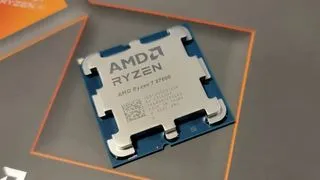
AMD launched a quartet of Ryzen 8000G ‘Phoenix’ APUs for desktops back at CES 2024 but it quickly became apparent that these chips used a thermal paste thermal interface material (TIM). Today, overclocking expert Roman ' Der8auer ' Hartung published some tests showing the performance / temperature improvements available from delidding these new APUs, specifically AMD’s top-of-the-range Ryzen 7 8700G (click to read our review). Impressively, moving from a stock sample to one with a Liquid Metal TIM applied could reduce core temperatures by up to 25 degrees Celsius. Processor performance could also be improved by up to 17%.
At the start of his video, Der8auer highlights that as the Ryzen 8000G processors are more closely related to the mobile parts they use thermal paste rather than a solder TIM. This usually means that delidding the processor and switching the TIM for liquid metal will pay excellent dividends.
Before starting his tests, Der8auer thought it useful to compare the new Ryzen 7 8700G with the tried and trusted Ryzen 9 7950X chip. A quick visual inspection reveals a big difference. There are lots of surface mount components visible on the chip substrate between the octopus legs of the 7950X. On the 8700G, you can only see these types of components by peeping under the IHS.
The visual inspection made Der8auer concerned that the Ryzen 7000 Delid-Die-Mate may be incompatible with Ryzen 8000G chips. However, the delidding process worked flawlessly and was even easier due to the paste TIM. The 8700G was delidded with no damage, so the testing plan could go ahead.

Der8auer tested the Ryzen 7 8700G in three configurations, and with three power / clock strategies. Before delidding he tested a stock 8700G as supplied, with PBO , and with a manual overclock at 5.0 GHz. After delidding he did the same tests using an 8700G which had a KryoSheet between the die and IHS, and finally with Liquid Metal.
He noted that the manually overclocked Ryzen 7 8700G would perform about 5% behind a Ryzen 7 7700X in Cinebench with the 5.0GHz overclock. However, some people will prefer the Phoenix desktop chip due to its strong iGPU .

Seeing the cool performance of the delidded chip using Liquid Metal, Der8auer found that the new sweet spot of the processor for manual overclocking was 5.3 GHz with core temperatures remaining under 80 degrees Celsius. The measured Cinebench performance of this chip was 15 to 17% better than the originally tested stock APU.
Why delid and test an APU like this? Der8auer says he did go through with this project because he likes doing these kinds of things… However, he also reckons that this kind of tinkering could deliver real benefits in some scenarios. For example, in size-constrained systems, where cooler size and design are more limited and where people tend to seek very quiet performance , being able to use a smaller cooler and / or a slower fan speed could be very attractive.