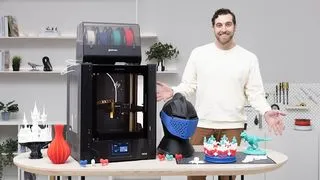
Phrozen’s design team is swinging for the fences with their first ever FDM 3D printer, launching today on Kickstarter . The Arco is a large format Core XY 3D printer with a four color multi-filament system and Klipper firmware. Phrozen is known for high-quality resin printers, such as the recently reviewed Sonic Mega 8K S .
The Arco has a print volume of 300x300x300 mm, making it the same size as a Creality K1 Max . It promises a top speed of 600 mm/s with a max acceleration of 30,000 mm/s². It has an all metal hotend, optional enclosure and the ability to custom print your own case. The Chroma Kit – a Bambu Lab style four spool material feeder – is also optional. The Chroma Kit promises to allow dual material printing, such as printing PLA and PETG together. These two filaments are generally incompatible, but work together brilliantly for easy to remove supports.
The Phrozen Arco Kickstarter price starts at $649, with global shipping expected to begin in July 2024. The machine will retail for $849.99 for a stand alone printer, and $1148 for a combo unit that includes both the enclosure and Chroma Kit.
Tom’s Hardware is slated to receive a review unit in late March, so at the moment all of this is on paper. If Phrozen can succeed with their goals, the Arco could be a phenomenal competitor to Bambu Lab’s X1 Carbon.
It appears that Phrozen has been studying their competition and are offering a printer that answers all the critics of Bambu Lab. The machine is larger, open source, customizable, upgradable and promises an easier to maintain hotend.
Phrozen’s Arco is inspired by the Voron 2.4, with a build plate fixed to the base for great stability. It also runs vanilla Klipper firmware and is open source, meaning users will be free to tinker, mod and repair the machine as they see fit. It also leaves the door open for collaborations with 3rd party manufacturers, which Phrozen has already hinted at being in the pipeline.
It will come with a custom slicer, dubbed PIXUP Slicer. Phrozen is also working on a library of files and an app for remote access. The machine comes with both a USB port and WiFi, and as it is running open source Klipper, will not need internet access to function.
MORE: Best 3D Printers
MORE: Best Budget 3D Printing
MORE: Best Resin 3D Printers