Gainward Python II and Palit Infinity 2 announced
The same design under two brands.

Palit and Gainward, both owned by the same company, have recently unveiled new cards. While both cards actually the same cooler design, the name varies depending on the manufacturer. Gainward is offering these cards as Python II and Palit has a new Infinity 2 brand. Essentially, these are identical cards with different names.
The first Python II/Infinity 2 models are based on GeForce RTX 4060, the lowest tier GPU in the Ada Lovelace family. This features an AD107 GPU with 3072 CUDA cores and comes with 8GB of GDDR6 memory across a 128-bit bus. Each of the custom models is offered with NVIDIA reference clocks as well as with 105 MHz overclocking.

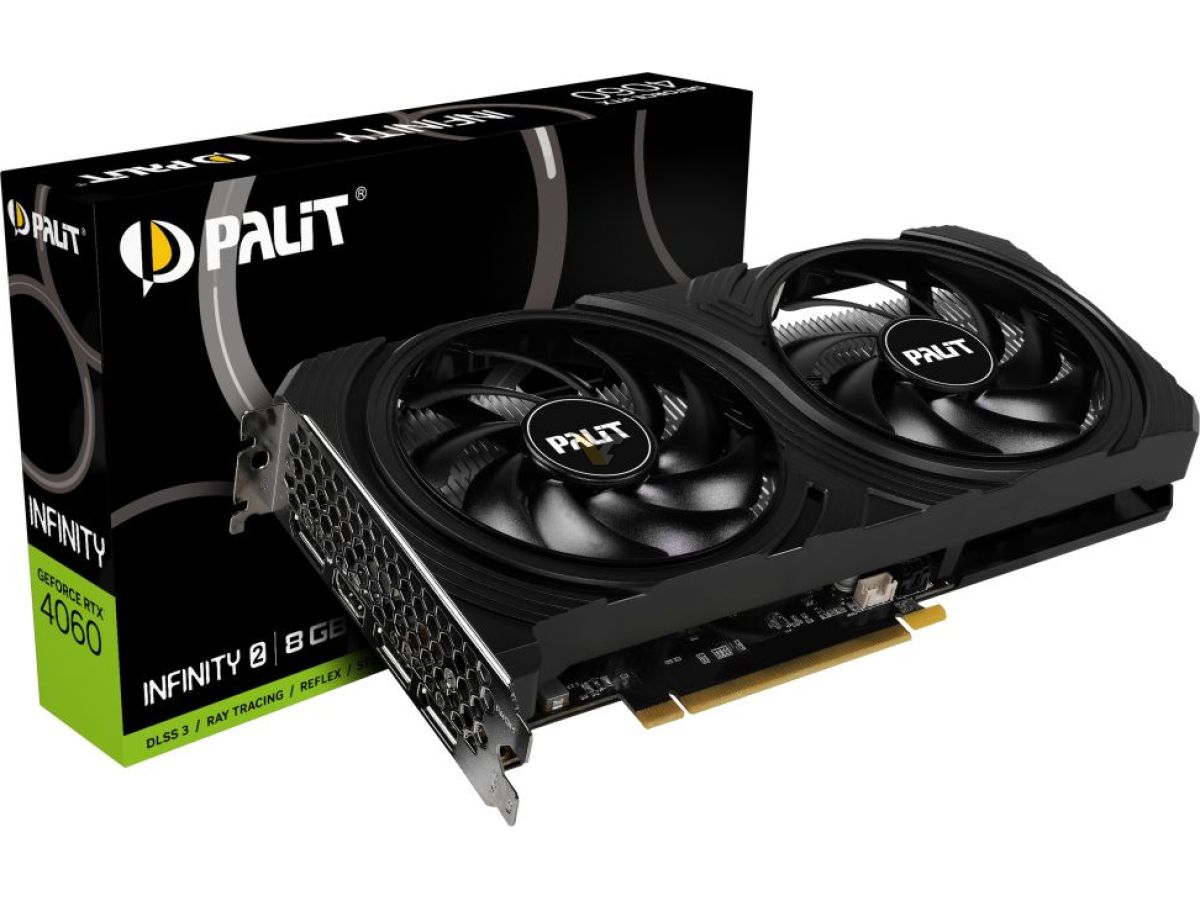
Gainward Python II and Palit Infinity 2, Source: VideoCardz
New Palit/Gainward RTX 4060 cards
- Gainward GeForce RTX™ 4060 Python II OC : 2565 MHz (Boost)
- Gainward GeForce RTX™ 4060 Python II : 2460 MHz (Boost)
- Palit GeForce RTX™ 4060 Infinity 2 OC : 2565 MHz (Boost)
- Palit GeForce RTX™ 4060 Infinity 2 : 2460 MHz (Boost)
According to Palit , the design of this graphics card features dual 95 mm fans equipped with 0 dB technology. This implies that the fans remain idle until a specific temperature threshold is reached. However, in the end, the Infinity 2 card turns out to be a lower-tier option in the company’s lineup.


In contrast to the RTX 4060 Dual, which came with a proper heatsink, the Infinity 2 opts for a sizable aluminum block. Additionally, both models share a backplate which has the same openings. But in the case of the Infinity 2 model there’s no airflow directed to the other side, simply because the block covers the whole area.
Although the card does not support the PCIe Gen4x16 interface, as the GPU is limited to 8 lanes, the Infinity 2 actually features a full-sized interface. In this case, half of the interface is not electrically connected, yet still an interesting change from Dual design.
Both models are expected to launch at or close to NVIDIA MSRP of $299.