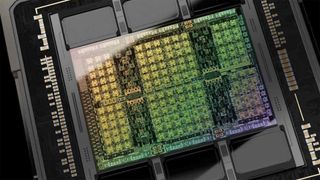
Nvidia is readying the company's GeForce RTX 50-series (Blackwell) products to rival the best graphics cards . While the launch date is still uncertain, renowned hardware leaker @kopite7kimi claims that based on his information, the memory interface configurations of the Blackwell family will not be too much different from the Ada Lovelace series. Since this is a leak, take it with a grain of salt. We gather from some previously released leaks that the company plans to retain a 384-bit memory bus with its next-generation range-topping GB202 GPU based on the Blackwell architecture .
Nvidia's Blackwell will likely be the company's first family to support GDDR7 memory, whose higher data transfer rates and architectural peculiarities promise to significantly increase performance compared to existing GDDR6 and GDDR6X -base memory solutions. Given that the 1st Generation GDDR7 SGRAM ICs will feature a data transfer rate of 32 GT/s, a 384-bit memory subsystem featuring these chips would offer around 1,536 GB/s of bandwidth, so a 512-bit memory interface will hardly be missed.
Although I still have fantasies about 512 bit, the memory interface configuration of GB20x is not much different from that of AD10x. March 9, 2024
Micron says that 16 Gb and 24 Gb GDDR7 chips will be available in 2025, though its roadmap does not indicate whether these devices will be launched simultaneously or 16 Gb will come out earlier. That said, what remains to be seen is whether Nvidia will use 16 Gb or 24 Gb GDDR7 memory ICs with its initial GeForce RTX 50-series graphics boards.
GeForce RTX 50-series Blackwell GPU Memory Configurations*
| Blackwell GPU | Width | Type | Capacity (16 Gb | 24 Gb) | Ada GPU | Width | Type | Capacity | Ampere GPU | Width | Type | Capacity |
|---|---|---|---|---|---|---|---|---|---|---|---|
| GB202 | 384-bit | GDDR7 | 24 GB | 36 GB | AD102 | 384-bit | GDDR6X | 24 GB | GA102 | 384-bit | GDDR6X | 24 GB |
| GB203 | 256-bit | GDDR7 | 16 GB | 24 GB | AD103 | 256-bit | GDDR6X | 16 GB | GA103 | 256-bit | GDDR6X | 16 GB |
| - | - | - | - | AD104 | 192-bit | GDDR6X | 12 GB | GA104 | 256-bit | GDDR6X | 16 GB |
| GB205 | 192-bit | GDDR7 | 12 GB | 18 GB | - | - | - | - | - | - | - | - |
| GB206 | 128-bit | ? | ? | AD106 | 128-bit | GDDR6 | 16 GB | GA106 | 192-bit | GDDR6 | 16 GB |
| GB207 | 128-bit | ? | ? | AD107 | 128-bit | GDDR6 | 8-16 GB | GA107 | 128-bit | GDDR6 | 8-16 GB |
*Specifications are unconfirmed.
With Nvidia's Blackwell family being at least two or three-quarters away, it is hardly a good business to make predictions by now. Yet, we have outlined possible memory configurations of the GB200 -series powered offerings in the table.
For several generations now, Nvidia's top-of-the-range consumer graphics cards have used a 384-bit memory interface ( AD102 , GA102 ), which has proven to be optimal from a performance and cost point of view. Cut-down versions of Nvidia's range-topping consumer graphics products featured a 320-bit memory interface, whereas high-end GPUs featured a 256-bit bus (e.g., AD103, GA103, and GA104). Meanwhile, there are also GPUs in performance mainstream segments with a 192-bit memory bus (e.g., AD104, GA106) and a mainstream segment with a 128-bit memory interface (e.g., AD106, AD107, GA107).
While the comment by the leaker indicates the Blackwell family will largely retain memory interface configurations of the current Ada Lovelace family, it should be kept in mind that based on the same leaker, the Blackwell series will lack the GB204 GPU. In contrast, the rumored GB205 will likely not directly succeed AD104.