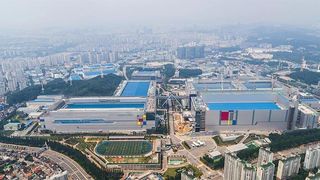
Yesterday Samsung's facility in Hwaseong, North Korea, suffered a one-minute long power outage, which has led to an estimated two- or three-day recovery time to get the production line back online, as reported by Yonhap . This factory produces DRAM and NAND memory. The power outage was caused by a power cable explosion at a nearby power substation.
Yonhap was informed that Samsung's machinery suffered no major damage, however, currently, the production line is under investigation to ensure it is ready to resume operations by the weekend.
Regardless of major damage or not though, any wafers that were in production would have to be scrapped, as even a very brief power outage could render them useless. These, along with any downtime until recovery is why even a brief outage can lead to significant losses.
No specifics were given with regard to the extent of the damage, but for reference, in 2018 Samsung's Pyeongtaek factory experienced a 30-minute blackout which caused about 50 billion won (US $43.3 million) in losses. All that Yonhap was able to report is that the damage is in the 'few billion' won range.
Nevertheless, in 2018 DRAM and NAND prices were significantly higher, and Samsung currently has a significant inventory, so chances are the actual damage won't be quite as severe for this incident as the 2018 Pyeongtaek outage.
According to Wikipdedia, Hwaseong is both a city in the South, and a county in the North. I'm fairly certain this news is referencing the city.
https://en.wikipedia.org/wiki/Hwaseong
I know they must use a lot of power, to run a facility that big, but I can't help but wonder whether $43.3 M couldn't build an adequate backup generator for it.
Ouch. Not where I live, fortunately.
https://www.engadget.com/2017/11/23/tesla-australia-powerpack-100-day-bet/https://www.generac.com/industrial/industrial-solutions/manufacturing
But it may be hard due to being North Korea.
Something much easier to find would be an APC Power Saving Back-UPS Pro 1500 which can be bought from Amazon or at a Bestbuy in countries not named North Korea
APC Power Saving Back-UPS Pro 1500 costs around $224
https://www.amazon.com/APC-Back-UPS-Battery-Protector-BR1500G/dp/B003Y24DEU
$43.3M / $224 = 193,000 APC Power Saving Back-UPS Pro 1500 units
193,000 x 1500 Volt Amps = 289,500,000 Volt Amps x a power factor of 0.8 = 231,600,000 or 231 MegaWatts
Now you wouldn't want all that to be in series which would reduce the maximum megawatts, but that should be enough juice for a minute of power loss.
I'm sure it isn't that simple, but North Korea is highly motivated to make it work.
And you could buy them from Bestbuy (in places not named North Korea) and have them shipped to North Korea much more easily than an industrial sized one.
And even with diesel generators, some batteries would still be needed to cover the gap until the generators can come online.
Given that they're probably made in China, which is a country sharing a border with North Korea, they'd probably be even cheaper for North Koreans to buy than us Americans.
P.S. Hi dude. Haven't seen you around, much.
Some power companies use flywheel energy storage to regulate frequency and voltage against transient load, might be a better option than batteries when disruptions rarely last more than a few seconds.
FWIW, the diesel generator at my job doesn't take even 10 seconds to fire up and step in. I couldn't tell you how big it is, though... maybe a couple hundred kW?
I happen to know that backup generators are available with enough battery backup to cover that gap, though they're not cheap. I imagine they might be used for hospitals.
I wonder what datacenters do. They've become fairly mission-critical, and a sudden power outage would be highly disruptive, although that would be a heck of a lot of generation capacity.
This is the very question I posed, in my first post. Is $43.3 M not enough to build that generation capacity? Any further outages they'd have avoided (like this one) could probably cover the ongoing maintenance.
The other question worth pondering is how much equipment would need backup power, simply to avoid batch spoilage and reduce production restart time. There might be a much lower bar for mitigating the impact, which could also be satisfied with cheaper & easier-to-maintain, battery-based solutions.