Alleged AMD Ryzen AI 9 365 10-core Strix Point APU gets an early preview
David Huang shares preliminary data from a prelaunch test.

David Huang claims to have gotten his hands on a prelaunch device featuring the AMD Strix Point APU, the next-gen consumer architecture for laptops and Mini-PCs. While the official launch date hasn’t been announced, AMD and their partners plan to introduce the first laptops next month. Some early data suggests that some laptops may become available as soon as July 15 . However, we don’t have details on the tested system’s conditions, such as TDP (only says 54W) or whether it was a preliminary, qualification, or retail sample.
The review focuses on architectural improvements and provides high-level comparisons between Zen3, Zen4, and Zen5 series. Additionally, David includes a separate test featuring Zen5c, the dense core available in the new APU series.

Zen5/Zen5 SPEC CPU test, Source: David Huang
Officially, only two SKUs are launching next month: Ryzen AI 9 HX 370 and Ryzen AI 9 365, with the latter being tested. The Ryzen AI 9 365 has 10 cores, while the HX 370 has 12 cores. There are also changes in the GPU department; the 365 has fewer GPU cores, but graphics testing was out of scope for this early review.
The Ryzen AI 9 365 features a maximum boost clock of 5.0 GHz, using four Zen5 cores and six Zen5c cores. It is just 100 MHz slower than the HX 370 version. Although AMD hasn’t confirmed the clock for the Zen5c core, David mentions that initial testing indicates the Zen5 core runs at 3.3 GHz, with both cores operating at their respective frequencies without affecting each other. The tested product has LPDDR5X memory rated for 7500 MT/s, with a capacity of 32GB.
Zen5 IPC (vs Zen4)
- SPEC CPU 2017 integer rate-1 (4.8 GHz) : 109.71%
- Geekbench 6 single-core (total) : 115.28%
- Geekbench 5 single-core (total) : 117.66%
In SPEC CPU tests, all processors were locked to 4.8 GHz (for classic cores). This shows that Zen5 has a 22% relative improvement over Zen4 and an estimated 9.7% IPC increase, with all architectures compared to their predecessors. Meanwhile, in Geekbench 6 single-core performance evaluation, the Zen5 architecture shows a 15% IPC gain over Zen4. In Geekbench 5, this value increases to 17.6%.


Zen5/Zen5 Geekbench CPU test, Source: David Huang
AMD has claimed 16% IPC uplift compared to Zen4, so David’s data is within that range.
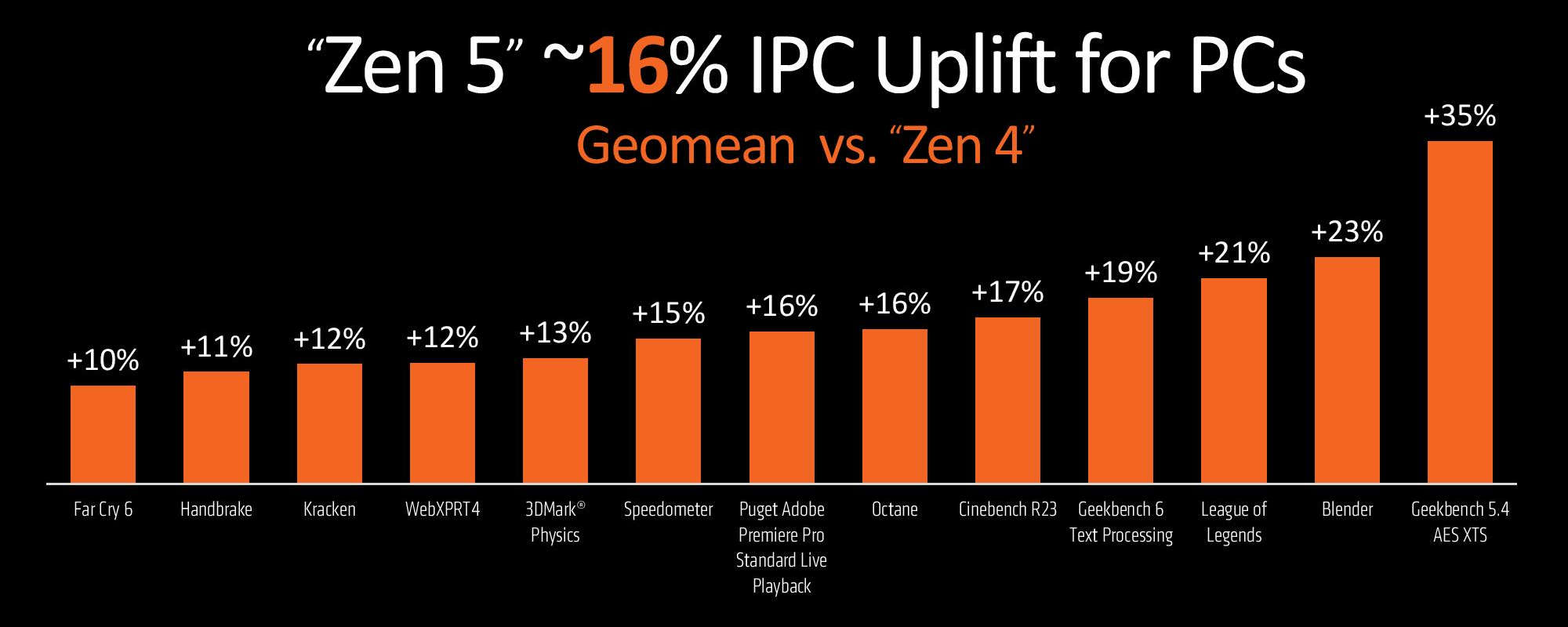
Zen5 IPC, Source: AMD
The review delves further into comparing inter-core latencies, microarchitectural features, instruction fetching, decoding, and micro-op cache. It’s definitely an interesting read for those looking to learn more about Zen5, though these details may not be essential for everyday users. But if you’re interested, check the link below.
| AMD RYZEN MOBILE APUs | |||||
|---|---|---|---|---|---|
| VideoCardz | CPU Cores/Threads | Boost Clock | GPU Graphics | NPU AI Acceleration | Configurable TDP |
AMD RYZEN AI 300 Series Strix Point Zen5/RDNA3.5 | |||||
| Ryzen AI 9 HX 370 | 12C/24T | 5.1 GHz | 16CU | XDNA2 | 15-54W |
| Ryzen AI 9 365 | 10C/20T | 5.0 GHz | 12CU | XDNA2 | 15-54W |
AMD RYZEN 8040 Series Hawk Point Zen4/RDNA3 | |||||
| Ryzen 9 8945HS | 8C/16T | 5.2 GHz | 12CU | XDNA | 35-54W |
| Ryzen 7 8845HS | 8C/16T | 5.1 GHz | 12CU | XDNA | 35-54W |
| Ryzen 7 8840HS | 8C/16T | 5.1 GHz | 12CU | XDNA | 20-30W |
| Ryzen 7 8840U | 8C/16T | 5.1 GHz | 12CU | XDNA | 15-30W |
| Ryzen 5 8645HS | 6C/12T | 5.0 GHz | 8CU | XDNA | 35-54W |
| Ryzen 5 8640HS | 6C/12T | 4.9 GHz | 8CU | XDNA | 20-30W |
| Ryzen 5 8640U | 6C/12T | 4.9 GHz | 8CU | XDNA | 15-30W |
| Ryzen 5 8540U | 6C/12T | 4.9 GHz | 4CU | N/A | 15-30W |
| Ryzen 3 8440U | 4C/8T | 4.7 GHz | 4CU | N/A | 15-30W |
Source: David Huang Blog