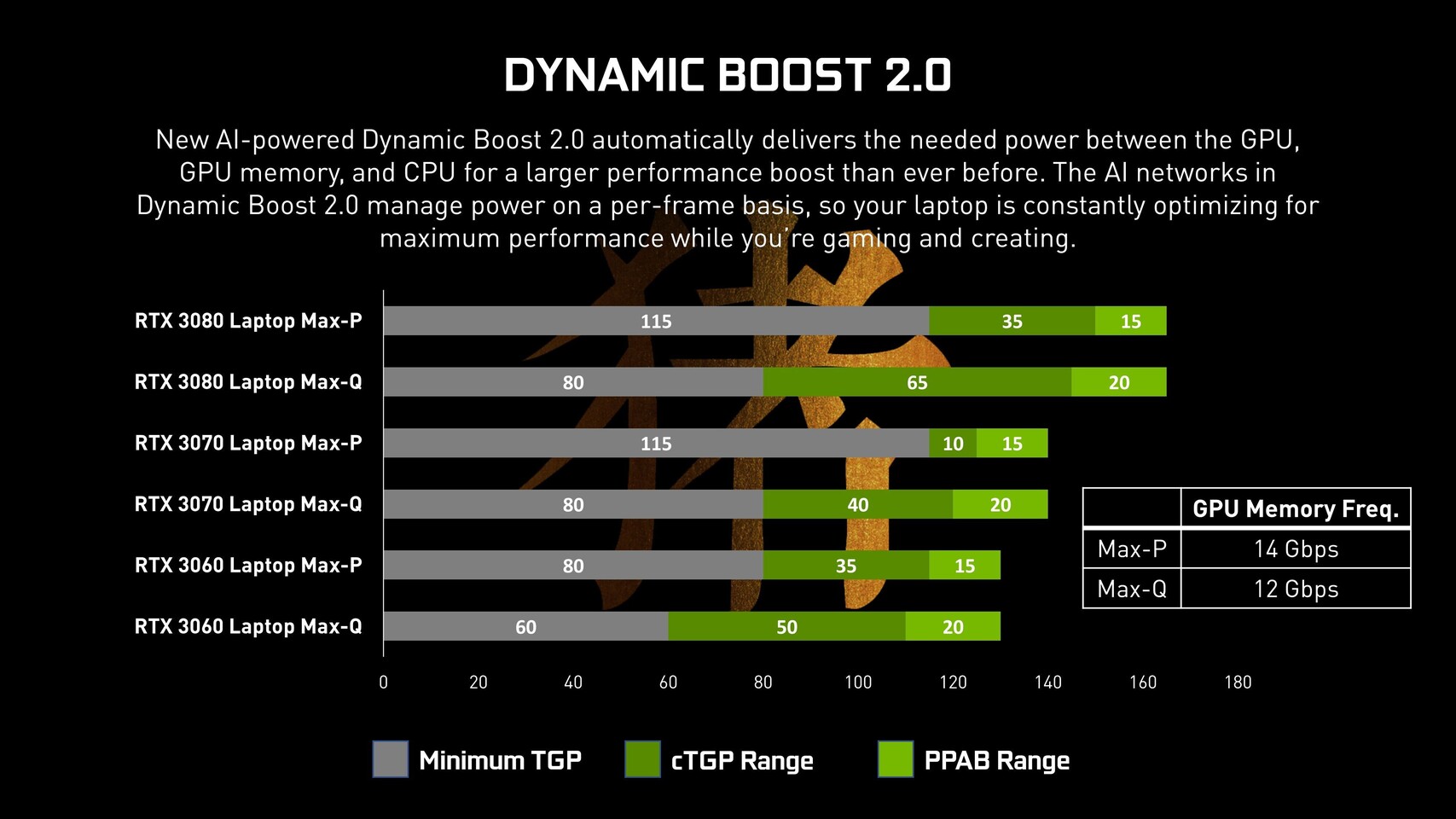
NVIDIA has recently introduced its 3000 series of Ampere graphics cards designed for mobile/laptop devices. And usually, these GPUs in the past few years have been divided into two configurations: Max-P and Max-Q. The Max-P variant was a maximum performance configuration meant for more power usage and higher temperatures, representing a standard GPU configuration. The Max-Q design was, according to NVIDIA, "a system-wide approach to deliver high performance in thin and light gaming laptops. Every aspect of the laptop, chip, software, PCB design, power delivery, and thermals, are optimized for power and performance." Meaning that the Max-Q variants are more TGP limited compared to the Max-P configuration.
Today, according to Notebookcheck, NVIDIA has decided to drop these naming differentiators in the products, where customers are now unable to know whatever their product uses the high-TGP or low-TGP configuration of a specific GPU SKU. From now on, laptop makers will no longer list the GPU configuration in their specifications and will just list a GPU model, without any explanation whatever it is a Max-P or a Max-Q arrangement. Originally the company did announce both types of SKUs for the 3000 series GPU based laptops. However, this change has happened recently, and now when looking at the laptop specifications, the GPU variant is not listed. Below you can check out the slide posted on Chinese social media spotted by @9550pro on Twitter , showing the differences in Max-P and Max-Q offerings. Laptop OEMs have already excluded the Max-P specification from the specification list.