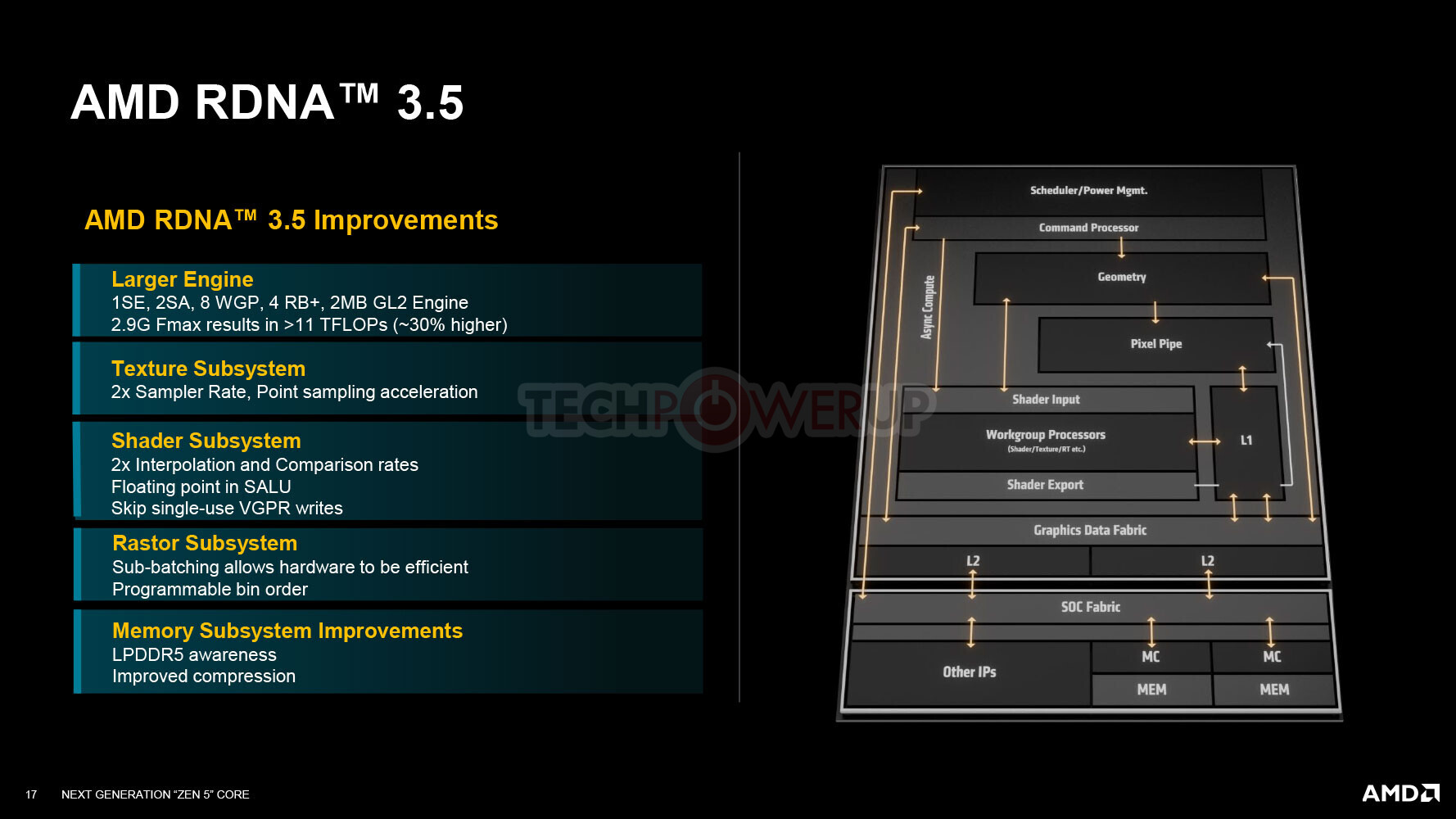
AMD presented a closer look at the Radeon 890M iGPU powering the Ryzen AI 300 series "Strix Point" mobile processor. The iGPU introduces the new RDNA 3.5 graphics architecture, with several architecture-level improvements built around the existing RDNA 3 SIMD, to yield performance/Watt improvements that AMD could trade in to increase the SIMD muscle for its processors, and proportionately increase performance. The iGPU features one Shader Engine with 8 workgroup processors (WGPs), which amount to 16 CU (compute units), for a total of 1,024 stream processors, 32 AI accelerators, and 16 Ray accelerators. The iGPU also has 4 render backends+, for 16 ROPs. It is specced with a maximum engine clock of 2.90 GHz, which yields over 11 TFLOP/s of FP32 throughput, which is around 30% higher than the iGPU of "Phoenix" (12 CU, RDNA 3), at comparable power.
AMD goes into the finer points of how it yielded the performance/Watt gains. The company worked on the texture subsystem to double the texture sampler rate, and introduced point-sampling acceleration. The shader sub-system features interpolation and comparison rate doubling. The raster sub-system introduces sub-batching of batch raster operations, with a programmable bin order, for the hardware to be more efficient. Lastly, AMD worked on the iGPU's memory-management, to be more aware of LPDDR5 (which has a different physical layer or way of writing/fetching than GDDR6). The company worked on improving the memory compression technologies, to improve performance, and reduce the iGPU's memory footprint.