AMD Fluid Motion Frames Part 2
Frame Generation at driver level.

AMD announced and launched its frame generation technology long before FSR 3 became available. The company decided to promote its technology as a separate feature, designed to boost framerates regardless of game developer support.
AMD Fluid Motion Frames is part of the HYPR-RX technology stack, a driver-level profile that can boost game performance with the click of a button. Gamers can also enable AFMF without using HYPR-RX and can apply it through per-game settings.
AMD has now announced a new version of this technology called AMD Fluid Motion Frames 2. According to AMD, it adds several new optimizations and tunable settings for an even better frame generation experience. The image quality improvements have been enhanced by AI algorithms, and the tech should now provide lower latency and better performance. Additionally, users will now be able to use FMF with borderless full screen and in Vulkan and OpenGL games.

AFMF 2 Technical Preview – A major advancement in frame generation technology for AMD HYPR-RX
- Lower Latency and Higher Performance
- AFMF 2 enhances fast-paced gaming by significantly reducing frame-generation latency and performance scaling through new modes.
- Fast Motion Optimization
- Enjoy smoother gameplay and higher FPS with improved frame generation consistency during fast motion.
- Improved Borderless-Fullscreen Support
- Expanded display mode support for RDNA 3 series graphics products ensures compatibility with virtually all borderless-fullscreen games.
- Expanded API Support
- Enable AFMF 2 for any OpenGL NEW , Vulkan NEW , DirectX® 11, and 12 titles.
- Radeon™ Chill Interop Support
- AFMF 2 now supports Radeon™ Chill, providing a low latency FPS capping option.
The technology is not yet part of the official and stable driver branch; instead, it is offered as a technical preview using a special driver. This shouldn’t be an issue for those eager to try it out, and it’s even better if they can provide feedback to AMD.
AFMF 2 supports new profiles, which are not required to be selected but this allows enthusiasts to tinker with their settings. The new Search Mode will provide a fallback when AFMF is temporarily disabled in high-motion scenes. AMD has other technologies that can provide good quality and performance (such as Radeon Boost), so frame generation isn’t needed in such scenarios.
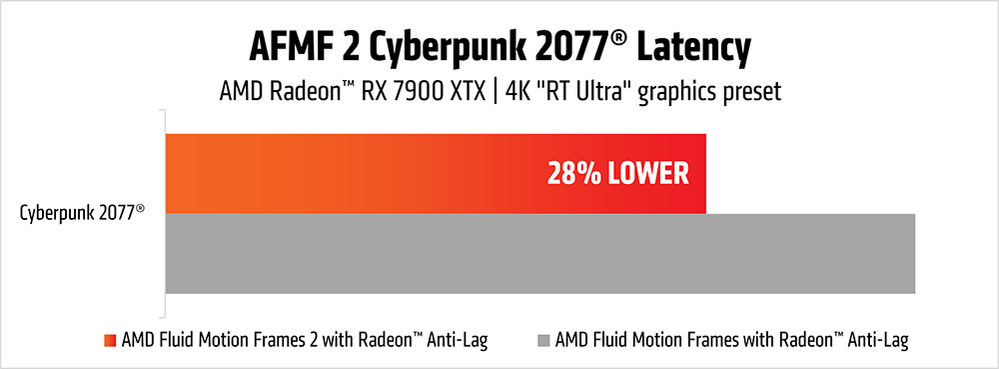
The secondary option is Performance mode. According to AMD, by choosing the sub-option called Performance, users on integrated graphics may experience higher performance. AFMF 2 has lower latency on Anti-Lag (up to 28% in Cyberpunk) and Anti-Lag 2 (up to 12% in Counter-Strike):

Unfortunately, there’s no update on support for older GPU architecture. The technology is still available on Radeon RX 7000/6000 and Radeon 7000. AMD provided the following chart explaining the support in detail and suggested profiles. We posted the chart as it was posted, but also note that AMD themselves confirmed support on Ryzen 8000G as well (see above).
| AMD Fluid Motion Frames 2 Support | |||
|---|---|---|---|
| Supported Graphics Hardware | Resolution | AFMF 2 Search Mode “Auto” default | AFMF 2 Performance Mode “Auto” default |
| AMD Radeon™ RX 6000 and 7000 series graphics cards (desktop and mobile) | 1440p and 4K | High | Quality |
| 1080p | Standard | Quality | |
| AMD Ryzen™ 7000 Series Processors with Radeon™ graphics, and higher (desktop and mobile)* | 1440p and 4K | High | Performance |
| 1080p | Standard | Performance | |
| *Excluding select AMD Ryzen™ 7000 Series Processors with AMD GCN and AMD RDNA™ 2 architecture-based graphics |