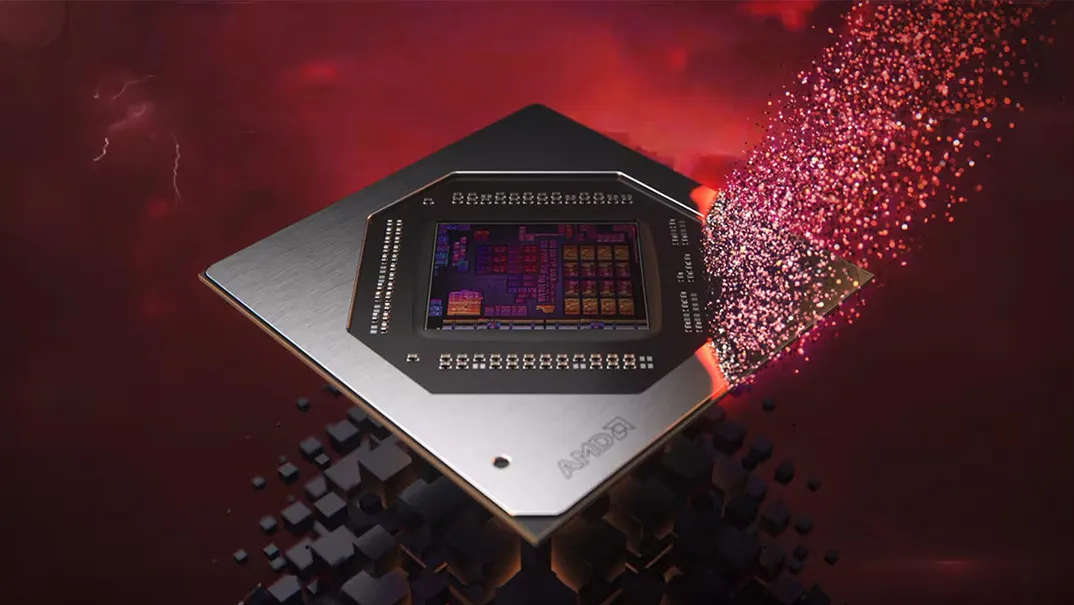
According to a post by @olrak29_ on X (formerly Twitter) , the package size of AMD's upcoming Navi 44 GPU, which will supposedly power the Radeon RX 8600 series has been leaked. While the package size does not reflect the die size, it is claimed to be around 31% smaller than Navi 33, the smallest GPU in the Navi 3X family.
Olrak shared the alleged package size of Navi 44, the budget-oriented GPU in the Navi 4X series. For the uninitiated, AMD's Radeon 8000 series will adopt an approach similar to the Radeon 5000 line-up; wherein AMD will not target the high-end market . Set to arrive in 2025 , the Radeon 8000 family will be based on 2 GPUs, Navi 48 and Navi 44. For context, RDNA3 (Radeon RX 7000) featured 3 GPUs; Navi 31, Navi 32, and Navi 33.
Package sizes:Navi 23: 35 x 35mmNavi 44: 29 x 29 mm October 14, 2024
Keep in mind that one of the key changes with Navi 44 and RDNA 4 compared to the prior generation Navi 33 GPU is that AMD likely uses a newer 5nm-class process node. Navi 44 used TSMC N6, packing 13.3 billion transistors into a 204 mm^2 die size. We don't have the die size for Navi 44, but if it uses a 5nm-class node like N5 or N4P, we can expect nearly a doubling in transistor density. As a related example, AMD's Zen 3 CCD used TSMC N7 and measured 83.7 mm^2 with 4.15 billion transistors, while Zen 4 shifted to TSMC N5 and packed 6.5 billion transistors into a 70 mm^2 die. Transistor density on those CPUs went from 49.6 MT/mm^2 (millions of transistors per square mm) to 92.9 MT/mm^2, and we would expect relatively similar scaling on the GPU side of things. In other words, a small package or even die size doesn't mean Navi 44 can't deliver a decent performance uplift compared to the current generation.
The Navi 44 GPU leak refers to a package size (not die size) of 29mm x 29mm which comes out to be 840 mm 2 . Navi 33 (which powers the RX 7600 series) on the flip side, comes in at 35mm x 35mm or 1230 mm 2 .
We should remind readers that when we talk about the package, it includes not just the die, but the surrounding metallic frame and other structural materials.
There is still the possibility that AMD could make the actual package smaller while retaining the same die size; but that is merely speculation for now.
All things considered, it is is seemingly clear that AMD are not going to compete against Nvidia for high-end GPUs. But, AMD seem willing to deliver the best bang for buck with its next generation of GPUs, possibly in an attempt to restore its dwindling GPU market share .
