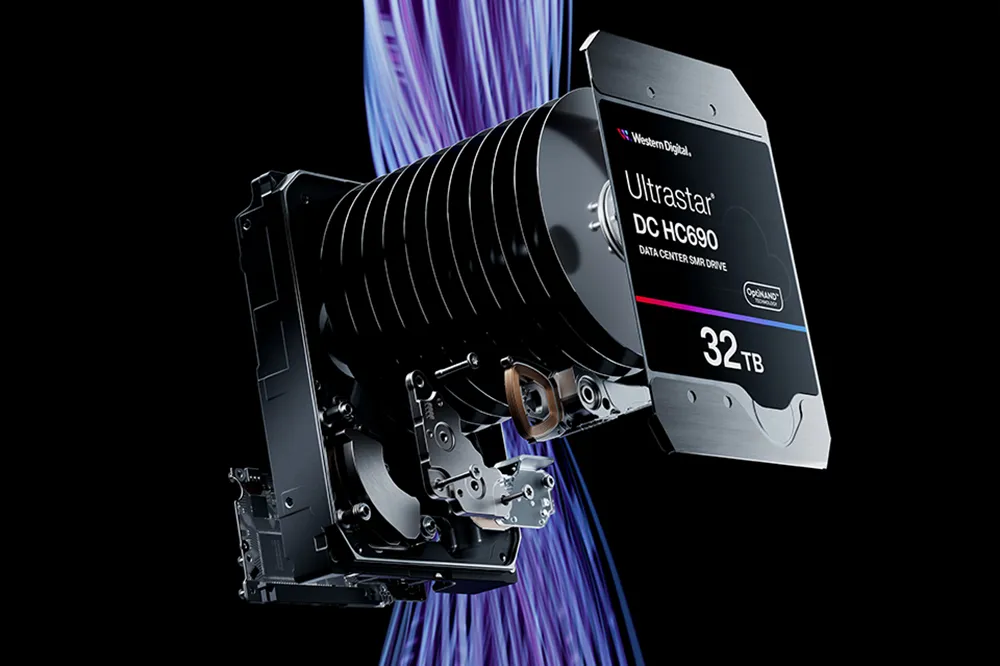
Western Digital’s newly launched ePMR-powered UltraSMR HDDs can store up to 32TB, a new record for shingled magnetic recording-based drives.
Thanks to ePMR, which WD has used since 2020 to improve HDD capacity, and the storage company’s much newer UltraSMR technology , WD introduced an 11-disk design for the 32TB Ultrastar DC HC690. WD’s previous champion, the Ultrastar DC HC680, had 28TB of storage thanks to a 10-disk design and was the company’s first drive to use UltraSMR tech.
While the HC690 does have 4TB or roughly 14% more storage than its predecessor, its performance is slightly down. The HC680 hit 265 MB/s, but WD says the HC690 is rated for 257 MB/s. Although a 3% performance loss doesn’t sound like much, it would eventually make a noticeable difference in a long read or write operation.
WD touts that large drives like the HC690 are ideal for AI computers since a large amount of data is required to train AI models, which can also create lots of data ( like faked video game trailers ) once up and running. Ultimately, the HC690 is just a bigger storage device, so WD might discuss its suitability for AI simply because it’s the current zeitgeist.
It may seem strange to use a traditional storage medium for AI rather than much newer solid-state drives, but SSDs are still relatively expensive for the capacity they offer. HDDs are a much more cost-effective solution for long-term data storage, where performance is less of a priority, perhaps even for AI.
WD also announced the 26TB Ultrastar DC HC590, which uses conventional magnetic reading (CMR) technology and is a direct successor to the 24TB HC580. This CMR-based drive also has a slight performance reduction compared to its predecessor: 288MB/s, down from 298MB/s. WD Gold variants of the 26TB HDD are also available.
Although WD is currently the density champion, its rivals are working on their next-generation drives with as much capacity, if not more. In May, Toshiba claimed it achieved 32TB using heat-assisted magnetic recording (HAMR) technology and 31TB using microwave-assisted recording (MAMR).
For its part, Seagate is researching multi-level HAMR technology , which the storage company hopes will allow it to make 120TB or larger HDDs by 2030. This would be accomplished by using multiple storage layers on a single disk that could potentially have 10TB of storage, much higher than the ~3TB disks that WD uses in its latest HDDs.
