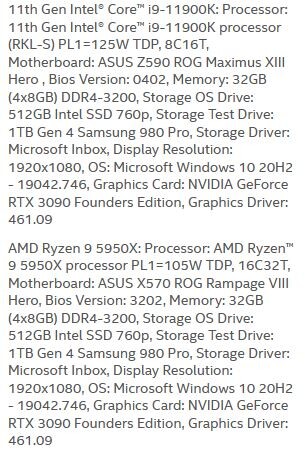
Intel claims that its upcoming 11th Gen Core "Rocket Lake-S" desktop processors offer up to 11% higher storage performance than competing AMD Ryzen 5000 processors, when using the CPU-attached M.2 NVMe slot. A performance slide released by Intel's Ryan Shrout shows a Samsung 980 PRO 1 TB PCI-Express 4.0 x4 M.2 NVMe SSD performance compared on a machine powered by a Core i9-11900K processor, compared to one powered by an AMD Ryzen 9 5950X. PCMark 10 Quick System Drive Benchmark is used to evaluate storage performance on both machines. On both machines a separate drive is used as the OS/boot drive, and the Samsung 980 PRO is used as a test drive, free from any OS role.
The backup page for the slide provides details of the system configurations used for both machines. What it doesn't mention, however, is whether on the AMD machine, the 980 PRO was installed on the CPU-attached M.2 NVMe slot, or one that was attached to the AMD X570 chipset. Unlike the Intel Z590, the AMD X570 puts out downstream PCI-Express 4.0, which motherboard designers can use to put out additional NVMe Gen 4 slots. On Intel Z590 motherboards, the M.2 NVMe Gen 4 slot the drive was tested on is guaranteed to be the CPU-attached one, as the Z590 PCH puts out PCIe Gen 3 downstream lanes. A PCI-Express 4.0 x4 link is used as chipset bus on the AMD X570, offering comparable bandwidth to the DMI 3.0 x8 (PCI-Express 3.0 x8) employed on the Intel Z590. And so a drive capable of attaining 7 GB/s sequential transfers should be in a sub-optimal situation on a chipset-attached M.2 slot. It would have been nice if Intel cleared this up in its backup.