
Nvidia's CES 2025 presentation showed off its new RTX 50-series graphics cards proudly, with the RTX 5090 through 5070 all offering around double the performance of their previous-gen counterparts in the RTX 40-series. Nvidia credited this in its keynote to the brand-new Blackwell architecture. However, a look at Nvidia's in-house benchmarks reveals that 2x improvements in games come more from the software suite of DLSS 4 than pure silicon vs. silicon matchups.
Deep Learning Super Sampling, or DLSS, has been a tentpole feature in Nvidia's consumer graphics cards since the 20-series. DLSS 4's software suite includes a bevy of new and improved AI features that increase in-game performance and visual quality over last-gen's DLSS 3/3.5. Software and hardware improvements lead to upgrades in DLSS's Super Resolution upscaling, ray reconstruction, and frame generation, a feature which AI generates one extra frame per rendered frame. DLSS 4 steps this up to Multi Frame Generation, a process which can generate three frames ahead of one rendered frame. This can effectively step a 30 FPS experience up to 120 FPS by generating and inserting the extra frames.

The DLSS 4 suite is, per Nvidia's testing, better in every way than DLSS 3. Nvidia's own relative performance benchmarks for the RTX 5090, 5080, 5070 Ti, and 5070, which pin the new cards against their previous-generation counterparts (RTX 4090, etc.), seek to prove this point exactly. Both cards more than double last-gen performance in Cyberpunk 2077, Black Myth: Wukong, and Alan Wake 2 all in 4K Max settings and a D5 Render productivity benchmark. However, the fine print reveals that though some DLSS 4 features will come to 40-series and older cards, DLSS 3 was used on the 40-series cards in testing.
There is no problem with testing in this way; DLSS 4 has not yet rolled out to older cards and Multi Frame Generation will only ever be feasible on 50-series cards thanks to its specific hardware needs. But the lead shrinks to a 1.5x boost or lower in games where DLSS 4 isn't yet available. A Plague Tale: Requiem was tested with DLSS 3 on all cards, while Far Cry 6 was tested with DLSS off completely and turned in a 1.25x generational improvement.

Let those gamers who purchase the RTX 50 series remember to crank all DLSS 4 settings and features up to eleven to see true performance boosts beyond the 40 series. On release of the 50-series, beginning this month, some DLSS 4 upgrades will also roll down to older cards, raising their boats with the 50 Series.
DLSS 4's Multi Frame Generation is also made interesting thanks to how it plays with input latency. Because of how Multi Frame Generation works (one frame is rendered, and the next three are generated based on extrapolating the previous one), some amount of input latency is introduced as some frames are generated without input data. Reflex 2 , a technology that seeks to squash input lag, seeks to make up for Multi Frame Generation's extra required headroom.
The appropriately named sequel to 2020's Reflex, Reflex 2 reduces latency in games by up to 75%, beating Reflex 1's 50% reduction. A standard latency pipeline follows mouse/keyboard inputs from the CPU, to the render queue, to the GPU, which then outputs an image around 58 milliseconds later. Reflex is an SDK that seeks to better synchronize the CPU and GPU, submitting updated input data from CPU to GPU just before it is needed, bypassing the render queue, and taking latency as low as 28ms. 90% of gamers keep Reflex on in its over 100 supported games, per Nvidia.
Reflex 2 performs this improved queueing process even faster than Reflex 1, and adds a bonus layer to its pipeline. "Frame Warp" can take super-quick mouse movements and, rather than render the new angle, simply warp the existing frame in the direction of the input, further reducing input lag by removing the need for a full render. A predictive algorithm paints in the gaps in the new warped frame's edges, and voila; latency is further cut down to 14ms.
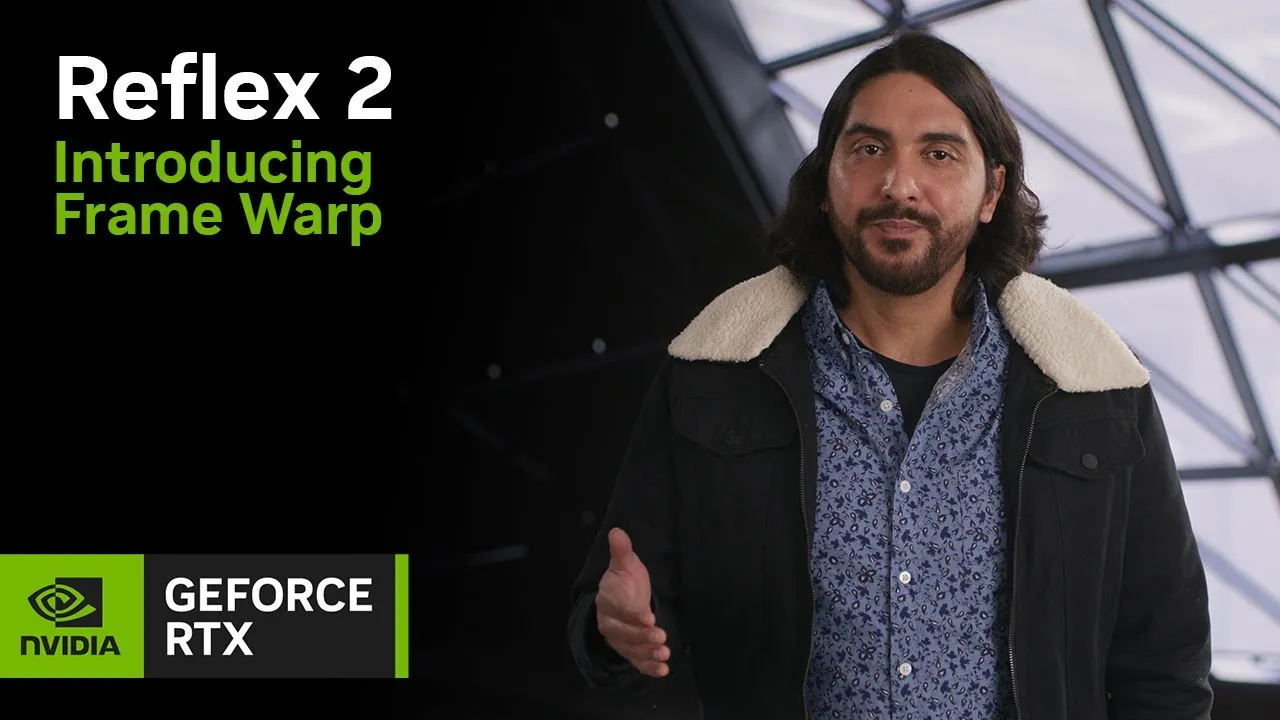
If you're confused by this witchcraft, the simplified explanation is that Reflex 2 further improves input lag and can help overcome the added frame latency of DLSS 4's Multi Frame Gen for those on RTX 50 Series. A much deeper explanation can be found in Nvidia's Reflex 2 video below.
Nvidia's RTX 50-series on Blackwell has been long awaited by consumers, and its twice-as-fast performance numbers over the RTX 40-series seem incredibly impressive. But while Blackwell may pack in double the memory bandwidth and double the ray-tracing cores over Ada silicon, the gap in real-world performance between the two generations seems to really come from DLSS 4's software-side improvements over the last gen. And of course, this is all based on Nvidia's own in-house benchmarks; once RTX 5090 and 5080 arrive for testing sometime this month, we will be able to more quantitatively support these numbers.
Check back in for our full testing of the RTX 50-series once it launches sometime this month, and be sure to keep an eye on Tom's Hardware 's CES 2025 coverage as the conference continues this week.