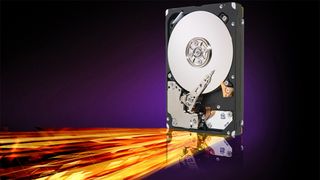
Seagate has announced that it had surpassed a shipments milestone this March. Throughout its history, the company has shipped three zettabytes (ZB) of hard drive storage. It is particularly noteworthy that 2ZB out of 3ZB were shipped in the last couple of years, which indicates that the world now generates more data than ever.
Seagate was founded in 1979, more than 41 years ago. Throughout its history, the company shipped hundreds of millions of hard drives. Seagate's math about its 3ZB achievement is pretty interesting by itself. Three zettabytes equals 30 billion 4K movies, 60 billion video games, 7.5 trillion MP3 songs, or 1.5 quadrillion selfies. Or, if you prefer SI metrics, one zettabyte is a thousand exabytes, which is a thousand petabytes. So 3ZB equals three billion TB. That's a lot of hard drives.
From a business perspective, Seagate's history looks no less impressive as the company has outlived more than 200 other HDD makers and is currently one of the three suppliers of hard drives, including some that compete with the best external hard drives . But what is particularly impressive is that the company is only getting started, as to remain relevant it will have to do more than it has done so far.

A number of important events on the market of storage happened in the recent years, which accelerated sales of high-capacity hard drives. First up, laptops shrank their dimensions and many of them no longer can accommodate a 2.5-inch hard drive, but rely on an SSD such as one of the best SSDs and cloud storage.
Secondly, cloud services have become ubiquitous and all of them use tens of thousands of HDDs to store data. Thirdly, since datacenters now consume more hard drives than ever, they use high-capacity HDDs, which is why Seagate and its competitors now offer drives that can store up to 20TB of data, which is more than an average person needs today. All of these factors allowed Seagate and its peers to significantly increase storage capacities they sell today even despite the fact that unit shipments of HDDs dropped in the recent years.
In the coming years demand for data storage will increase once again. Consumers and businesses will continue to expand usage of cloud storage, so the appropriate services will have to use more drives.
As major Hollywood studios launch their own streaming services, they (or rather their datacenter partners) will naturally need more storage too. But end-users, businesses, and streaming services will still be responsible for only a fraction of that data that will have to be stored several years from now. Smart cities, smart factories, smart devices, autonomous vehicles, and robots will generate more data than the whole of humanity combined throughout its history.
As a result, Seagate and its rivals will sell tens of zettabytes of hard drive storage in the coming years. Last year Seagate and IDC estimated that the sum of data generated globally by 2025 was set to accelerate exponentially to 175ZB. To store data four years down the road, Seagate and other makers of HDDs will need to offer higher capacity drives and these is where technologies like heat-assisted magnetic recording (HAMR) will come into play. Seagate expects capacities of its HDDs to increase to 40TB ~ 50TB by 2025 ~ 2026 and to 100TB in 2030.
Hard drives provide a good balance between storage capacity and performance. Meanwhile, loads of cold data will be stored using tape drives, so 1PB tapes by Fujitsu and IBM will come in quite handy. Furthermore, as there will be loads of 'hot' data that will have to be always available, makers of NAND flash as well as dozens of SSD manufacturers will definitely not sit without a job.