
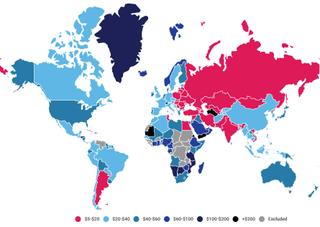
UK-based broadband comparison website Cable.co.uk has published its annual global broadband pricing information and put the U.S. in the 119th spot in terms of pricing for consumer Internet access, as spotted by TechSpot . Last year, the U.S. didn't fare much better and ranked 104th.
That's not to say that prices for broadband in the U.S. are going up. Rather, the year-on-year cost has dropped by $17.69 for the average subscription. But that hasn't done much to help the position in the global rankings, since prices for broadband have been falling all over the world.
The cable comparison site noted that global broadband speeds increased by 20.65% on average between 2018 and 2019. Meanwhile, the average price of a broadband package decreased by 19.975% between the end of 2018 and beginning of 2020, it said.
Despite the almost abysmal rankings for pricing on the global scale, the U.S. fares quite well when it comes to broadband speeds. In 2017, the average connection in the U.S. had a speed of 20 Mbps. In 2018 that figure rose to 25.86 Mbps, and in 2019 it jumped to 32.89 Mbps. Consequently, the U.S. is in 15th place when it comes to average broadband speed connections.
Leading the connection speed charts is Taiwan with an average connection speed of 85.02 Mbps, and Yemen takes last place at a meager 0.38 Mbps.
Back to prices. The most expensive country is Eritrea, where the average cost of fixed-line broadband is a painful $2,666.24 per month. Yemen followed closely at $2,466.67, and the third most expensive location was Mauritania with an average cost of $694.63. Note that in many parts of the world, large portions of the population don't use broadband, and less developed countries often rely on mobile data connections rather than fixed-line connections for Internet access.
If you want the cheapest fixed-line Internet access, you'll have to move to Syria, where the average broadband connection costs just $6.60 a month.
A lot of those countries with lower cost are very small and have very low amounts and easy to implement infrastructure to support their broadband. And others like SYRIA, broadband may be the cheapest, but access to such services is virtually non-existent, so of course its cheap, $0 have been invested in infrastructure there.
You want avg speeds in the US to equal Taiwan (85Mbps)... how many TRILLIONS do you have to invest in the infrastructure to support such a system nation wide?
A fair and accurate article would compare the US prices and speeds against countries with similar sized (sq-mileage), similar population, and similar access to services. Bottom line, there are 3 major variables not accounted for in this article!
What is the definition/minimum speed of broadband in this context? I think the FCC started using 25/3 Mbps back in 2015. Has is it increased since then, or based on our current FCC, lowered? Or at least how does the UK research define it?
The answer is "literally no amount of money can upgrade our internet infrastructure". Because right now it isn't a funding problem its a legislation/monopoly problem. It is nearly impossible to get permits to lay fiber on public lands - and it is essentially illegal for competition to enter the market in many municipalities.
Not that the cost would matter - Internet is not a public utility, so it isn't "our" infrastructure at all.
For what it's worth, the cost to simply lay the lines is estimated at $61Billion (and we've already paid these companies for it many times over, according to "The book of broken promises".)
https://www.telecompetitor.com/economists-put-the-tab-at-61-billion-to-bring-fiber-broadband-to-rural-u-s/https://www.huffpost.com/entry/the-book-of-broken-promis_b_5839394
Of course, looking at the data in a logical way like that doesn't get you clickbait headlines like "118 Countries Have Cheaper Broadband Internet Than the US Right Now". Let's just ignore the performance of the Internet in those countries. Sure, you can mention the $6.60 cost of broadband in Syria, but one should also point out that the average speed of this "broadband" is less than 1 mbps.
Also, it should be noted that the data in this study doesn't account for affordability, instead simply using a quick currency conversion to USD. That often won't be representative of how affordable something is in a country, as it doesn't account for how much income people are actually making in these regions, what their cost of living is, and how much of their money goes to things like taxes. That makes the ranking a bit more vague than what is shown here.
You can't pay more for something that doesn't exist... Well, I guess you technically can and that actually happens all the time with US ISPs, but you won't actually get what you pay for.
Something like 1/3 of the country doesn't have access to that 75mbps, regardless of what they're willing to pay.
But meh. You you're trolling so you already know that.