The current ATX power supply specification has been quite consistent since about 1995 with but a few changes since. However, that might change soon, according to CustomPC . The site reported that Intel will launch its "ATX12VO" design specification, with the "O" standing for "Only," this year.
Initially, the transition will only hit system integrators, so the DIY space will likely continue using the existing 12V ATX design for quite some time.
The idea behind ATX12VO is that it ditches the 3.3V and 5V rails, leaving the power supply's only job as to provide 12V to the system's components. This simplifies the power circuitry design and, thus, lowers the production cost of components.
This change isn't surprising, as many devices can make do with 12V only, and many power supply designs operate with a single big 12V rail that uses a simple step-down DC-DC converter to provide 5V and 3.3V to the components that do still need it. These components include hard drives, SATA-mounted SSDs and most USB devices.
Many of the pins on the current 24-pin ATX connector are redundant by today's standards, and a lot of modern systems don't need SATA hard drives or SSDs anymore now that NVMe M.2-based SSDs are gaining popularity. Moreover, various USB devices are also slowly starting to adopt 12V as their input voltage to speed up charging, and chances are that there will be a day when all new USB devices are built on using 12V rather than 5V.
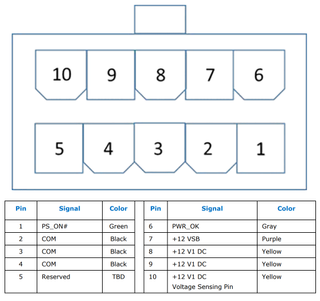
For the motherboard connectors that do remain, the replacement is said to be a 10-pin connector with the EPS power connector becoming an optional extra for use in high-power systems.
We wouldn't worry too much about this creating problems with support for legacy USB devices or hard drives, though. The report indicates that 3.5-inch and 2.5-inch SATA devices will be able to draw power from the motherboards instead of the PSUs.
Additionally, chances are that motherboard vendors will continue to include step-down conversion to 5V on their motherboards for legacy USB devices as long as the demand is there for it, so it could possibly take up to a decade for a full transition.
I guess eventually we'll get to that point in the DIY market, and when we need 5V or 3.3 we'll have to use adapters that have built-in step downs or something. But that probably will take years.
Side note, I hope OEMs adopt the 12VO standard instead of the proprietary crap. Using standard PSUs as replacements in certain OEM boxes has been annoying for years, in many cases I've had to either use adapters, or cut and splice.
Yea Dell has been doing this for about 4 years now. it makes it a pain though from a IT point of view. Lucikly i do have 1 PSU for testing, but they also are doing a different form factor now on their PSUs so I can't even use a 24 pin adapter to their 8 pin adapter that Dell uses unless i leave the PSU hanging out. For OEM's I don't see any issue with this so long as there can be 3rd part supplies of power supplies as well. On the main stream/custom side I don't want that to ever dissapear. Some of us still run multiple hard drives ( I have 12!) and i just don't see all those amps being able to go though the motherboard.