
Blender 4.4 delivers on another half-year worth of improvements to this leading open-source and cross-platform 3D modeling solution.
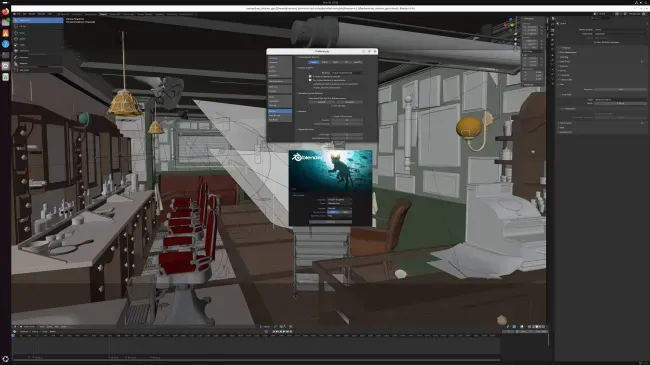
Some of the key Blender 4.4 highlights include:
- The experimental Vulkan back-end has received a big update with greater performance, stability, and compatibility. Vulkan is still considered experimental in Blender 4.4 but is showing much better performance compared to using OpenGL. Blender's Vulkan back-end aims for production readiness later in 2025 .
- Support for the NVIDIA GeForce RTX 50 (Blackwell) and AMD Radeon RX 9000 (RDNA4) series graphics cards for GPU-based rendering.
- AMD HIP RT support is no longer considered experimental and will be enabled by default in the next Blender release. But HIP RT on RDNA1 GPUs is no longer available.
- AMD ROCm/HIP support on Linux now requires at least ROCm 6.0. The AMD Windows driver requirements were also increased.
- The OptiX denoiser was updated to improve denoising quality.
- Blender's 3D Viewport overlays have been rewritten for better consistency and extendability.
- The CPU compositor for Blender has been rewritten for future development and can allow for much better performance compared to the old compositor.
- Blender videos can now be rendered using the H.265 (HEVC) video codec.
- For the geometry nodes code porting the triangulate node from BMesh to Mesh has yielded a 300~100x performance improvement.
- The Pose Library has been updated to allow for a smoother workflow when working with other Pose assets.
- Integer sockets are now supported in the compositor.
- Continued improvements around glTF support.
- A new brush type, the "Plane brush" has been added.
- Various UI improvements.
More details on all of the many Blender 4.4 changes via the release notes . Blender 4.4 downloads from Blender.org . Updated Blender benchmarks soon for both CPUs and GPUs.