
TechSpot means tech analysis and advice you can trust .
The big picture: Despite promising massive, unprecedented improvements in both speed and power efficiency, optical technology has yet to become a common feature of modern chip design. Now, a display company claims it can take optical solutions to the next level – at least, when it comes to transmitting data between machines and chips.
X Display is focused on developing and licensing new intellectual property related to MicroLED and other display technologies. The North Carolina-based developer recently unveiled a novel application of the traditional "display" concept – one that transmits massive amounts of digital data through the air.
According to X Display, this optical connection can achieve data rates equivalent to a million frames per second, though no human will ever be looking at the other side of the screen.
A refresh rate of one million hertz would eclipse any prototype of high-refresh computer displays we know today, but no gaming or visual applications are planned for this technology. What is likely the fastest "display" ever reported is designed purely for machine-to-machine communication, in keeping with X Display's other innovations.
The technology uses thousands of ultra-fast, multi-wavelength emitters that transmit digital data in parallel, X Display explained. The system dynamically writes and controls data across discrete sequential frames, with each frame consisting purely of light. On the receiving end, a high-speed camera captures the light and converts it back into digital bits and bytes.
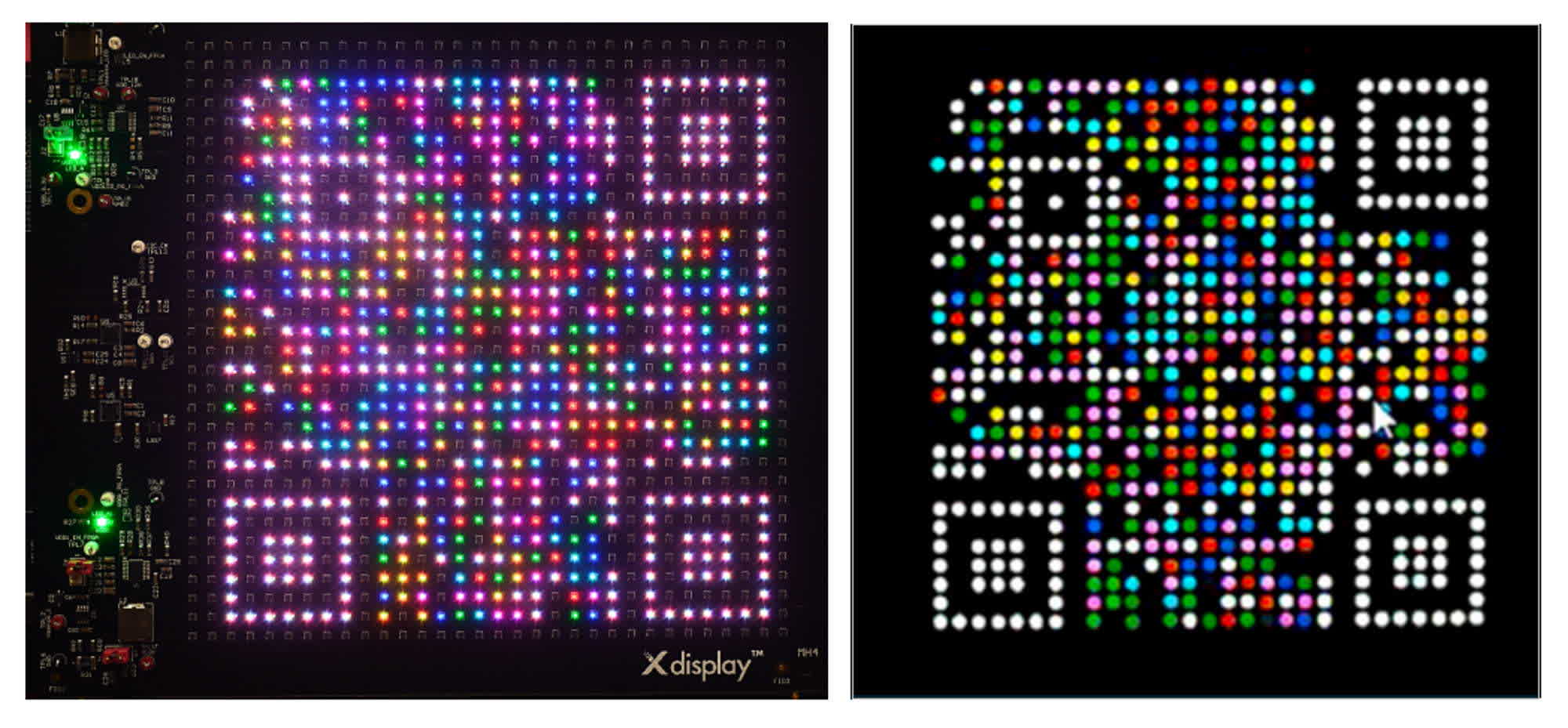
X Display says its new intellectual property represents a breakthrough for free-space optical wireless communication systems. The solution is specifically designed to accelerate connectivity in AI data centers and other large-scale computing environments, where stable, cable-free communication links could enable significant gains in efficiency, scalability, and system reconfigurability.
By literally making data fly through the air, the technology could eliminate the need for complex fiber-optic cable bundles. This would simplify the configuration of xPU clusters and allow systems to dynamically adapt to changing bandwidth demands. The company also claims the system offers 2 – 3x greater energy efficiency compared to traditional 800G optical transceivers, making it a compelling option for future "green" data center and AI infrastructure initiatives.
// Related Stories
"The capacity to dynamically transmit data at megahertz speeds through the air holds transformative promise for cloud infrastructure," said Nikhil Jain, X Display's director of OptoElectronics & strategic partnerships.
Following the development of what it calls the world's fastest display-based optical data link, X Display is now aiming to achieve terabit-per-second data rates and beyond. Potential use cases include optical data transmission, LiFi (light fidelity), digital media broadcasting, and other high-bandwidth communication applications.