
TechSpot means tech analysis and advice you can trust .
What just happened? Since its introduction in 2006, CUDA has been a proprietary technology running exclusively on Nvidia's own GPU hardware. Now, the GeForce maker appears ready to open CUDA to at least one additional processor architecture. Just don't expect to run CUDA-optimized code on AMD or Intel GPUs anytime soon.
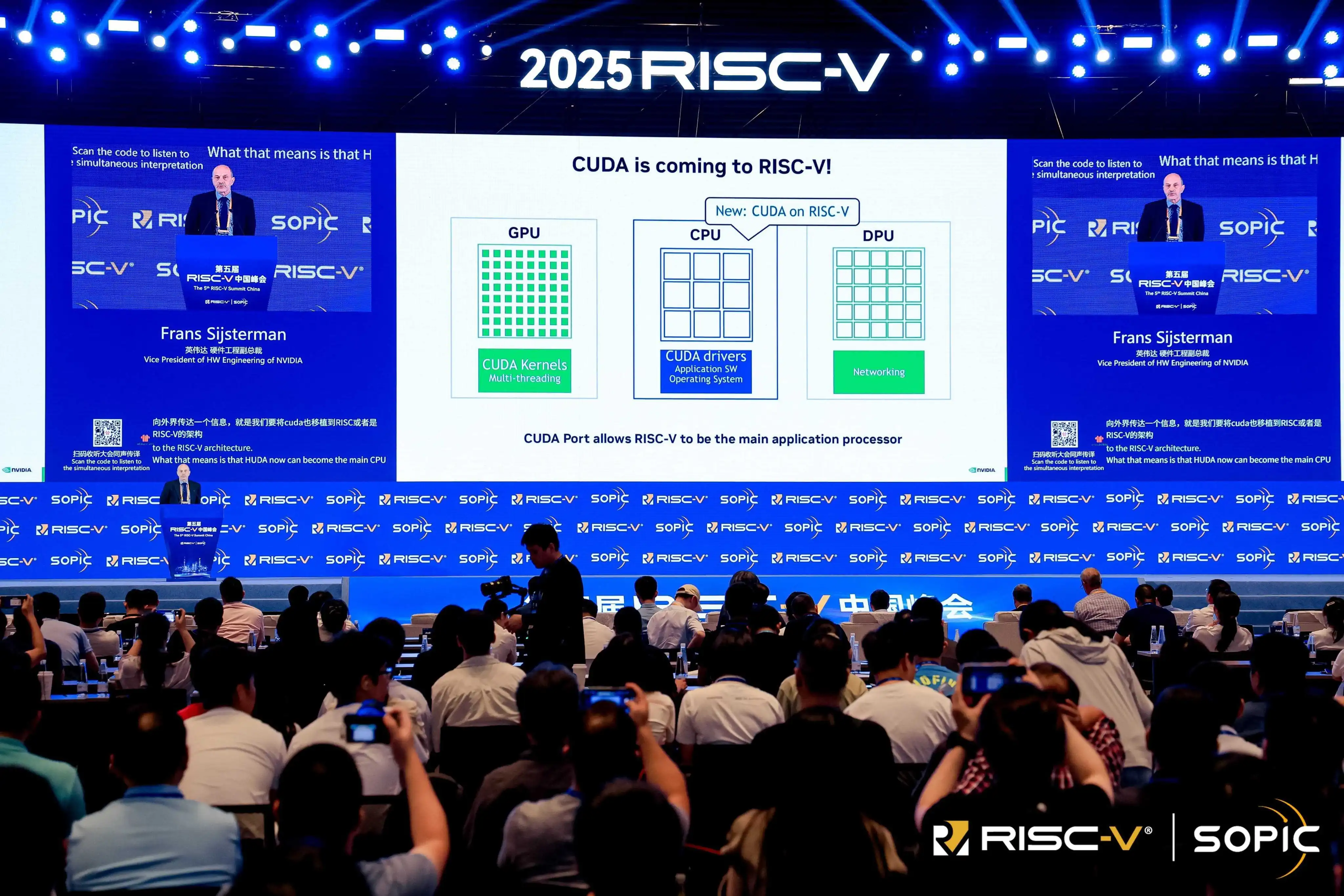
Nvidia has officially ported its Compute Unified Device Architecture (CUDA) to RISC-V, a move announced at a recent RISC-V summit in China. According to Nvidia's Frans Sijstermans, this port enables a RISC-V CPU to act as the central application processor in CUDA-based AI systems. RISC-V International shared a slide from his presentation illustrating an ideal CUDA AI setup with GPU, CPU, and DPU (data-processing unit) components, highlighting the platform's potential to reshape AI hardware.
Sijstermans explained that a RISC-V CPU will soon be able to orchestrate an AI system by managing application software and operating system tasks. A CUDA-compatible GPU – meaning a Nvidia GPU or AI accelerator – would handle multithreaded CUDA kernel execution, while the DPU would take care of networking operations.
Nvidia has yet to announce a release date for the RISC-V CUDA port. With enough investment and development, RISC-V could eventually rival Arm in performance and efficiency. Its royalty-free model makes it particularly appealing in China and other regions affected by US tariffs on advanced chip technologies.
Based on an open-source standard, the RISC-V architecture has become a popular choice for microcontrollers and other embedded systems. Several major Linux distributions now offer official support for the ISA, while open-source developers are making a significant push toward consumer-oriented applications like gaming .
Despite generating billions from AI hardware and other proprietary technologies, Nvidia has supported the RISC-V architecture for years. The company has used RISC-V cores in specialized microcontroller units since 2015, developing both hardware and software solutions in-house.
// Related Stories
Although Nvidia fully backs RISC-V as a legitimate CPU architecture, it isn't ready to bring CUDA to other third-party processors yet. Optimized code designed for CUDA still requires Nvidia hardware to run – though efforts are underway to enable CUDA binaries on non-Nvidia GPUs.