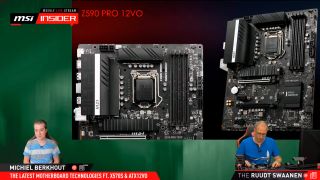
In the latest installment of the MSI Insider show, MSI has revealed the brand's Z590 Pro 12VO motherboard that employs Intel's 10-pin ATX12VO power connector. Besides the motherboard's featureset, the vendor has also shared the benefits of the ATX12VO power connector.
Despite Intel promoting the ATX12VO power connector as far back as last year, the standard hasn't really caught on. There are a handful of motherboards on the market that utilize the ATX12VO specification, but it's far from being mainstream. As its name implies, the ATX12VO only maintains the 12V rail. Therefore, motherboards will have to come with buck converters to translate voltages down to 5V and 3.3V for hardware that still rely on one of the aforementioned voltages.
In addition to improving power efficiency, the ATX12VO power connector is also smaller since it only comes with 10 pins. This is beneficial in compact systems since the footprint is smaller. However, the ATX12VO power connector has yet to prove its worth on ATX motherboards. Take MSI's Z590 Pro 12VO for example. While the motherboard doesn't have that chunky 24-pin power connector, it has gained a 6-pin PCIe power connector and up to three additional 4-pin power connectors. Evidently, the ATX12VO standard does little for cable clutter in a full-sized desktop system, but again, its resides in the power saving.
The Z590 Pro WiFi is the mainstream counterpart of the Z590 Pro 12VO so naturally the MSI representatives used the former for comparison. They took out the wireless module from the Z590 Pro WiFi so that both motherboards are on even grounds. The hosts employed the same Core i9-11900K (Rocket Lake) processor, memory and SSD for both tests. There were a lot of fluctuations in the measurements, and the tests were short so take the results with a grain of salt. For easy comprehension, we've rounded the values to the nearest whole.
MSI Z590 Pro 12VO Power Consumption
| Z590 Pro WiFi | Z590 Pro 12VO | Power Reduction | |
|---|---|---|---|
| System Idle Consumption | 42W | 38W | 10% |
| Average CPU Package Power | 17W | 14W | 18% |
| System Idle Consumption (C10) | N/A | 24W | N/A |
| Average CPU Package Power (C10) | N/A | 8W | N/A |
The Z590 Pro 12VO showed a 10% lower system idle power consumption in comparison to the Z590 Pro WiFi. There was also a 18% reduction in average processor package power.
The MSI representative went inside the Z590 Pro 12VO's BIOS and changed the "Package C State Limit" option from Auto to C10. If you're not familiar with C-states, they are low-power modes that a processor can come into when it's idling. C10 is the deepest state where the chip turns off.
With C10 enabled, the Z590 Pro 12VO dropped its system idle power consumption from 38W to 24W, a 37% decrease. The average processor package power, on the other hand, decreased from 14W to 8W, representing a 43% power saving.
OEMs are held to a stricter environmental standards, which is why you'll likely find the ATX12VO power connection inside a pre-built system. DIY users, on the other hand, don't have to abide by environmental regulations. The ATX12VO standard only strives in idle or low-load scenario, which begs the question on how many of us leave our systems idling at prolonged periods of time. Only time will tell if the ATX12VO ever becomes a widely accepted standard. With the rumor that Intel is allegedly giving the specification a hard push with its next-generation Alder Lake-S processors, the 10-pin power connector may be more common on upcoming LGA1700 motherboards.