EXO Labs' primary project is EXO, an open-source framework for running large language models (LLMs) efficiently across mixed hardware setups. Rather than treating inference as a task bound to a single GPU or accelerator, EXO automatically spreads workloads across whatever devices you have—turning a cluster of desktops, laptops, workstations, servers, tablets, or even smartphones into a cooperative AI mesh. EXO's newest demo combines two of NVIDIA's DGX Spark systems with Apple's M3 Ultra–powered Mac Studio to make use of the disparate strengths of each machine: Spark has more raw compute muscle, while the Mac Studio can move data around much faster. EXO 1.0, currently in early access, blends the two into a single inference pipeline, and it apparently works shockingly well .


In EXO's benchmark with Meta's Llama-3.1 8B model, the hybrid setup achieved nearly a threefold speedup over the Mac Studio alone — matching the DGX Spark's prefill speed while keeping the M3 Ultra's quick generation time. The result is a 2.8× overall gain, and that was with an 8K-token prompt on a relatively modest 8B model. Longer prompts or larger models should see even greater gains.
This kind of "disaggregated inference" isn't exactly a novelty, but it's still very clever. It hints at a future where AI performance scales not by buying one massive accelerator, but instead by more intelligently orchestrating the hardware you already have. NVIDIA seems to agree: its upcoming Rubin CPX platform will use compute-dense Rubin CPX processors for the context-building prefill stage while standard Rubin chips with huge HBM3e memory bandwidth handle the decode stage—he same principle EXO is already demonstrating on off-the-shelf hardware.
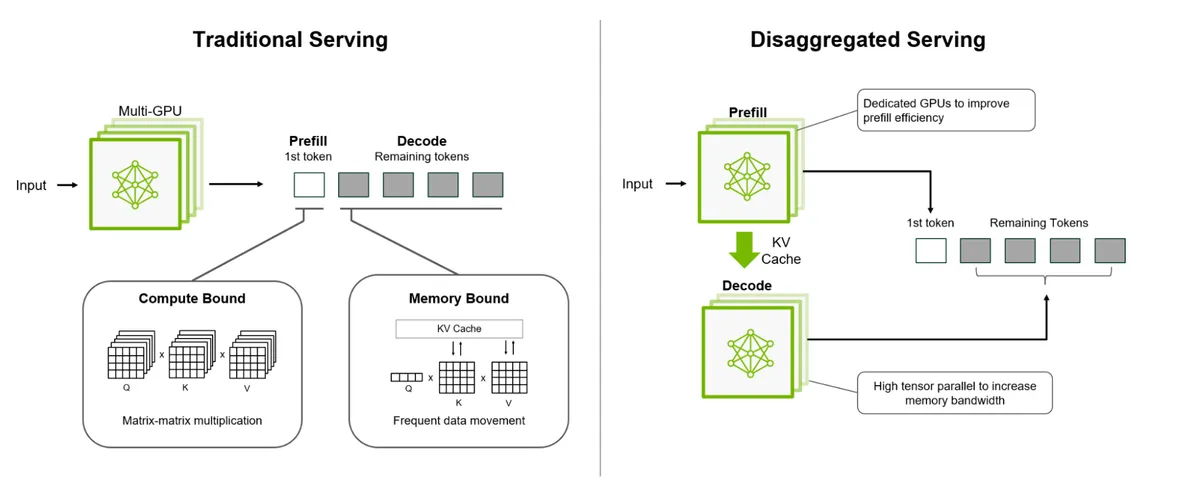
EXO's early-access release is still in the experimental stages. The current open-source version (0.0.15-alpha) dates back to March 2025, and the full 1.0 build — with automated scheduling, KV streaming, and heterogeneous optimizations — isn't public yet. It's not plug-and-play software for consumers, at least not yet; for now, it's a research-grade tool proving that disaggregated inference can deliver real gains.
Even so, it's an exciting proof of concept. By making intelligent use of mixed hardware, EXO shows that high-performance AI doesn't have to be monopolized by data centers . It's enough to make you wonder about the potential of the devices sitting around your office.

Follow Tom's Hardware on Google News , or add us as a preferred source , to get our latest news, analysis, & reviews in your feeds.