Sapphire wants more control over card designs, TOXIC GPUs may return

In an interview with Hardware Unboxed, Ed Crisler (NA PR Manager at Sapphire Technology) says board partners should get more room to design their own graphics cards, instead of working inside tight rules set by the chip maker.
Sapphire is an AMD-exclusive board partner, and unlike their competitors such as ASUS, Gigabyte and MSI, its market presence and offering have been very much limited to what AMD has to offer. Although their call is threfore directed at AMD, it should also apply to NVIDIA board partners who are very limited in what they can do with the cards (with some exceptions).
Ed’s preferred approach is straightforward. AMD would supply the GPU and memory, set the requirements needed for the card to work correctly, then let partners handle the rest. He says that would enable real differentiation between models, rather than many cards feeling too similar.
Sometimes I really wish the chip makers would get out of the way and let us partners just make our cards. Give us the chip. Give us the RAM. Tell us what we have to provide to make it work with the board. And then let us make the cards. Let us have our fun. Let us go nuts. Let there be real differentiation. Sometimes it feels like this market becomes too too much the same.
— Ed Crisler, Sapphire
On the same GPU tier, he says performance differences between the lowest and highest factory-overclocked cards can be around 1.5% to 2% , which is often within margin of error. That shifts the buying decision toward cooler construction, PCB design, power delivery, noise, and support, but those areas are harder for reviewers and buyers to quantify than FPS charts.
He also argues that tight control limits what partners can do with quality-of-life features and industrial design. Partners can still change coolers and layouts, but he wants fewer constraints so they can push further and make each model stand out.
Sapphire TOXIC series on hold until they can go ‘nuts’
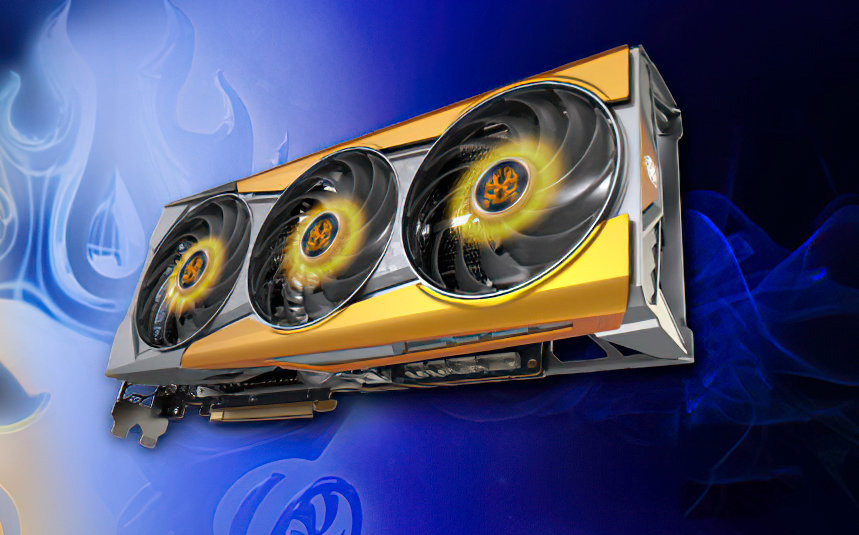

Radeon RX 6900X TOXIC Series, Source: SAPPHIRE
On the “Toxic” line, he says Sapphire considers bringing it back every generation, but it has to be an extreme product. It would need higher clocks, heavier cooling, and more visual flair than Nitro+.
The problem is cost. A hypothetical top-binned card with a big overclock, near-silent cooling, and upgraded power delivery could add around $150 to the price, and Sapphire has to judge whether enough buyers would pay that to justify development and production.
Toxic is not an exception, most board partners have mostly abandoned the ultra-OC segment. The only cases that this wasn’t true in current-gen series were GALAX RTX 5090D HOF with dual 12V-2×6 connectors and ASUS RTX 5090 MATRIX with 800W mode thanks to the extra GC-HPWR power connector.
On RX 9070 NITRO+ 12V-2×6 power connector: even if they fix the connector, it will still carry stigma
Ed Crisler says Sapphire used the 12V-2×6 connector on its card because it let them hide the plug and keep the build looking clean, which matters for the Nitro lineup. He also says the company has seen three known cases of connector-related issues, and in each case he attributes the issue to an adapter cable, not the card’s connector , the card itself, or the power supply.


On whether Sapphire will keep using that connector, he says he does not know, and that the decision sits with engineering and marketing. His personal view is that the connector, when implemented properly and used at lower power levels around 300 to 350 W, is reasonably safe if it is fully seated and not subjected to tight bends or strain.
He also says the standard still needs a redesign, and that the larger problem may be stigma. Even if the connector is improved, he expects the reputation to linger and influence buyer perception, so future use is not just a technical decision.
Ed touches on many interesting topics, so make sure to see the video yourself.
Source:
