Please note that this post is tagged as a rumor .
Intel Core i9-12900K with 3.9/5.3 GHz clock speeds
Qualification samples of Intel Alder Lake-S processors are already available for a few weeks now. It appears that the first information on these samples is slowly beginning to leak.
According to a post on NGA.cn forums, a qualification sample of the flagship “Alder Lake-S” CPU, the Core i9-12900K featuring 8 big (high-performance) and 8 small (high-efficiency) has a base clock of 3.9 GHz and a boost clock of 5.3 GHz. It is nowhere near the rumored 5.5 GHz but still higher than the reported 5.0 GHz, a leaker claims.
The post also covers possible configurations of the 12th Gen Core series CPUs, including 12700K with 8C+4c configuration and 12600K with 6C+4c specs. He continues to provide benchmark results for Cinebench R20 multi-core test:
- Core i9-12900K (ES2): 9300+
- Core i9-12900K (QS calculated): 11300+
- Core i7-12700K (QS?): 9500+
- Core i5-12600K (QS?): 7400+
With a score above 11K points, the Core i9-12900K would outperform AMD’s 16-core Ryzen 9 5950X processor which scores around 10400 points. However, this score was calculated based on a higher turbo clock in comparison to 9300 points scored by the 12900K engineering sample.
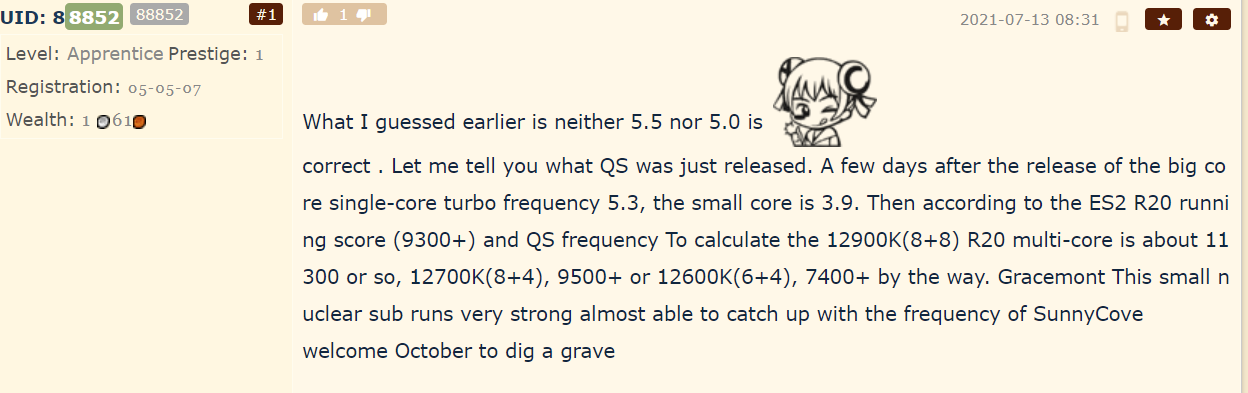
Information on Intel Alder Lake qualification samples, Source: NGA (machine translation)
Just a day ago another leaker (YuuKi_AnS) shared early information on all known mobile Alder Lake Engineering Samples (ES) bugs. He also confirmed that in order to benefit from Intel’s Hybrid Technology (heterogeneous architecture), the latest Windows 11 operating system is required.
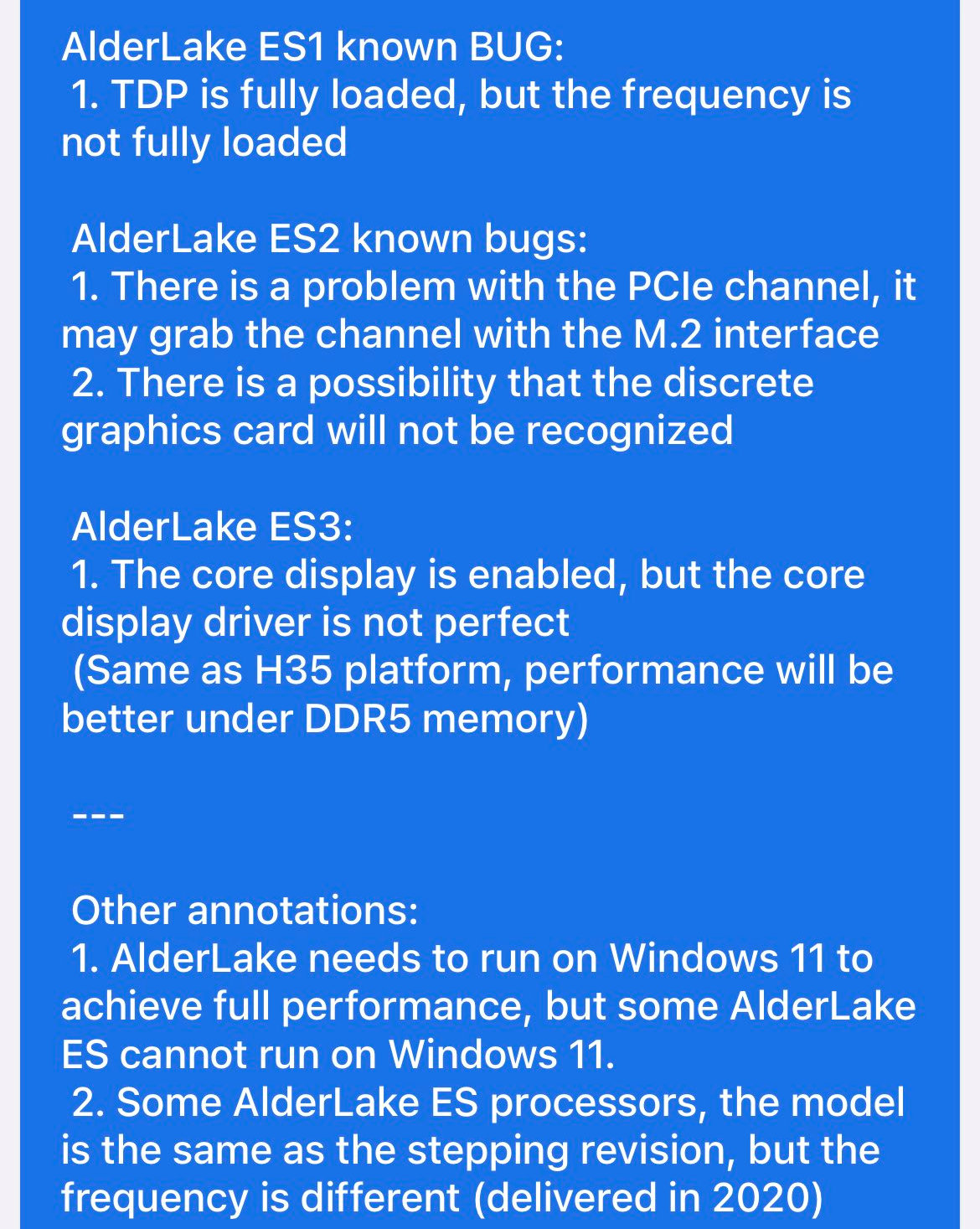
Information on Intel Alder Lake engineering samples, Source: YuuKi_AnS
Intel 12th Gen Core desktop series codenamed Alder Lake-S are now set to launch in the fourth quarter, with a possible announcement already in the third. These are Intel’s first mainstream processors based on 10nm Enhanced SuperFin node and the first to support DDR5 memory, although the architecture will be compatible with DDR4 standard as well. Next-gen motherboards will also support the PCIe Gen5 standard, which means that Intel will be skipping from PCIe Gen3 to Gen5 in less than a year.
| Intel Mainstream Desktop CPU Series | |||||
|---|---|---|---|---|---|
| VideoCardz.com | Rocket Lake-S | Alder Lake-S | Raptor Lake-S | Meteor Lake-S | Lunar Lake-S |
| Launch Date | March 30, 2021 | Q3/Q4 2021 | Q4 2022 | 2023 (?) | 2024 (?) |
| Fabrication Node | 14nm | 10nm Enhanced SuperFin | 10nm Enhanced SuperFin | 7nm Enhanced SuperFin | TBC |
| Core µArch | Cypress Cove | Golden Cove + Gracemont | Raptor Cove + Gracemont | Redwood Cove + Gracemont (?) | TBC |
| Graphics µArch | Gen12.1 | Gen12.2 | Gen12.2 | Gen 12.7 | Gen 13 |
| Max Core Count | up to 8 cores | up to 16 (8+8) | up to 24 (8+16) | TBC | TBC |
| Socket | LGA1200 | LGA1700 | LGA1700 | TBC | TBC |
| Memory Support | DDR4 | DDR4/DDR5 | DDR5 | DDR5 | DDR5 |
| PCIe Gen | PCIe 4.0 | PCIe 5.0 | PCIe 5.0 | PCIe 5.0 | PCIe 5.0 |
| Intel Core Series | 11th Gen Core-S | 12th Gen Core-S | 13th Gen Core-S | 14th Gen Core-S | 14th Gen Core-S |
| Motherboard Chipsets | Intel 500 (Z590) | Intel 600 (eg. Z690) | Intel 700 (eg. Z790) | TBC | TBC |
Source: NGA.cn via @9550pro , @yuuki_ans