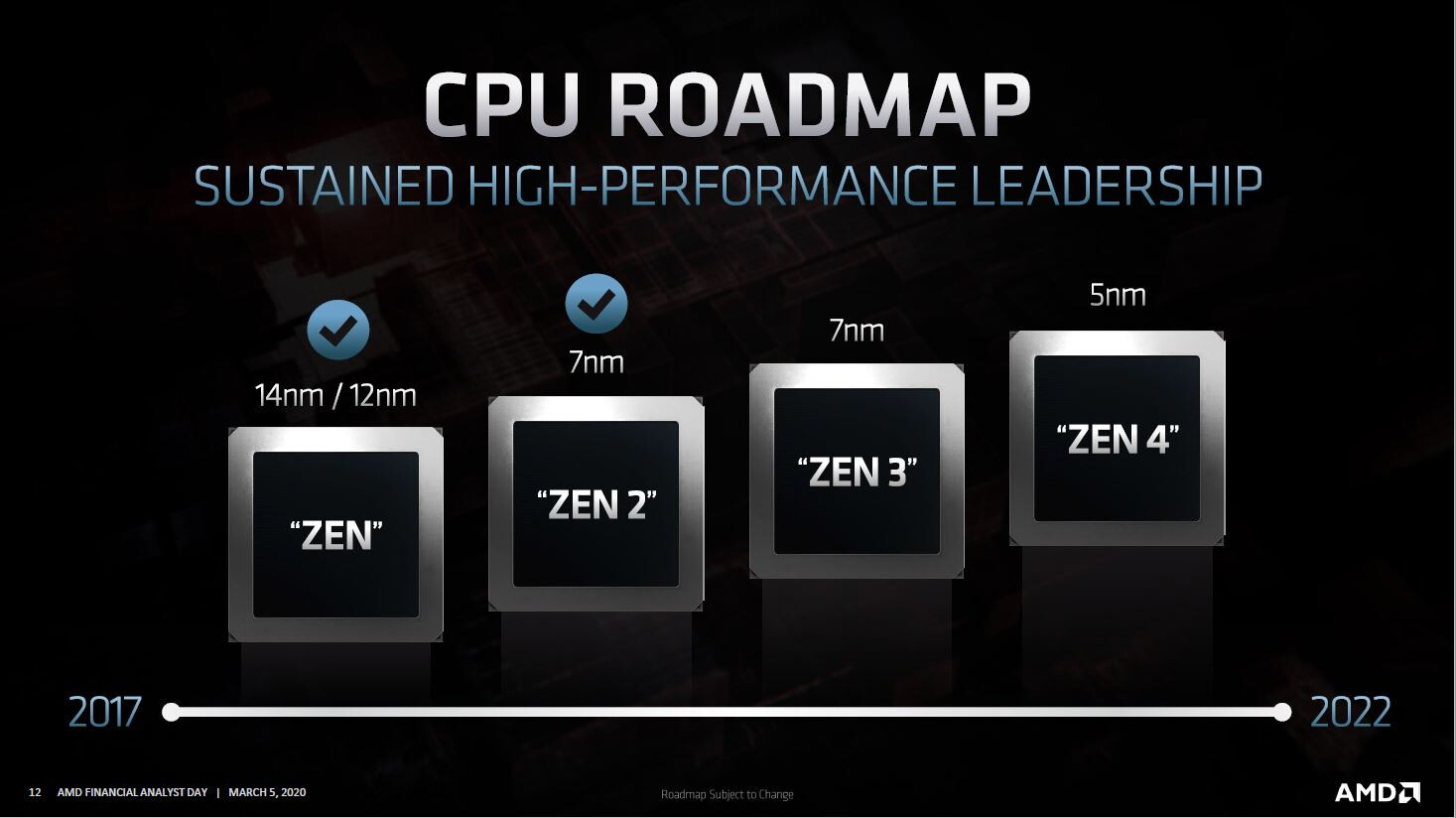
For starters, "Zen 4" continues on AMD's trajectory of adding IPC gains with each generation. Secondly, "Zen 4" will leverage the advanced 5 nm silicon fabrication process, which should significantly increase transistor densities over even the most advanced iterations of 7 nm, such as 7 nm EUV. "Zen 4" comes out roughly the same time as the RDNA3 and CDNA2 graphics architectures, and AMD's 3rd generation Infinity Fabric interconnect that enables exascale supercomputers thanks to coherent unified memory and vast shared memory pools between CPUs and compute GPUs. Elsewhere in the roadmap, we see AMD announcing that its upcoming "Zen 3" microarchitecture and its enterprise implementation, the EPYC "Milan" processor, will release only toward the end of 2020. This would give EPYC "Rome" close to 6 calendar quarters of market leadership.