Intel's CPU journey has been a roller coaster this decade, from the highs of Alder Lake and Lunar Lake to the lows of Arrow Lake. While the company has been strong in certain departments each generation, the one department where Intel has really managed to show its expertise is offering a chip that not just uses a hybrid architecture approach but also mixes and matches several IPs together. It all started with Alder Lake, got refined in Raptor Lake, built into a singular SoC with Meteor Lake, tested for higher-efficiency with Lunar Lake, and then for higher-performance with Arrow Lake. All of these iterations were done to create the one perfect chip that does it all, and that is Panther Lake.
Earlier this month, all PC vendors, including Intel, showcased their next-gen SoCs. And they showed how they are better than their competitiors previous or current-gen offerings. None of the chips launching this year have yet been compared against one another, and Intel launching Panther Lake first shows that they are confident that they can handle the impending war.
Panther Lake has a lot to prove; it has to prove that Intel's 18A process node is a viable technology for future products and that the blue team is on the right path. It has to prove that Intel can deliver a good balance of performance and efficiency in a singular package rather than having two different versions like Lunar Lake and Arrow Lake, it has to prove that Intel's graphics division is still worth a shot, not just at iGPUs, but also at dGPUs, and it has formidable opponenents lined up this year such as AMD's Ryzen AI 400, and Qualcomm's Snapdragon Elite X2.
Panther Lake also comes at a time when the entire PC market is in the tight grips of the memory crisis, which has led to prices skyrocketing for all consumer-aimed products, including PCs and laptops. While everyone is riding the "AI" craze, Intel's Panther Lake launch shows that they are still focused at the client market, and with the amount of showtime that Panther Lake recieved, which was almost the entirety of it, it looks like Intel at least wants consumers to enjoy a good PC experience, and not just back up their products with the new beloved buzzword of the tech industry.
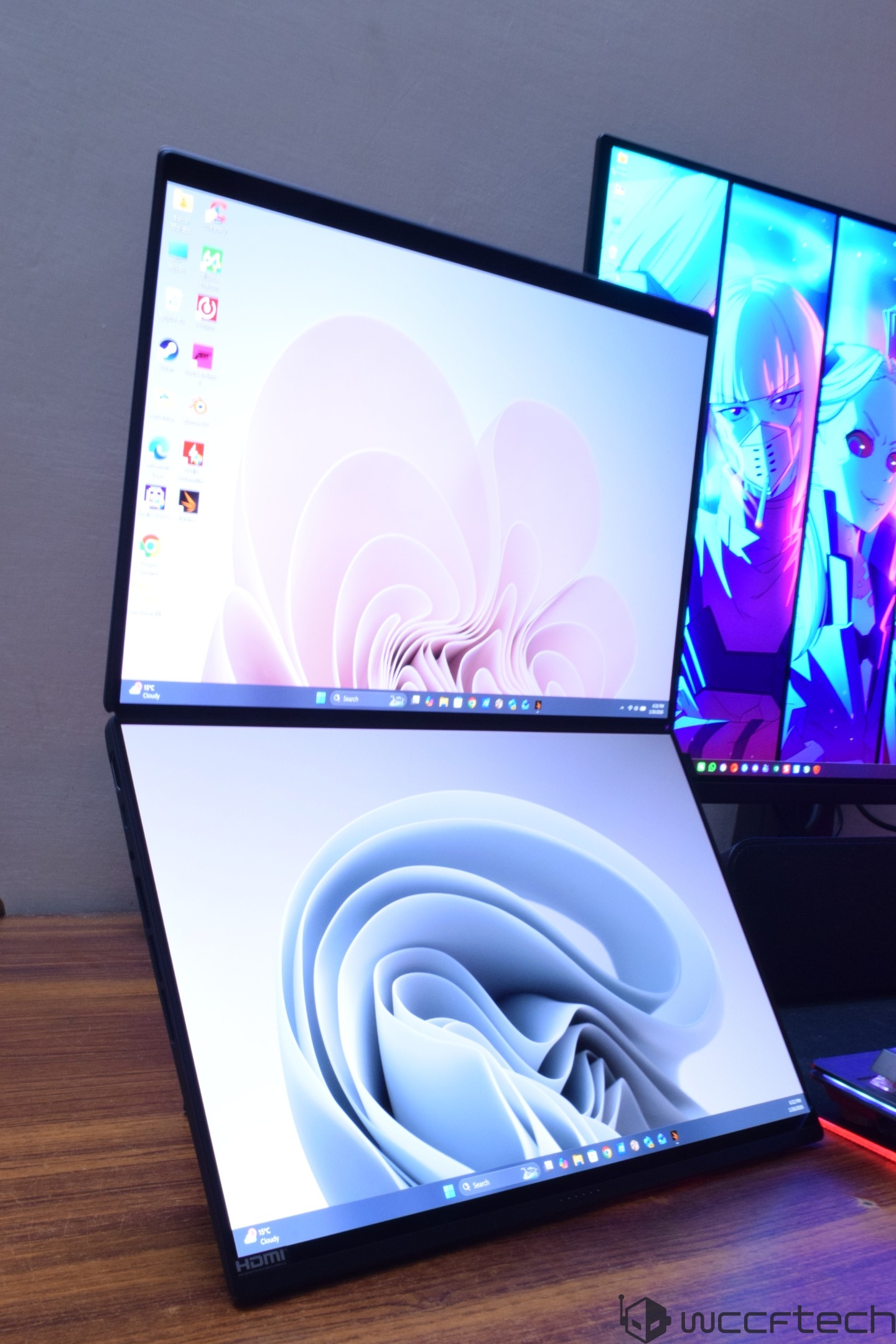
So today, Intel is launching its Panther Lake "Core Ultra Series 3" processor family. These chips feature brand new CPU cores, GPU cores, NPU cores, many new technologies which we highlighted in our deep-dive here, and then some more. For this testing, Intel provided us with the ASUS Zenbook Duo 2026 (UX8407), a high-end device featuring the flagship Core Ultra X9 388H processor with Arc B390 graphics.
In terms of specifications, the ASUS Zenbook Duo "UX8407" laptop is equipped with the Intel Core Ultra X9 388H CPU. This is the flagship processor within the Panther Lake-H mobile lineup and has a lot to talk about, so let's get started.
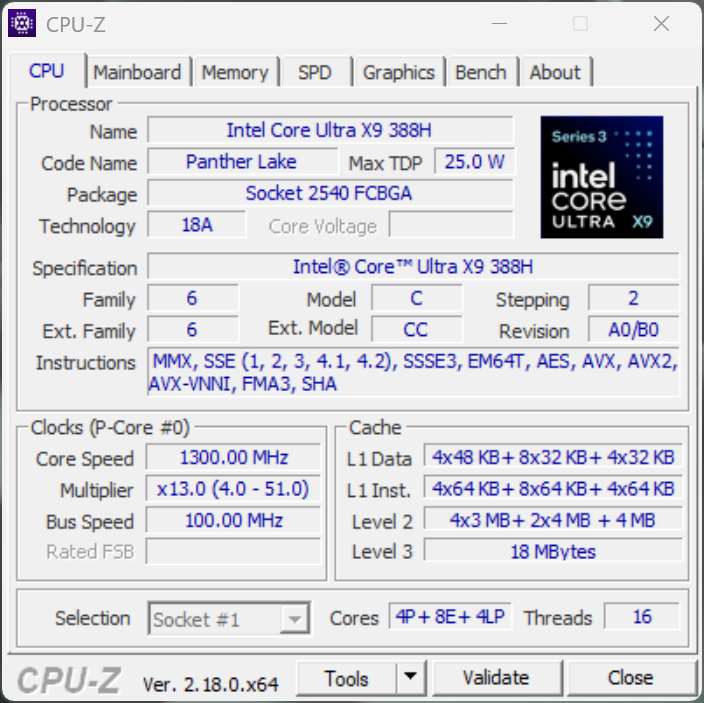
The Intel Core Ultra X9 388H CPU features 16 cores in total with 16 threads. These are a combination of 4 P-Cores, 8 E-Cores, and 4 LPE cores based on the Cougar Cove P-Core and Darkmont E-Core architecture.
The CPU has a base frequency of 2.1 GHz and boosts up to 5.1 GHz on the P-Cores, while the E-Cores have a base frequency of 1.6 GHz and a boost frequency of 3.8 GHz. The LPE cores clock in at 1.6 GHz base and 3.7 GHz boost clocks. The chip features an 18 MB L3 cache, 21 MB L2 cache, and has a TDP rating of 25W at the base and 80W MTP (Maximum Turbo Power). The chip can also be configured down to 15W as its minimum assured power rating (shouldn't be mistaken with idle power).
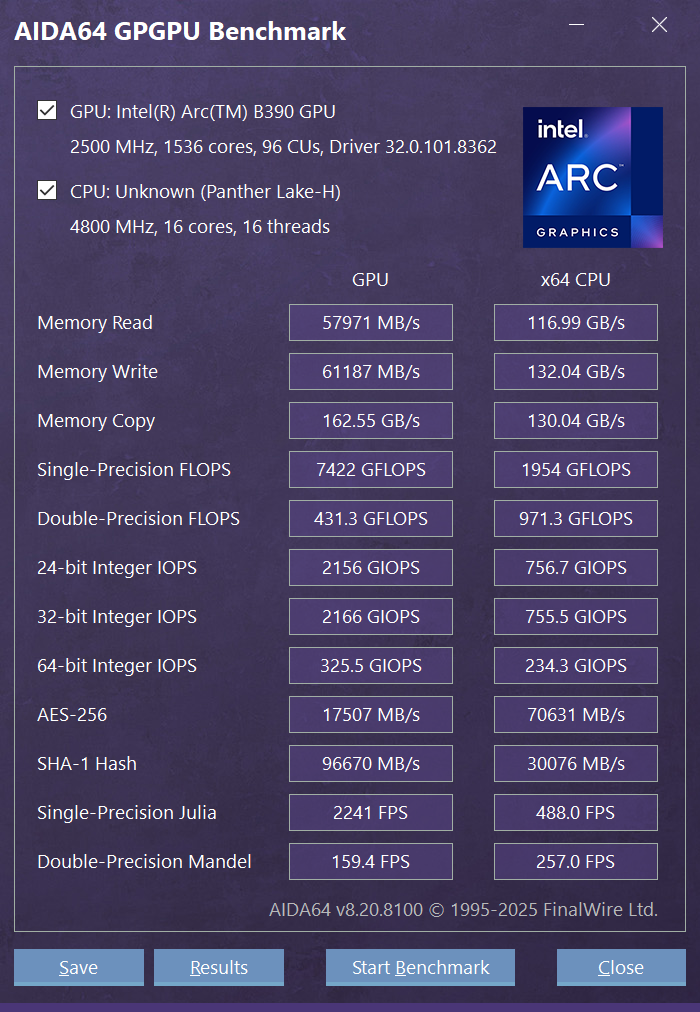
For the iGPU, Intel is using an upgraded version of its Battlemage architecture known as Xe3. The Intel Core Ultra X9 388H is configured with the Arc B390 GPU, which offers 12 Xe cores that clock up to 2.50 GHz and feature a maximum TOPS (INT8) rating of up to 120. The iGPU supports all the latest APIs and AI Frameworks, including newer Ray Tracing Units and even support for XeSS MFG, which is far better than the DP4a model on the older Alchemist-based iGPUs.
On the NPU side, the Intel Core Ultra X9 388H is equipped with an updated NPU5, which offers a peak TOPS (INT8) of 50 and supports all the latest AI frameworks such as OpenVINO, WindowsML, DirectML, ONNX RT & WebNN.
Intel Core Ultra Series 3 CPU Lineup Specs (Official):
| CPU Model | P-Cores (Cougar Cove) | E-Cores (Darkmont) | LP-E Cores (Skymont) | CPU Clocks (Max) | Xe3 iGPU Cores | TDP (Base / MTP) |
|---|---|---|---|---|---|---|
| Core Ultra X9 388H | 4 | 8 | 4 | 5.1 GHz | 12 @ 2.50 GHz | 25-80W |
| Core Ultra 9 386H | 4 | 8 | 4 | 4.9 GHz | 4 @ 2.50 GHz | 25-80W |
| Core Ultra X7 368H | 4 | 8 | 4 | 5.0 GHz | 12 @ 2.50 GHz | 25-80W |
| Core Ultra 7 366H | 4 | 8 | 4 | 4.8 GHz | 4 @ 2.50 GHz | 25-80W |
| Core Ultra 7 365 | 4 | 0 | 4 | 4.8 GHz | 4 @ 2.50 GHz | 25-55W |
| Core Ultra X7 358H | 4 | 8 | 4 | 4.8 GHz | 12 @ 2.50 GHz | 25-80W |
| Core Ultra 7 356H | 4 | 8 | 4 | 4.7 GHz | 4 @ 2.45 GHz | 25-80W |
| Core Ultra 7 355H | 4 | 0 | 4 | 4.7 GHz | 4 @ 2.50 GHz | 25-55W |
| Core Ultra 5 338H | 4 | 4 | 4 | 4.7 GHz | 10 @ 2.40 GHz | 25-80W |
| Core Ultra 5 336H | 4 | 4 | 4 | 4.6 GHz | 4 @ 2.30 GHz | 25-80W |
| Core Ultra 5 335 | 4 | 0 | 4 | 4.6 GHz | 4 @ 2.45 GHz | 25-55W |
| Core Ultra 5 332 | 2 | 0 | 4 | 4.4 GHz | 2 @ 2.30 GHz | 25-55W |
| Core Ultra 5 325 | 4 | 0 | 4 | 4.5 GHz | 4 @ 2.45 GHz | 25-55W |
| Core Ultra 5 322 | 2 | 0 | 4 | 4.4 GHz | 2 @ 2.30 GHz | 25-55W |
With the internals of the CPU covered, let's talk about the rest of the specifications. First, we have the memory, which comes in the form of 32 GB of LPDDR5X. These are 64-bit DRAM modules that are rated at 9600 MT/s speeds, and this is soldered memory, so you'd better keep in mind the configuration you are purchasing based on your demands. Storage includes a 1 TB SSD.
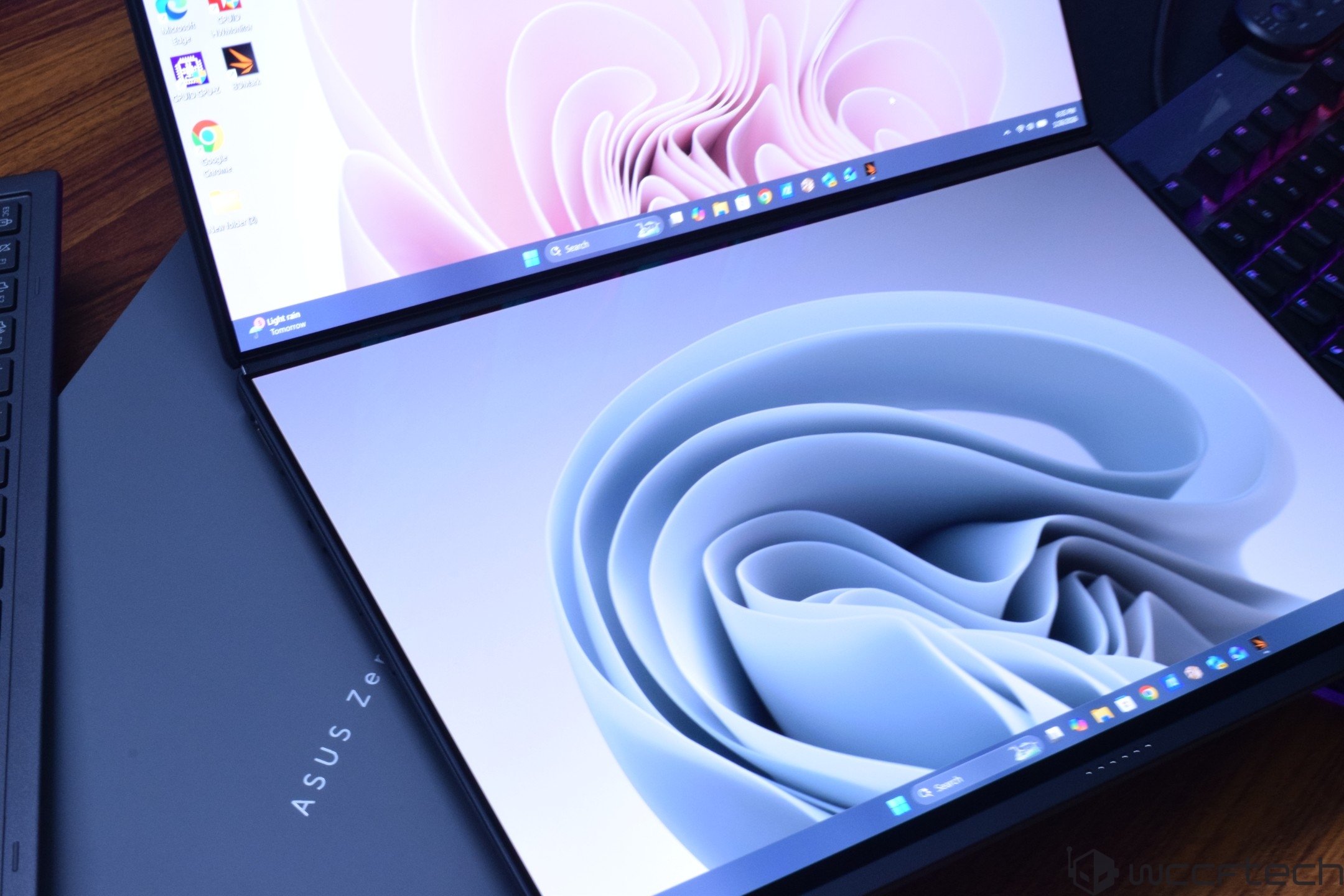
Being a dual-screen laptop, the ASUS Zenbook Duo 2026 features two 14" and 3K (2880x1800) OLED panels with a 16:10 aspect ratio, a 144Hz refresh rate (0.2ms), 500nits of peak brightness, and Display HDR TrueBlack 1000 certification. The screen-to-body ratio is 93%. ASUS has also developed a new hinge design that is better and more durable than the previous iterations. The new design features a 5% smaller footprint, 8.28mm thin, & weighing just 1.65 kg. The dual fan configuration enables up to 45W of cooling.
The laptop comes with a 99Whr battery and is bundled with a 100W AC Ultra Mini adapter. IO includes dual Thunderbolt 4 ports, HDMI 2.1, USB 3.2 Gen2 Type-A ports, 6 speakers, WIFI7. There's also a magnetic keyboard that docks over the second screen and can also be used undocked wirelessly with Bluetooth. It has its own charging and can easily last several days without requiring a charge.
We start by comparing the 3DMark CPU Profile tests, where the Intel Core Ultra X9 388H offers a 14% boost in single-thread and an impressive 24.4% boost in multi-core tests despite featuring the same number of cores (16 vs 16). The chip offers twice the core/thread count as Lunar Lake, and sips a similar amount of power while offering almost double the performance.
0
4000
8000
12000
16000
20000
24000
10449
10242
6492
4327
2306
1207
8396
8478
6576
4236
2140
1061
6348
6149
5276
3664
2202
1157
5751
5736
5756
3708
2085
1139
The X9 388H reaches new heights in terms of memory and cache performance on AIDA64. With its ultra-fast 9600 MT/s LP5X solution, it not only delivers higher memory bandwidth but also offers much lower latency than the past-gen offerings, dropping in the sub-90ns range.
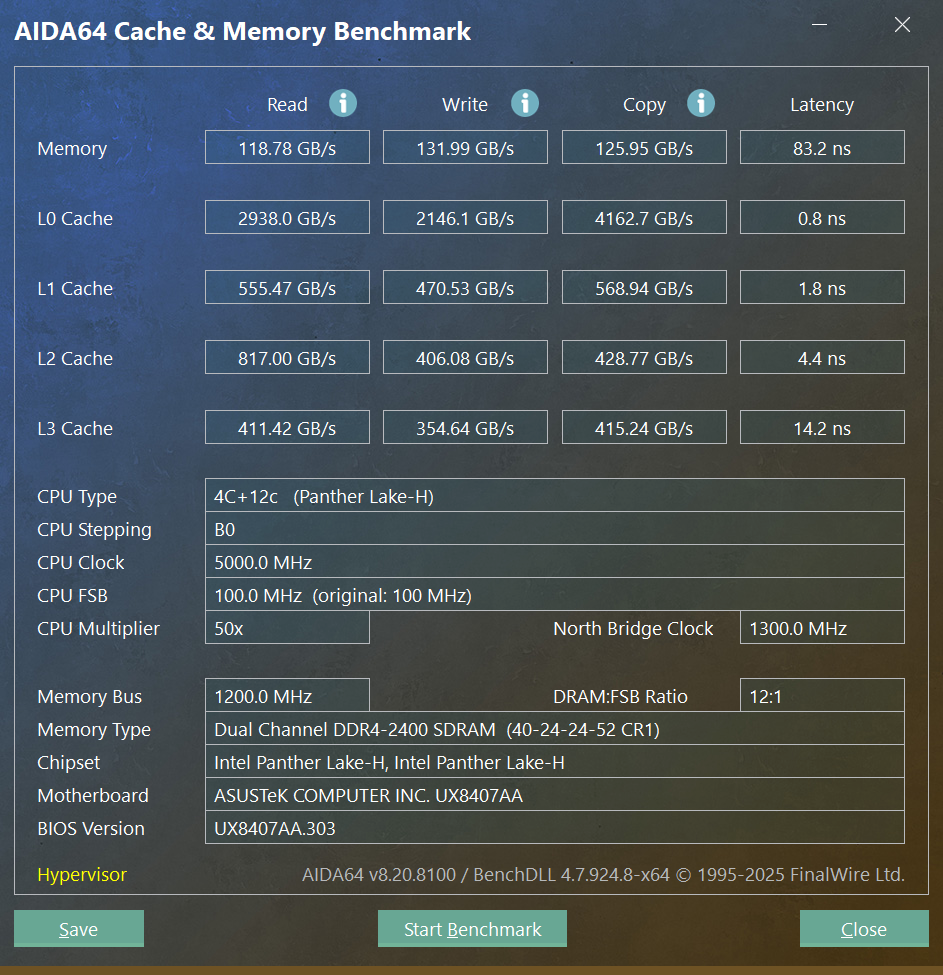
0
21999
43998
65997
87996
109995
131994
118780
131990
125950
83.2
For Blender, the Intel Core Ultra X9 388H "Panther Lake" CPU delivers a 23% boost over the 285H in Classroom render, a 35.5% boost in Junkshop render, and a stunning 47.5% boost in Monster render.
In CPU-Z, the single-core score takes a hit and is only slightly faster than the Core Ultra 7 258V Lunar Lake chip, but in multi-threading, the X9 388H takes the lead over the 285H by 4%.
0
2000
4000
6000
8000
10000
12000
For Cinebench, Intel's Panther Lake secures the top spot in single-core performance with 130 points. In the multi-threaded test, it surpasses the 285H by 43% and stomps Lunar Lake with a 2.24 lead. This is highly impressive for Panther Lake.
0
400
800
1200
1600
2000
2400
Geekbench 6 is the same story with the Intel Core Ultra X9 388H securing top place in the single-core tests, and offering a 11.1% boost over the 285H. This is faster than Arrow Lake performance with power draw similar to Lunar Lake. Loving it!
0
4000
8000
12000
16000
20000
24000
Lunar Lake surprised us with its strong Office task performance in Procyon, and Panther Lake extends this lead, offering top-tier power.
0
2000
4000
6000
8000
10000
12000
In the WinRAR compression test, the Core Ultra X9 388H is 28% faster than the Arrow Lake 285H, and more than double the performance of the Lunar Lake 8-core chip.
0
5000
10000
15000
20000
25000
30000
Next up, we have our AI benchmarks for the latest Intel and AMD CPUs. First up, we have the Geekbench AI benchmarks, where the Intel Core Ultra X9 388H offers anywhere from 20% to 50% boost in the ONNX tests. Running the same tests on the GPU and NPU results in an even higher performance uplift versus the AMD XDNA 2 architecture and Intel's prior generation NPUs on Lunar Lake and Arrow Lake chips. The full results can be seen below:
0
2000
4000
6000
8000
10000
12000
0
5000
10000
15000
20000
25000
30000
0
10000
20000
30000
40000
50000
60000
For UL Procyon, we again see Intel's Core Ultra X9 388H and its various AI accelerators, such as the NPU and the GPU, offering better performance capabilities than the Ryzen AI offerings.
0
500
1000
1500
2000
2500
3000
0
400
800
1200
1600
2000
2400
0
500
1000
1500
2000
2500
3000
Now we are going to look at the GPU performance, and before we present to you the gaming numbers, we first have to see how the performance fares in synthetic benchmarks. For this purpose, we first want to outline the single-precision FLOPs each iGPU offers. Intel's Battlemage, Alchemist+, and AMD's RDNA 3.5 are entirely different architectures, and despite the FLOPS of the Radeon iGPU being higher, it doesn't necessarily mean that the Radeon iGPU will be faster.
But with that said, the following is how the two chips compare:
0
2000
4000
6000
8000
10000
12000
In 3DMark Speed Way, a purely raytracing benchmark, we see that the Arc B390 iGPU is the fastest among the bunch.
0
200
400
600
800
1000
1200
For 3DMark Steel Nomad, we get to see our first non-RT performance of the Intel Arc B390 iGPU, and here, it delivers a massive 72.6% boost over the 8 Xe2 iGPU for Lunar Lake, and a 2.71x boost over the Radeon 880M.
0
400
800
1200
1600
2000
2400

In 3DMark Port Royal, the Intel Arc B390 iGPU offers a 2.47x lead over the Radeon iGPU. This is a ray tracing-heavy benchmark and goes on to show that the results we saw in the Speed Way test are an anomaly, something that you will also notice in the gaming tests. It is also 75% faster than the Arc 140V iGPU.
0
700
1400
2100
2800
3500
4200

In 3DMark Time Spy, Intel's Arc B390 iGPU once again leads with a 2.25x higher graphics score than its competitor, and a 63% boost over its predecessor.
0
4000
8000
12000
16000
20000
24000

For Fire Strike, Intel offers great performance even on DX11 APIs, which is a good showcase, as many games still run on DX11. We can also see the CPU performance here, which is up 21.1% versus the 285H.
0
7000
14000
21000
28000
35000
42000
Lastly, we have 3DMark Night Raid, where Intel scores another 60%+ lead over the Arc 140T and more than 2x over the AMD RDNA 3.5 iGPU.
0
13334
26668
40002
53336
66670
80004
A major factor of today's laptops is their power consumption, and in that regard, the Intel Core Ultra X9 388H CPU has a higher out-of-the-box power profile set at 45W versus the 28W of AMD's Ryzen AI 9 365. Both laptops are set to their "Balanced" preset by default, but you can opt into the "Performance" mode through the MyASUS application. These are just power profiles, and actual power consumption can be very different.
In our case, the Panther Lake laptop almost never went above 40W, and only hit its peak power of 69W in stress tests. The gaming numbers show that the chip is very efficient and is on par with other chips of the same category while delivering some big performance uplifts.
Panther Lake does get a bit hotter than the other chips. This thin and light design from ASUS is rated at 45W, so we did see thermal throttling in AIDA64's stress test. That wasn't the case while gaming, but even then, the laptop gets warm around 70-80 °C.
The Intel Panther Lake CPUs do deliver some amazing battery timings with the Office Productivity Suite test in UL Procyon, offering over 22 hours worth of time versus AMD's 12-13 hours. For gaming tests, you can get up to 4 hours of battery time with the Arc B390, with the brightness set to 60%, while the Radeon 880M ends up closer to 3 hours. Furthermore, for video playback and lightweight tasks, the laptop can even offer over 30 hours of battery time with the second screen disabled, which is superb.
0
400
800
1200
1600
2000
2400