How to Tarnish Platinum: Sell It as Xeon 9200
in 2019, Intel announced its Cascade Lake family of enterprise processors, and sitting at the top of the stack was the Cascade Lake-AP family: a quartet of parts that changed Intel’s paradigm for high-end processors. This hardware used two of Intel’s large 28-core silicon dies in the same package, providing a weakly linked dual-processor system in a single package, built to look like a single processor up to 56 cores and 12 memory channels with up
Imagination and Apple Renew IP Licensing Agreement

Today Imagination Technologies has announced that Apple has signed a new multi-year licensing with the company, giving the Cupertino company continued access to Imagination’s IP.
AnandTech Year In Review 2019: Solid State Drives
In 2019, flash memory prices have leveled out and have even crept back upward a bit, and new technologies have been slow to roll out, although we are currently on the cusp of a PCIe 4.0 revolution. The pace of R&D is still keeping up, so as we move into 2020, we should start seeing plenty of interesting developments build on the backbone of 2019 designs. Here is our Year In Review 2019 for SSDs.
Taking Immersion in Gaming One Step Further: Full PC Immersion with the CoolBitts ICEbox
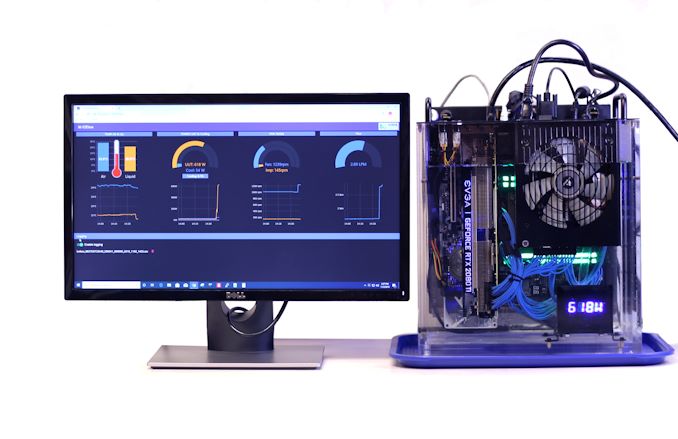
One of the news items that went under the radar at Supercomputing was from CoolBitts. The company focuses on fully immersed systems whereby the CPU, GPU, and all the components are put into a non-conductive liquid. There are two types of immersive systems: two phase, where the liquid turns to a gas on heating and then condenses back into a liquid, or single phase systems that rely on a pump and a radiator to help move the liquid. This is the latter, and if you’ve ever heard
Kioxia: 3D Stacked Storage Class Memory, like 3D XPoint, Isn’t the Future
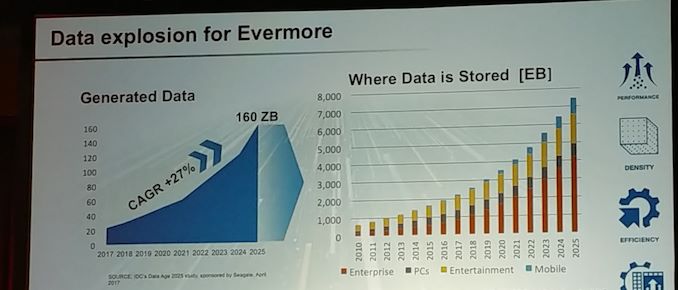
One of the key battlegrounds of the next decade is going to be storage: density, speed, and demand. Naturally all the major players in the space want to promote their own technologies of that of their competitors, and Kioxia (formerly Toshiba Memory) is no different. This year during their plenary talk at the International Electron Devices Meeting (IEDM) the company set forth its promotion of its BiCS flash product family, as well as its upcoming XL-Flash technology. What was interesting during this talk is a graph
This Smartphone Fingerprint Sensor Gets Two Thumbs (Up)

One of the cool features that came out of Qualcomm’s Tech Summit last month was its new fingerprint sensor. This one goes above and beyond anything I’ve seen before – where fingerprint sensors used to be small and have a sensing angle no bigger than a sesame seed, Qualcomm’s new 3D Sonic Max sensor is massive.
For Explosive Environments: Dell Latitude 7220EX Rugged Extreme Windows Tablet
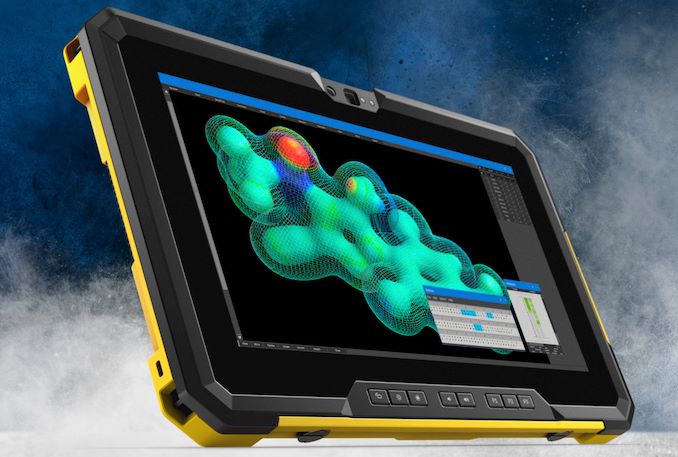
With industry and research, computers are needed everywhere, including various harsh environments for which companies develop ruggedized PCs, tablets, or smartphones. But there are also hazardous environments that not only pose danger to devices for whatever reasons, but which are potentially explosive because they are filled with gases, vapors, combustible gases, and other flammable components. The use of regular electronics in such environments is dangerous, but Dell has developed its Latitude 7220EX Rugged Extreme Tablet just for this purpose.
The Dell Latitude 72
An Interview with AMD’s CTO Mark Papermaster: ‘There’s More Room At The Top’
On the back of a very busy 2019, AMD is gaining market share and is now a performance leader in a lot of CPU segments. The company has executed well not only with a good product but also at a time when its main competition is having manufacturing and production issues, which means AMD is ripe to push boundaries, gain market share, and make noise with a lot of wins. This year AMD’s Ryzen 3000 CPUs and EPYC Rome CPUs both have the new Zen 2
TureMetal Builds a Fanless 32-Core EPYC PC with an RTX 2070
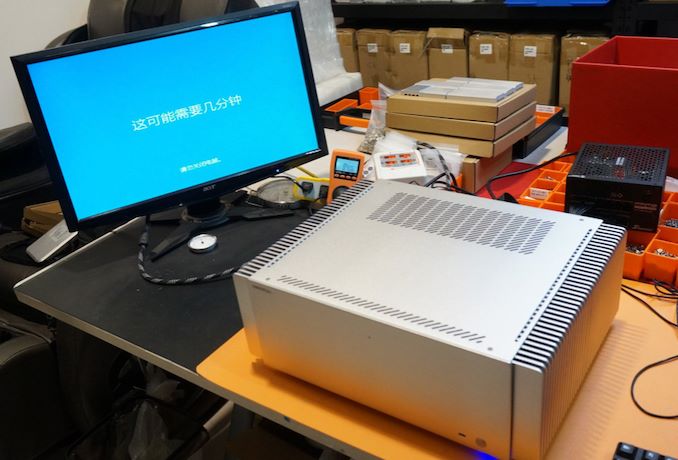
Turemetal, a maker of cases for fanless PCs, has published photos of a passively cooled system featuring an AMD EPYC processor and an NVIDIA GeForce RTX 2070 graphics card. The computer uses numerous custom components, with the founder of TureMetal stating that this is a custom build for a specific customer, although it uses one of their standard fanless PC cases.
AnandTech Year In Review 2019: Lots of CPUs
Throughout 2019, we’ve had quite the reverse of performance when it comes to the competitiveness of the modern performance-oriented desktop processor. This year we’ve seen AMD introduce its Zen 2 processor designs, offering up to 16 cores for mainstream use cases, and matching if not beating Intel in raw clock-for-clock performance. In a similar vein, AMD’s Rome CPUs offer up to 64 cores per socket on the server side, where Intel can only offer 28