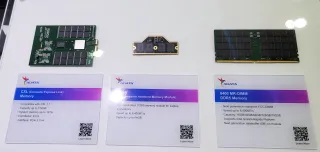
A number of all-new memory module standards targeting different applications emerged in the last couple of years. Introduction of new modules represents challenges and opportunities for module makers, so Adata decided to show that it is ready to produce CAMM, CXL, and MR-DIMM modules for client and server applications at Compute 2023.
The Compression Attached Memory Module (CAMM) specification is to be finalized only sometimes in the second half of 2023, but Adata is already demonstrating a sample at the trade show. It is noteworthy that Adata's CAMM module looks quite a bit different from the one used by Dell today , but this is not particularly surprising as Dell uses some sort of pre-JEDEC-approved modules.

For those not familiar, CAMMs are projected to replace SO-DIMMs for ultra-thin laptops and other small form-factor applications. Their advantages include simplified connection of memory ICs to memory controllers (which enables usage of both module-optimized DDR5 and point-to-point interconnections-optimized LPDDR5 chips on CAMMs), simplified dual-channel connectivity (as every module is going to enable dual-channel connectivity by default), higher density, and lower Z-dimensions.
Another module that Adata is showing off is a CXL 1.1-compliant memory device with a PCIe 5.0 x4 interface and featuring an E3.S form-factor. This module carries 3D NAND memory that can act to expand system memory for servers and are meant to enable a relatively inexpensive way of system memory expansion using PCIe modules for machines that need it.
Yet another module aimed at servers that Adata is showing off at the trade show is an MR-DIMM (multi-ranked buffered DIMM). MR-DIMMs are projected to be next-generation buffered memory modules for servers (along with MCR-DIMMs ). These modules are expected to be supported by next-generation CPUs from AMD and Intel (including Granite Rapids CPUs) and tangibly increase performance and capacity of memory subsystems by essentially combining two memory modules on one.
The modules are set to start at 8,400 MT/s (based on information from Adata) and then scale to 17,600 MT/s data transfer rate. Meanwhile, Adata claims that the modules will exist in 16GB, 32GB, 64GB, 128GB, and 192GB capacities.