HDD技術の変遷。MRから始まりHAMR/MAMR、そしてBPMまで
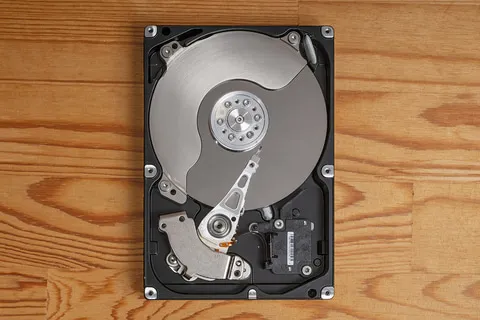
I'd like you to summarize the evolution of the technology used in HDDs these days, is the request I received. By the way, IBM's... RAMAC There's no need to go back that far, we're starting from relatively recent (?:) times.
As a foundational story, the one from 2008 where Seagate conducted an event within the city. Workshop article Since this was the case, I want to base it on this. In other words, for stories up until 2008, please refer to that article.
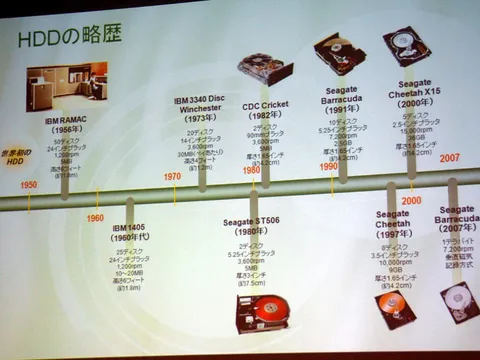 Table of Contents
 - Current HDD status
- Types of magnetic heads such as MR or GMR
- What is BPM (Bit-Patterned Media) under research currently?
Current HDD status
In fact, the basic elements of HDDs were largely completed in the early 2000s. It involves using stepper motors to drive platters and sliding magnetic heads over both sides of these platters for reading and writing. The maximum number of platters is around 11, and the capacity of an HDD is determined by the storage capacity that can be held on these platters.
In the past, efforts were made to reduce access time by rotating the platter at speeds of 10,000 rpm or 15,000 rpm. For drives with a speed of 15,000 rpm, since the centrifugal force was too strong for a 3.5-inch platter, some products adopted a 2.5-inch platter, leading to the drawback of a smaller capacity.
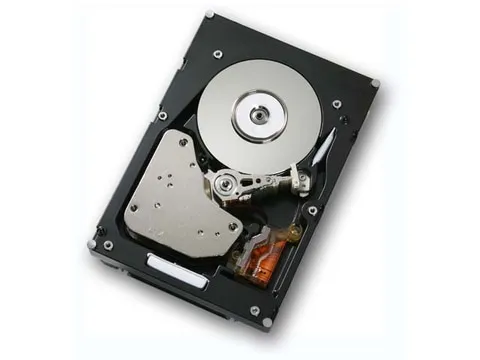 The 3.5-inch HDD "Ultrastar 15K147 series" with a speed of 15,000rpm that appeared in 2004 had capacities of 36GB, 73GB, and 147GB.
 However, such things no longer exist. In the first place, ultra-high-rotation HDDs were designed to be used in large RAID configurations, but these uses have been largely replaced by enterprise SSDs. Not only is the access speed of SSDs faster, but products with a capacity of 61TB using U.2 are already being shipped, and sampling of 122TB products has also begun.
On the other hand, HDDs top out at around 30TB. However, in terms of capacity-price ratio, HDDs are producing excellent numbers that rival enterprise SSDs, which is why they continue to be used for warm storage, albeit infrequently and regularly.
For warm storage, running costs also become important, so drives with speeds above 10,000 RPM are inappropriate as they can cause the operating temperature to rise too high, and even in recent enterprise models, the speed is limited to 7,200 RPM.
Given the circumstances, you should also know about the transfer speed. If it were ideal, accessing the platter's outer rim sequentially, we could expect transfer speeds close to 300 MB/s, but such an ideal situation is hardly ever achieved.
If that were the case, the interface would be more than enough at 3Gbps, let alone 6Gbps. The Serial ATA (SATA) Rev 3.0, which defined 6Gbps, was released in 2008, but performance-wise, it's sufficient to use SATA Rev 2.0 from 2004. While the latest revision of SATA specifications is 3.5a in 2021, the connection between HDDs and interfaces is nearly covered by Revision 3.0 released in 2008.
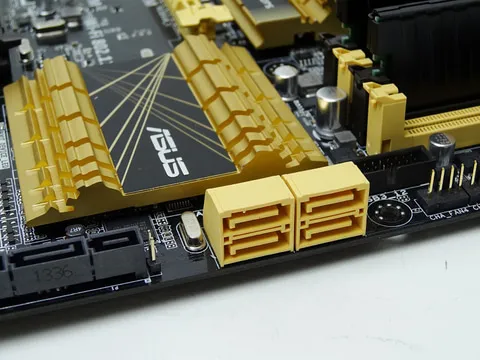 SATA connector
 In enterprise environments, SAS (Serial Attached SCSI) is often used, but even here, the target has shifted from HDDs to SSDs in the middle, and as for SAS HDDs, they are almost fully covered by SAS-2 (6Gbps) in 2009 or SAS-3 (12Gbps) in 2013, and I have never seen a HDD that corresponds to SAS-4 (22.5Gbps) released in 2017. In terms of transfer speed, it's even enough to exceed SAS-3 with SAS-2.
Other examples include technology that doubles transfer speeds by equipping two arms with magnetic heads, such as Seagate's Multi Actuator Technology launched in December 2017. announcement In March 2018, Protests were also held. However, there has been no talk of products actually coming out at all so far.
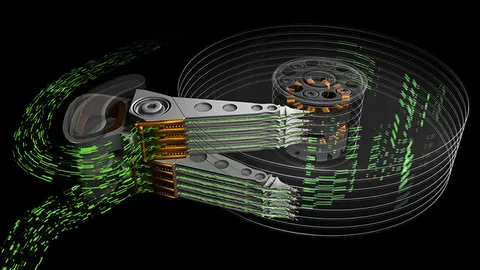 Image of Multi-Actuator Technology
 August 2nd, Updated
I wrote that, but later, thanks to reader feedback, it was revealed that Seagate had actually released the product (which the author was completely unaware of). It was unveiled at the 2020 CES. MACH.2 Multi-Actuator Technology The product equipped with two magnetic heads named 'as' is called Exos 2X14. announcement In November 2022, Exos 2X18 was also released. announcement Was done.
The Exos 2X14 is an enterprise-level SAS HDD available in either 14TB or 7TB x 2 configurations, while the Exos 2X18 offers 16TB or 8TB x 2/18TB or 9TB x 2. Both models claim maximum sequential read speeds of 524MB/s and 554MB/s, respectively (Interestingly, a SATA model for the Exos 2X18 is also available). However, there are no subsequent products in this line as of now, seemingly missing out on becoming mainstream.
Around 2010 as well, it will be equipped with an SSD for caching on HDDs. Solid-state hybrid drives (SSHD) or Hybrid HDDs have also emerged. However, with the shift towards M.2 NVMe SSDs for PC boot drives, offering capacities of up to 4TB or more, the demand for hybrid products has gradually decreased and they are becoming less common these days.
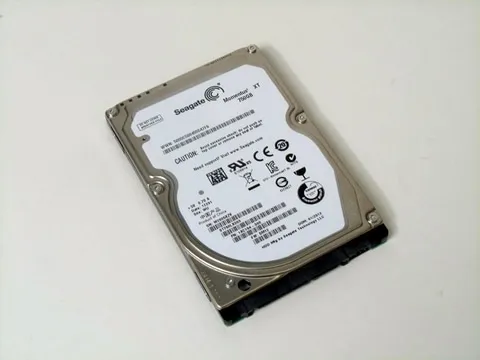 Seagate's 2.5-inch SSHD 'Momentus XT'
 Types of magnetic heads such as MR or GMR
As a result, the focus of technological innovation regarding HDDs will largely be on increasing capacity, i.e., the competition to record as much data as possible on one platter.
Even if we say so, the area of the platter itself has reached the limit size, and there is no way to increase capacity other than improving the recording density from here on. Thus, efforts to improve recording density will be piled up.
The first method for increasing recording density is through improvements to the magnetic head. The magnetic heads used in HDDs since 1990 have employed the following technologies.
- 1990: MR/AMR (Magneto Resistance/Anisotropic Magneto Resistance)
- 2000: GMR (Giant Magneto Resistance)
- 2004: TMR (Tunnel Magnetoresistance)
- 2024: HAMR/MAMR (Heat Assisted Magnetic Recording/Microwave Assisted Magnetic Recording)
In essence, an HDD operates as follows.
- Reading (or retrieving) data
Read the magnetic direction from the recording medium (i.e., the platter) and output it as data. - Writing (light)
Change the magnetic direction on the recording medium to match the data and overwrite.
Now, increasing recording density means that the area required to record 1 bit decreases. While this can cause issues during writing, a bigger problem arises during reading when the "amount of magnetic charge that can be read" decreases.
MR (Magneto Resistance)
The first method adopted to solve this was MR, which, as its name suggests Magneto Resistance, takes advantage of the fact that the resistance value changes in response to a magnetic field (more precisely, magnetic flux density).
The effect was first discovered in 1856, which is quite old, but at that time there were still problems with the material, and since the change in resistance was also small, it was not much used. However, later, with the discovery of new materials such as InSb (indium antimonide), it became possible to measure magnetic fields with higher sensitivity than conventional methods (methods using induced currents in a magnetic field), and around 1990, MR elements began to be used as magnetic heads.
By the way, GMR (Giant Magnetoresistance) or TMR (Tunneling Magnetoresistance) can also be categorized under MR (Magnetoresistance), and they are sometimes explicitly called AMR. The early MR sensors utilized the property known as Anisotropic Magneto Resistance directly. These sensors consist of a hard magnetic material, and the resistance value changes by approximately 3-5% depending on whether the orientation of the magnetic field aligns with or doesn't align to that of the sensor material. The difference in resistance values is measured to determine this change.
Giant Magneto Resistance (GMR)
Next, around the year 2000, GMR (Giant Magneto Resistance) was introduced. This technology utilizes the characteristic that the resistance value becomes larger (2-3 times) by inserting a non-magnetic metal between two ferromagnetic bodies. A larger variation in resistance value (i.e., higher sensitivity) makes it easier to detect even slight changes in magnetic fields, enabling the detection at levels comparable to AMR despite reducing the recording area on the platter.
Tunnel Magneto Resistance (TMR)
Following GMR, TMR (Tunnel Magneto Resistance) was put into practical use around 2004. Structurally similar to GMR, it sandwiches two ferromagnetic bodies with a non-ferromagnetic metal, but the way current is applied differs from GMR. It utilizes the tunnel effect, and its characteristic feature lies in its extremely high change rate of resistance, more than 30 times that of AMR, which significantly enhances its sensitivity compared to GMR.
This means that it becomes possible to reduce the area of the memory region, or in other words, achieve high-densityization. In fact, since 2004, magnetic heads utilizing TMR (Tunnel Magnetoresistance) have begun to appear, and even 20 years later, products within the mainstream still use these TMR magnetic heads. I believe that going forward, TMR magnetic heads will continue to be used for small-capacity HDDs.
Perpendicular Magnetic Recording (PMR)
For the next HAMR/MAMR, we will explain later, and first, I would like to explain about the improvement technologies other than the head. The PMR (Perpendicular Magnetic Recording: vertical recording method), which appeared almost at the same time as TMR, was introduced. In 2005, there was a press conference by HGST (Hitachi Global Storage Technologies) that demonstrated this PMR. This article Is wrapped up.
Until then, it was recorded in a circular track along the periphery of a platter, known as either the face recording method or the long-side recording method. With vertical recording, however, it is recorded vertically on the platter, allowing for higher density.
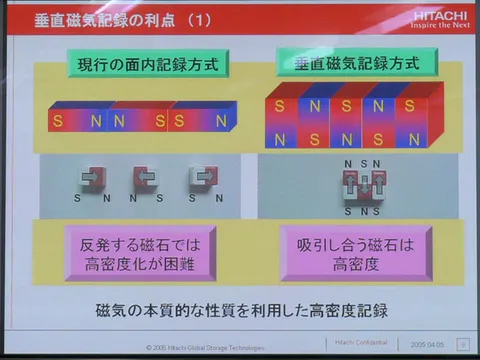
Toshiba was the first to commercialize PMR. However, initially, the main goal was to increase the memory capacity of smaller HDDs less than 3.5 inches (Toshiba originally adopted a 1.8-inch size). But soon it became adopted for 3.5-inch HDDs as well. In PMR, the area occupied on the platter is very small, so naturally, it was commercialized in conjunction with TMR magnetic heads.
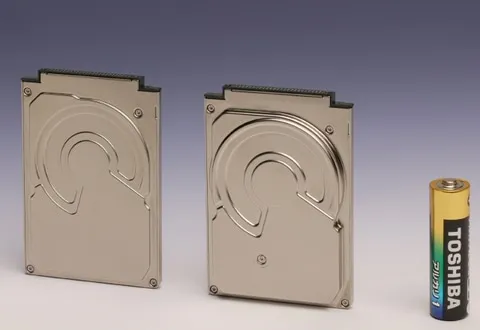 A 1.8-inch HDD developed by Toshiba using the PMR method
 This enhanced the performance of this PMR. WD's ePMR (Enhanced Perpendicular Magnetic Recording) is a technique that stabilizes the writing signal by flowing a slightly larger current during writing, which ultimately increases the recording density.
We adopted this in 2023. Sampling shipment of 28TB product has begun. Reportedly, it will be launched in October 2024. Shipping of up to 32TB items begins. Was done.
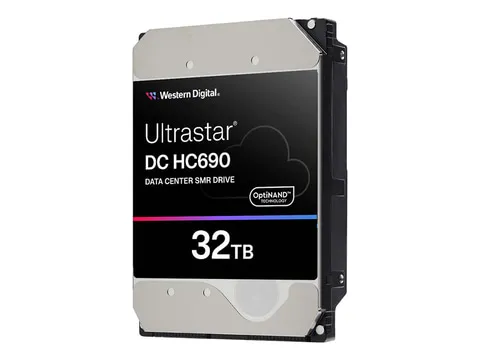 Adopting ePMR, 'Ultrastar DC HC690 SMR HDD'
 Helium filling
The next technology adopted is helium-filled. In essence, the HDD's interior is not a vacuum (as it would be dangerous for the head to adhere to the platter in a vacuum) but rather filled with air. Of course, if garbage or other impurities enter, it can cause a crash, so it is sealed with clean air without any debris. However, as recording density increases, controlling the head's position becomes extremely difficult.
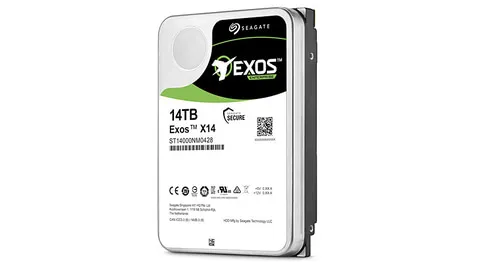 Seagate's 'Exos X14' with helium gas filling.
 Most air molecules are N2 (nitrogen) with a molecular weight of 28.0134 g/mol, followed by O2 (oxygen) with a molecular weight of 31.999 g/mol. When a platter rotates at 7,200 rpm, the air inside the HDD also moves at a considerable speed along with it.
The air hitting the arm that supports the HDD head makes it unavoidable for the arm to vibrate to some extent. Completely suppressing this phenomenon, known as flutter, is very difficult, so we have to accept a certain level of it, but then we need to allow for margins so that the head does not contact the platter even if the arm moves up and down slightly due to flutter. This is why the number of platters that can be mounted in a single HDD was limited to around five.
However, here an idea was born to fill the HDD's internal with Helium (He). The reason is simple: its much smaller molecular weight (4.003 g/mol), which means it's much lighter compared to N2 or O2 molecules of the same quantity. Lighter implies that the force causing flutter on the arm is smaller, allowing us to significantly reduce the height-direction width required for contact prevention.
As a result, it will be possible to accommodate 10 or more platters in a single HDD. Since the number of platters is directly related to the capacity of the HDD, this helium filling has made a significant contribution to increased capacity.
By the way, if we use H2 (hydrogen), the molecular weight would be further reduced (2.016 g/mol), and it is much cheaper compared to helium; however, there are issues like those mentioned below, so it has not been adopted.
- Even if you convert helium into hydrogen, there's not much room for significant increases in quantity, to put it mildly. Once you've used helium, the number of possible increases is already at its limit, and further increases are quite difficult.
- Hydrogen is very difficult to seal due to its tendency to easily escape, so attempting to truly seal it in the current 3.5-inch HDD size would be quite challenging. Helium, while not as straightforward as traditional sealing technologies (in fact, IBM faced significant technical hurdles when releasing helium-filled HDDs in 2015), is technically feasible to contain within a 3.5-inch HDD size.
- Hydrogen leaks and, when it combines with oxygen, it poses an explosion hazard. Helium is an inert gas, so it doesn't have this risk.
Shingled Magnetic Recording (SMR)
Another thing not to be forgotten is Shingled Magnetic Recording (SMR). The technical structure of SMR is... This article I'd like you to take a look at this. To put it simply, SMR is suitable for sequential access, but its performance does not deteriorate to the extent that it becomes unsuitable for random access." By the way, the conventional recording method is calledCMR (Conventional Magnetic Recording).
In the SMR (Selective Media Reset) method, a temporary memory area (called Media Cache) is secured around the periphery of the platter using the CMR (Continuous Memory Reset) method, and the random write operation first writes to this Media Cache and then writes back to the SMR area later. However, there is a limit to the capacity of the Media Cache, and since SMR needs to write sequentially from the beginning in principle, it is suitable for use cases where data is simply written (such as storage for surveillance camera records), but when considering general usage, there are some questions.
Adopting SMR again will increase capacity by around 10% or 20%, far from reaching double or triple figures. For this reason, HDD manufacturers have started clearly stating whether they use SMR or CMR methods.
Heat-Assisted Magnetic Recording
Microwave-Assisted Magnetic Recording
As such, I'd like to introduce the current hot topics, HAMR (Heat-Assisted Magnetic Recording) and MAMR (Microwave-Assisted Magnetic Recording), in the final section.
Collectively known as heat-assisted magnetic recording (HAMR) or magneto-resistive (MAMR), these are still head-side technologies, but unlike the previous evolution from AMR to GMR to TMR, which focused on enhancing read performance, HAMR/MAMR is a technology aimed at improving write capabilities.
The issue at hand is the bottleneck that has emerged in increasing recording density through the combination of TMR and PMR. To be more precise, in terms of the TMR method alone, further improvement in recording density is still possible. In other words, as far as read operations are concerned, it can handle even higher recording densities. However, when it comes to write operations, it has fallen behind.
In short, even when the recording area is reduced to ensure a sufficient magnetic field density, using high-permeability materials in the platter to counter thermal fluctuation (a phenomenon where magnetism disappears or reverses due to temperature rise) resulted in difficulties with writing.
As a countermeasure, a mechanism was devised to "add heat only during the writing process". Heat fluctuation refers to the fact that magnetic state changes more easily as temperature rises, and by leveraging this, raising the temperature only during the moment of writing makes it possible to perform writing easily.
If heating is stopped immediately after the process is complete, it will quickly return to room temperature while the written state is securely maintained. This is due to the mechanism of 'heating during writing', which is why it's called heat-assisted. With this heat assistance, it is said that future recording density can be improved by three times or more compared to TMR+PMR.
The system is simple but far from easy to implement. In fact, the 2008 Seagate workshop introduced at the beginning also mentioned this thermal assistance.
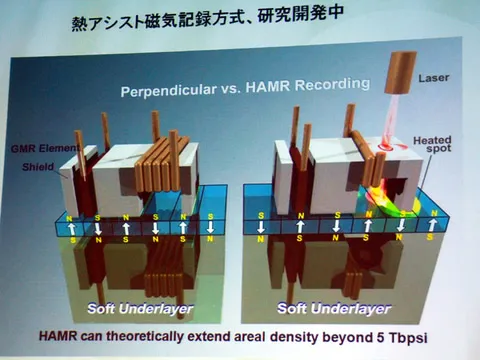
In fact, research on thermal assistance began around 2004, when mass production of TMR magnetic heads started, and it took 20 years to reach mass production. There are two main types of thermal assistance.
- Laser-based heating and thermal processing (HAMR)
- Microwave heating method (MAMR)
When it comes to which is better, there are both advantages and disadvantages. Both methods have technical challenges that took time to overcome, which is why TMR+PMR has been used for such a long period of 20 years.
While HAMR is easy to implement, the head also heats up. As a result, there are even talks that its lifespan is one digit shorter than that of MAMR heads (Seagate claims to have secured an equivalent lifespan to MAMR heads).
On the other hand, what about MAMR? Currently, it does not perform as well as HAMR. Toshiba is leading in MAMR technology, and originally, the company used a method called FC-MAMR (Flux Control-Microwave Assisted Magnetic Recording: Magnetization Control Type Microwave-Assisted Magnetic Recording) in 2021. Beginning sample shipment of 18TB HDDs. is doing.
However, at this time, the configuration is 16TB to 18TB with 9 plates, which means an increase in memory capacity per plate of only 12.5%. The real potential of the MAMR method lies elsewhere. A method called MAS-MAMR (Microwave Assisted Switching Magnetic Recording, or Resonant Microwave-Assisted Magnetic Recording) is planned. However, it is believed that it will take some time before mass production begins. FC-MAMR technology was originally born during the development of MAS-MAMR. The plan is to first build a solid technical foundation and accumulate experience.
Seagate
By the way, to be more precise... Seagate adopts HAMR In January 2025, it will be equipped with the Mozaic 3+ based on HAMR. Beginning sample shipment of Exos M HDDs It has a platter capacity of 3.6TB, with a maximum capacity of 36TB when configured in a 10-plate setup.
August 2nd, Additional Note
It was discovered through reader feedback that the first adoption of HAMR was announced on January 25, 2024. IronWolf Pro 24TB It was. However, to be honest, I don't know when the mass shipment will be. According to AKIBA PC Hotline!, the IronWolf Pro 24TB model will be released in March 2024. Release It states that the model released at this time is ST24000NT002, which does not use HAMR. The model number for the HAMR version is ST24000NT031.
Actually Seagate's Technology incorporated into the drive According to the information, only EXOS M and IronWolf Pro models with 28TB/30TB capacities are HAMR-compatible. It seems that the 24TB IronWolf Pro was only a sample shipment and production has been canceled. Apparently, samples still exist, as mentioned by someone in Century Micro's PC support in May this year. Received ST24000NT031 from Seaagate. That's why I'm writing this. However, as of now, there has been no mass production and shipment of drives that have adopted HAMR. This year July It feels right to do so.
Toshiba
Toshiba is considering both HAMR and MAMR compatibility. As mentioned earlier, products using the FC-MAMR method have already been shipped, but it will take some time for those using the MAS-MAMR method.
【Apology and Correction】Initially, we incorrectly published the notation for MAS-MAMR.
To keep up with the leading Seagate, we plan to begin sampling 32TB HAMR products by 2025. In the long term, we will switch to MAS-MAMR, but this transition is expected to take several years, according to the company.
Western Digital
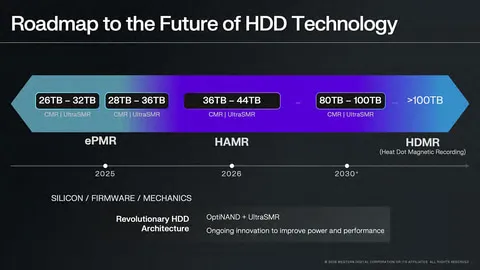
In 2017 Explained the advantages of the MAMR method. It was WD, held in February 2025. Roadmap for Investor Day 2025 As shown by the 'see', it is planned to increase the capacity up to a maximum of 36TB this year while maintaining the existing ePMR, and to start using HAMR in the fiscal year 2026.
As such, by 2025, each company aims to achieve over 30TB with HAMR+PMR, and anticipates increasing the capacity to around 40-50TB. Along the way, it may switch to MAMR+PMR, but this depends on the progress of MAMR technology development.
What is BPM (Bit-Patterned Media) currently under research?
Lastly, let me introduce what comes next, or rather, the topic of research currently underway: Patterned Media, also known as BPM (Bit-Patterned Media). The technology labeled HDMR (Heat Dot Magnetic Recording) in the following image is what we're looking at for after 2030.
 After all, it's not written anywhere that MAMR should not be used, so it might be that Toshiba, like HAMR, supports both MAMR and HAMR.
 The current platter is composed by depositing a magnetic coating on a glass or aluminum disk. So, it's structured such that multiple magnetic particles make up a 1-bit memory area, but as recording density increases, it becomes difficult to maintain a stable state due to mutual interference between neighboring particles.
By arranging one magnetic particle to perform a 1-bit recording, it is possible to increase the recording density while preventing mutual interference, which is the basic principle of Patterned Media. In fact, this has been a topic of research for a long time, and Toshiba demonstrated BPM (Bit Patterned Media) and achieved a recording density of 2.5 Tbit/square inch at TMRC 2010 (The 21st Magnetic Recording Conference).
At that time, we only succeeded in prototyping BPM, but we couldn't read or write it freely... By the way, the prototyped BPM had magnetic particle diameters of 17 nm.
Even at the current stage, a fully functional BPM has not been completed. The lack of a clear timeline for HDMR in the roadmap is due to uncertainty about when a BPM at a usable level will be ready. In the meantime, it is expected that efforts will be made towards increasing capacity by combining HAMR or MAMR with PMR.