How Netflix Scales its API with GraphQL Federation (Part 1)
Netflix is known for its loosely coupled and highly scalable microservice architecture. Independent services allow for evolving at different paces and scaling independently. Yet they add complexity for use cases that span multiple services. Rather than exposing 100s of microservices to UI developers, Netflix offers a unified API aggregation layer at the edge.
UI developers love the simplicity of working with one conceptual API for a large domain. Back-end developers love the decoupling and resilience offered by the API layer. But as our business has scaled, our
Keeping Netflix Reliable Using Prioritized Load Shedding
How viewers are able to watch their favorite show on Netflix while the infrastructure self-recovers from a system failure
By Manuel Correa , Arthur Gonigberg , and Daniel West
Getting stuck in traffic is one of the most frustrating experiences for drivers around the world. Everyone slows to a crawl, sometimes for a minor issue or sometimes for no reason at all. As engineers at Netflix, we are constantly reevaluating how to redesign traffic management. What if we knew the urgency of each traveler and could selectively route cars through, rather than
A Day in the Life of a Content Analytics Engineer
Part of our series on who works in Analytics at Netflix — and what the role entails
by Rocio Ruelas
Back when we were all working in offices, my favorite days were Monday, Wednesday, and Friday. Those were the days with the best hot breakfast, and I’ve always been a sucker for free food. I started the day by arriving at the LA office right before 8am and finding a parking spot close to the entrance. I would greet the familiar faces at the reception desk and take a moment

Netflix Android and iOS Studio Apps — now powered by Kotlin Multiplatform
Netflix Android and iOS Studio Apps — now powered by Kotlin Multiplatform
By David Henry & Mel Yahya
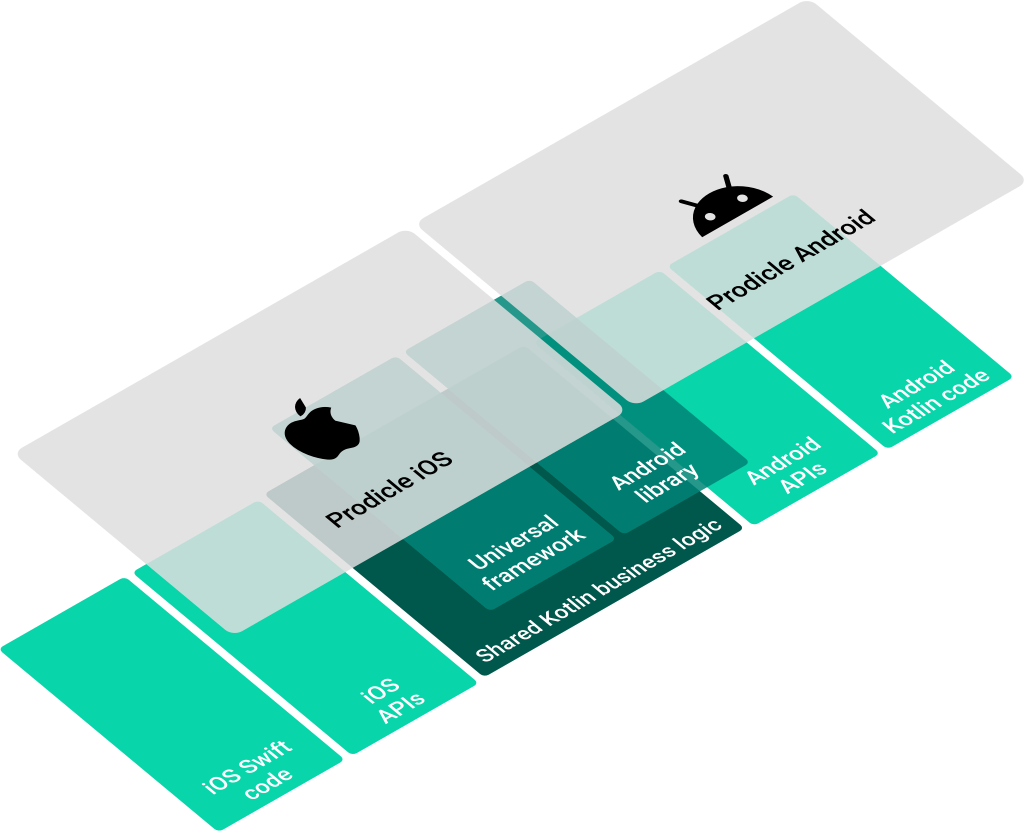
Over the last few years Netflix has been developing a mobile app called Prodicle to innovate in the physical production of TV shows and movies. The world of physical production is fast-paced, and needs vary significantly between the country, region, and even from one production to the next. The nature of the work means we’re developing write-heavy software, in a distributed environment, on devices where less than ⅓ of
Bulldozer: Batch Data Moving from Data Warehouse to Online Key-Value Stores
By Tianlong Chen and Ioannis Papapanagiotou
Netflix has more than 195 million subscribers that generate petabytes of data everyday. Data scientists and engineers collect this data from our subscribers and videos, and implement data analytics models to discover customer behaviour with the goal of maximizing user joy. Usually Data scientists and engineers write Extract-Transform-Load (ETL) jobs and pipelines using big data compute technologies, like Spark or Presto , to process this data and periodically compute key information for a member or a video. The processed data is

Building Netflix’s Distributed Tracing Infrastructure
Our Team — Kevin Lew , Narayanan Arunachalam , Elizabeth Carretto , Dustin Haffner , Andrei Ushakov, Seth Katz , Greg Burrell , Ram Vaithilingam , Mike Smith and Maulik Pandey

“ @Netflixhelps Why doesn’t Tiger King play on my phone?” — a Netflix member via Twitter
This is an example of a question our on-call engineers need to answer to help resolve a member issue — which is difficult when troubleshooting distributed systems. Investigating a video streaming failure consists of inspecting all aspects of a member account
Analytics at Netflix: Who we are and what we do
Analytics at Netflix: Who We Are and What We Do
An Introduction to Analytics and Visualization Engineering at Netflix
by Molly Jackman & Meghana Reddy

Across nearly every industry, there is recognition that data analytics is key to driving informed business decision-making. But there is far less agreement on what that term “data analytics” actually means — or what to call the people responsible for the work.
Even within Netflix, we have many groups that do some form of data analysis
How Our Paths Brought Us to Data and Netflix
Part of our series on who works in Analytics at Netflix — and what the role entails
by Julie Beckley & Chris Pham
This Q&A provides insights into the diverse set of skills, projects, and culture within Data Science and Engineering (DSE) at Netflix through the eyes of two team members: Chris Pham and Julie Beckley.

[Chris] Julie and I joined the Streaming DSE team at Netflix a few years ago and have been close
Seamlessly Swapping the API backend of the Netflix Android app
How we migrated our Android endpoints out of a monolith into a new microservice
by Rohan Dhruva , Ed Ballot
As Android developers, we usually have the luxury of treating our backends as magic boxes running in the cloud, faithfully returning us JSON. At Netflix, we have adopted the Backend for Frontend (BFF) pattern : instead of having one general purpose “backend API”, we have one backend per client (Android/iOS/TV/web). On the Android team, while most of our time is spent
HDMI — Scaling Netflix Certification
HDMI — Scaling Netflix Certification
Scott Bolter , Matthew Lehman , Akshay Garg ¹
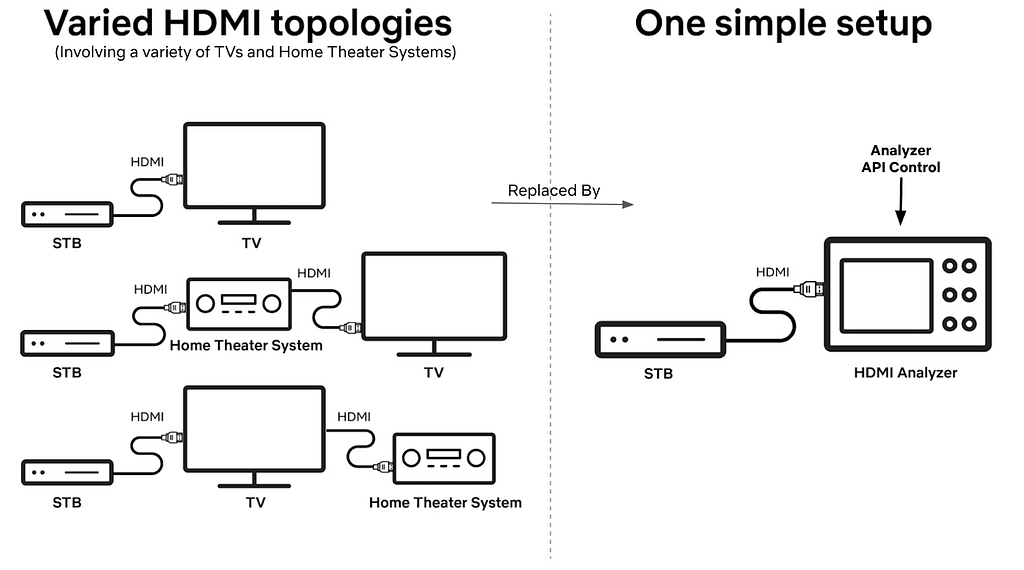
At Netflix, we take the task of preserving the creative vision of our content all the way to a subscriber TV screen very seriously. This significantly increases the scope of our application integration and certification processes for streaming devices like set-top-boxes (STBs) and TVs. However, given a diverse device ecosystem, scaling this deeper level of validation for each device presents a significant challenge for our certification teams.
Our first step towards addressing this challenge